Home » Custom Cable Assemblies & Solutions » Custom LVDS Cables

Custom LVDS Cables

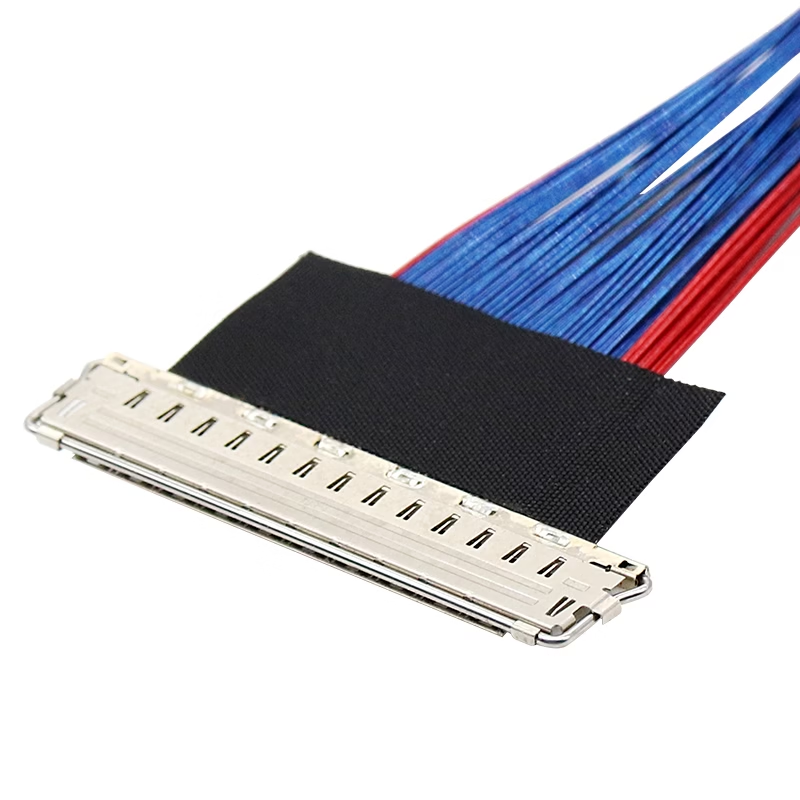
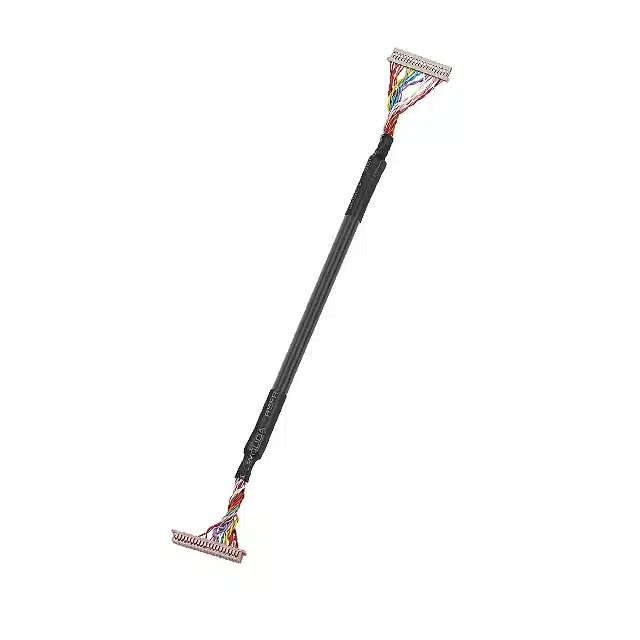
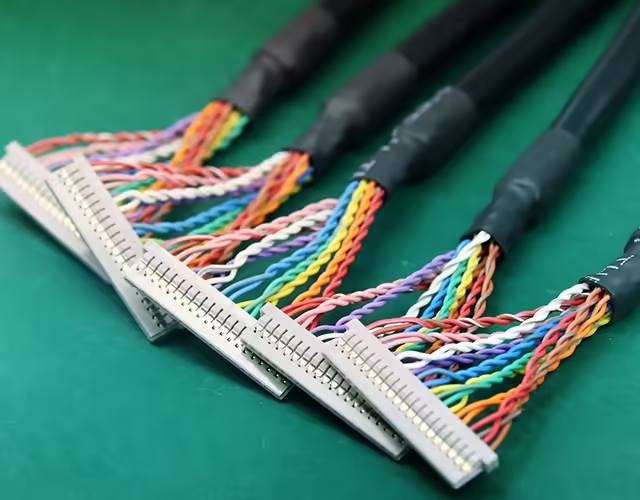
Our customized LVDS cables
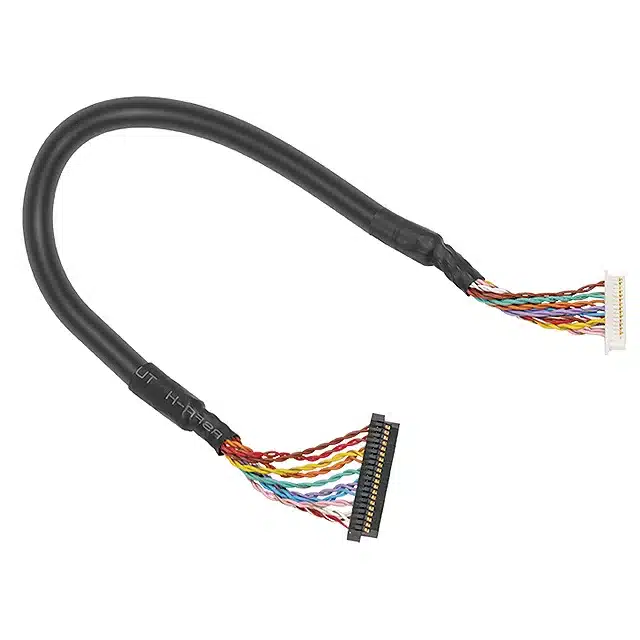
Our customised LVDS cables

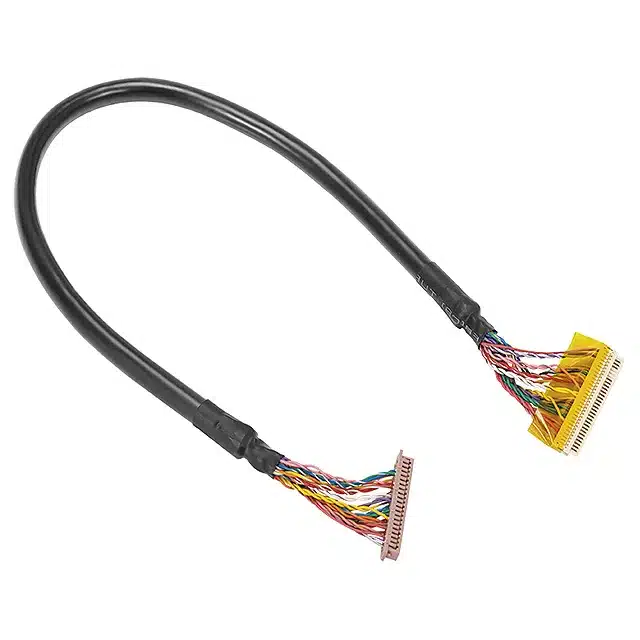
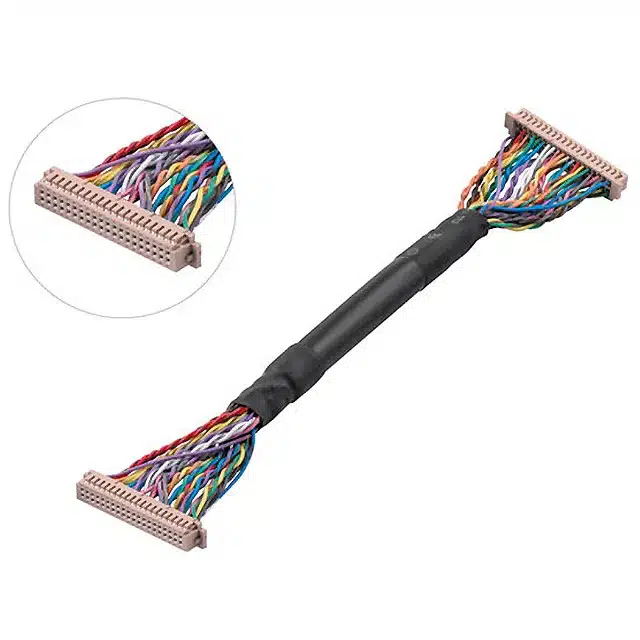
Our custom LVDS cables are designed for high-speed, low-power data transmission with minimal noise and interference. Perfect for displays, embedded systems, industrial machinery, and automotive electronics, these cables deliver reliable signal integrity in compact, flexible designs.

Romtronic provides tailored solutions to meet your specific connector, length, and shielding requirements.

Our Product Range

Not All LVDS Cables Are the Same

Two LVDS cables can look identical on a datasheet and still perform very differently once installed. Before comparing quotes, check these five factors:

  • Impedance & twist ratio — controlled 100 Ω differential impedance and a consistent twist per inch keep the signal clean; drift on either causes reflections and noise.
  • Shielding — foil/braid shielding protects against EMI in industrial and automotive environments; unshielded or lightly shielded cables fail first in high-noise settings.
  • Length vs. data rate — the achievable data rate drops sharply as cable length increases; a run that comfortably supports a high rate at 1 m will generally need a noticeably reduced rate (and, in some designs, additional signal conditioning) at 5 m. The exact trade-off depends on the connector, conductor gauge, and cable construction, so we confirm the achievable rate/length combination for your specific design during review rather than quoting a fixed number here.
  • Connector type & plating — FFC/FPC, JST, Hirose, Molex, I‑PEX, DF13/DF14 all mate differently; gold-plated contacts hold up better over repeated mating cycles.
  • Application fit — automotive (temperature/vibration/moisture), medical (strict EMI compliance), consumer (thin, flexible) each demand a different build.

Getting any of these wrong shows up as flicker, intermittent data errors, or early field failures — see the FAQ below for details on each.

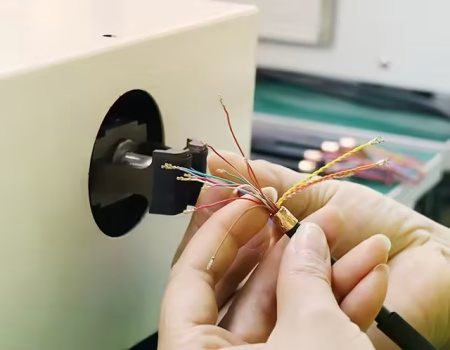
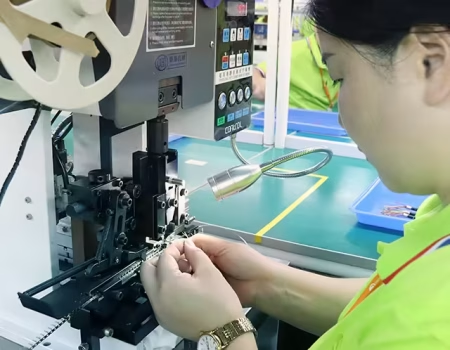
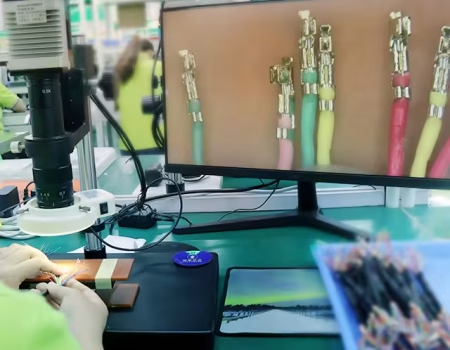
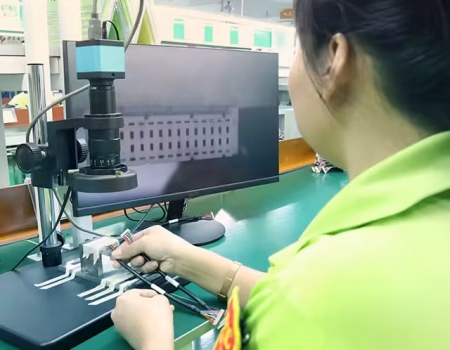
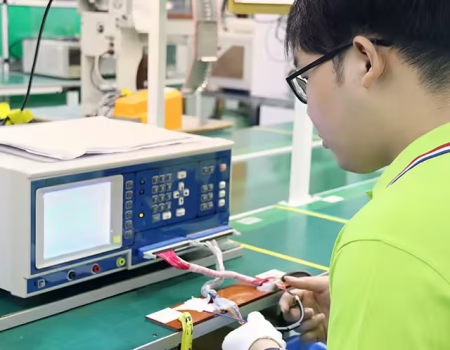
Our LVDS cable manufacturing process

Advantages of our customized LVDS cables

  •  Customized high-end complex LVDS cable assemblies are available.
  • Accepting small-batch production orders at affordable prices.
  • Fast delivery: All processes, including soldering, over-moulding, and performance testing, are completed in-house, typically within 10-15 working days.
  • We have passed the UL, CE, and USB4 TID certification audit reports. To meet any special custom requirements, we can offer a variety of connector configurations, cable types, and cable jacket material colour options.

You may want to know more about LVDS cables

LVDS Components

The most basic LVDS devices are the LVDS driver and receiver. The LVDS driver consists of a current source that drives the differential wire pair at 3.5 mA. The LVDS receiver has a high input impedance, so the current at the driver output is 100 Ω, matching the resistor value, and the voltage at the receiver input is approximately 350 mV. (A current source with a constant current characteristic and a termination resistance between 100 and 120 Ω can produce a voltage from 3.5mA x 100 = 350mV to 3.5mA x 120 = 420mV.

When the driver flips, it reverses the direction of current flow through the resistor, resulting in valid “1” and “0” logic states. It needs time to change from the logic “0” to the “1” level. Since the physical level of the LVDS signal varies between 0.85 and 1.55V, the time required to change from a logic “0” level to a logic “1” level is much faster than the TTL level. The time from a logic “0” level to a logic “1” level is quicker than the TTL level, so the LVDS cable is more suitable for transmitting high-speed signals. Due to their low voltage and low power consumption, LVDS cables are ideal for transmitting high-speed signals.

LVDS Cable
LVDS Cable

LVDS Electrical Characteristics

Two standards define LVDS technology: ANSI/TIA/EIA644 (approved in November 1995) and IEEE P1596.3 (approved in March 1996). Both standards focus on determining the electrical characteristics of LVDS.

Both standards define the electrical characteristics of LVDS, including:

  • Low voltage, low swing amplitude (~350 mV), high speed. The LVDS physical interface uses a nominal 1.2 V common-mode bias with a swing of roughly 250–450 mV. The low-current drive mode supports high-speed transmission, with the original standard specifying rates on the order of 655 Mb/s and practical implementations reaching roughly 1–3 Gb/s depending on the driver/receiver IC and cable length — exact maximum achievable rate depends on the specific components and installation, and should be confirmed against the datasheet of the driver/receiver IC used in your design rather than treated as a fixed figure.
  • Low power consumption. The constant source drive limits the output current to approximately 3.5 mA, minimizing spike disturbances during frequency hopping and resulting in low power consumption. This enables further improvements in IC density, PCB board efficiency, and costs.
  • It has a relatively slow edge rate (dV/dt is approximately 0.300V/0.3ns, i.e., 1V/ns), adopts differential transmission, dramatically reduces signal noise and EMI, and exhibits strong anti-interference capabilities.

Therefore, LVDS exhibits excellent characteristics, including high speed, ultra-low power consumption, low noise, and low cost.

Application of LVDS cable

LVDS cables are mainly used to connect laptop motherboards and panels to transmit power and signals.

Application of LVDS products in other fields

  • Medical equipment cables are characterized by their ability to transmit signals accurately and reliably.
  • Mobile phone motherboards and panels are connected to transmit signals, characterized by high transmission efficiency, stable impedance, and high bending strength.
  • It is also used in digital video (DV), digital cameras, LCDs, car navigation systems, and more.

Frequently Asked Questions (FAQs)

We produce custom LVDS cables for a wide range of applications, including LCD displays, industrial monitors, automotive infotainment systems, and medical imaging equipment.

Yes. We offer full customization with connector options such as Hirose, JST, Molex, I‑PEX, DF13/DF14, and FFC/FPC, with pinouts built to your design specs or schematics.

Absolutely. Our LVDS cables use twisted pairs, controlled impedance, and shielding options (foil/braid) to ensure stable transmission and minimal EMI, even in industrial or automotive settings.

Yes. We support both rapid prototyping and small-volume orders — ideal for R&D or pilot production before scaling to full volume.

Definitely. Share the panel model or display interface details and our engineers will help design a cable that ensures full compatibility and performance.

No. Impedance control, twist ratio, shielding, connector quality, and cable length all affect real-world performance, even between cables that look identical on a datasheet. See the five factors above before comparing quotes on price alone.

Achievable data rate depends heavily on cable length: as a general engineering guideline, LVDS links running close to 1 Gbps typically need a short, high-quality cable (around 1 m), while longer runs of several meters are generally paired with a correspondingly lower data rate, thicker conductors, or additional signal conditioning to preserve signal quality. We confirm the specific length/data-rate combination against your driver and receiver ICs during design review, rather than quoting a fixed figure independent of your components.

Automotive cables need to withstand temperature extremes, vibration, and moisture; medical cables must meet strict EMI compliance for accurate, safe operation; consumer electronics need thin, flexible constructions for tight spaces. We build to whichever profile applies to your application.

Contact plating matters — gold-plated contacts maintain conductivity and stable connections over far more mating cycles than lower-cost platings, which is especially relevant for cables that will be disconnected/reconnected during service or testing.

The most frequent issues are: mismatched impedance or connector/pinout, insufficient shielding for the EMI environment, exceeding a cable’s rated length/speed combination, and specifying a cable built for the wrong operating environment (e.g., a consumer-grade cable in an automotive application). We review all of these against your use case before quoting.

Get in Touch for Custom LVDS Cable Solutions

Romtronic provides custom LVDS (Low Voltage Differential Signaling) cables for high-speed, low-power data transmission in applications such as displays, embedded systems, industrial equipment, and automotive electronics. We offer flexible configurations, shielding options, and connector choices to match your system requirements.

To request a quote or discuss your LVDS cable project, feel free to contact us through the form on this page or using the details below — our team will respond within 12 hours with tailored support.

📧 Email: info@romtronic.com
📞 Phone: (+86) 199-2816-5824

Romtronic delivers reliable, high-performance LVDS cable solutions for customers worldwide.