


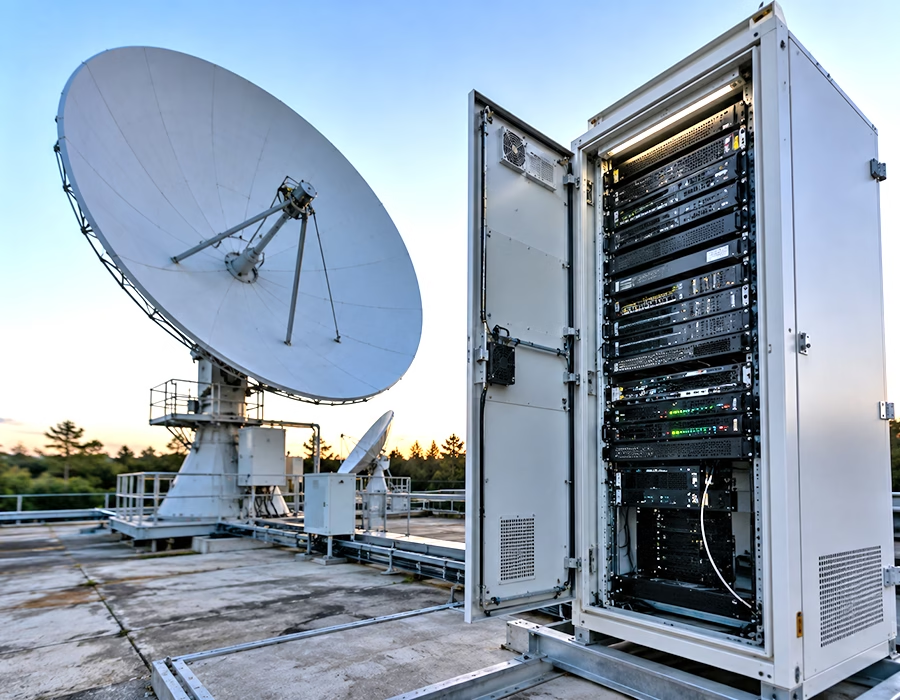
Zero Tolerance for Dropped Frames or Signal Loss
Broadcast satellite equipment has one job that can’t slip, even for a fraction of a second: keep the signal moving. That’s true whether you’re running SDI video around a studio, feeding a camera from an OB van a few hundred feet away, or pushing an RF signal up to a satellite from a fixed uplink dish.
A bad connector or a marginal cable run doesn’t just degrade quality. It can knock a live broadcast off the air.
We design and manufacture cable assemblies specifically for broadcast satellite equipment. That covers studio SDI, hybrid fiber camera cabling, RF coax for satellite feeds, and broadcast audio. Our custom interconnects are built for long cable runs, tight bend radii on set, and zero tolerance for signal degradation.
We bring 29 years of OEM/ODM experience to broadcast and satellite infrastructure projects. As a high-mix, low-volume (HMLV) contract manufacturer, we handle everything from a single custom camera cable to a full OB van rebuild. That way, production teams aren’t stuck chasing parts from multiple vendors before a shoot.
- ISO 9001 factory validation. Every broadcast satellite equipment assembly runs through our certified quality pipeline before it ships.
- IPC-A-620 Class 2/3 workmanship. SDI coax termination, SMPTE hybrid cable assembly, and connector overmolding all meet a documented, repeatable quality standard.
- 100% signal integrity testing. We test every finished assembly for continuity, impedance, and insertion loss, not just a sample batch, since a single bad connector can take a live feed down.
- Field-rugged construction. Reinforced strain reliefs, gold-plated contacts, and abrasion-resistant jacketing survive daily coiling, uncoiling, and travel in a road case.
Technical Specifications and Manufacturing Matrix
| Parameter | Manufacturing Capability | Validation / Material Standards |
|---|---|---|
| Workmanship standard | IPC/WHMA-A-620 Class 2/3 | Certified IPC workmanship |
| Quality management | ISO 9001 factory certified | Third-party audited and documented |
| Video connector types | BNC (50Ω/75Ω), SMPTE hybrid fiber | Compatible with LEMO, Neutrik, Canare, or custom overmolds |
| SDI cable performance | 3G-SDI, 6G-SDI, 12G-SDI rated coax | Return loss and insertion loss tested per assembly |
| RF/satellite feed cabling | Low-loss coax, N-type and 4.3-10 connectors | 50Ω impedance, tested per RF cable assembly standards |
| Hybrid camera cabling | SMPTE 311M-style fiber + copper power/control | Two single-mode fibers plus copper conductors in one jacket |
| Audio cabling | Multi-pair XLR snakes, balanced audio cores | Shielded, low-noise construction for live sound |
| Functional verification | VNA-based VSWR, insertion loss, and continuity testing | Full traceability per batch |
Six Cabling Types We Build For Broadcast Satellite Equipment
We design, tool, and assemble interconnects across six core categories for broadcast satellite equipment:
- SDI studio and rack interconnects. BNC-terminated coax runs carry 3G, 6G, and 12G-SDI video between cameras, switchers, and routers in a control room or master control rack.
- SMPTE hybrid fiber camera cables. A single cable carries video, audio, intercom, tally, and camera power between a broadcast camera and its base station. Built to the SMPTE hybrid fiber cable convention, it dramatically cuts the cable count for OB vans and studio floors.
- Satellite uplink and downlink RF coax. Low-loss coaxial feeds connect transmitters, LNBs, and antenna systems at fixed and mobile uplink sites. Each run is engineered for stable impedance over long outdoor distances.
- Broadcast audio snakes and multicore cabling. Multi-pair XLR assemblies route balanced audio between stage boxes, mixing consoles, and recording equipment, with minimal noise pickup.
- OB van and flypack cabling kits. Pre-terminated, labeled cable sets ship ready to install. So mobile production trucks and temporary event rigs go from cases to cabled in hours, not days.
- Antenna and LNB feed cabling. Weatherproof coax and control cabling connect satellite dish feeds and low-noise block downconverters, built to survive outdoor exposure at fixed teleport sites.
Two Failure Modes We Design Every Broadcast Assembly Around
Signal Degradation Over Long SDI and Coax Runs
Long cable runs are unavoidable in broadcast work, whether it’s a studio floor or a stadium camera position hundreds of feet from the truck. Impedance mismatches, poor shielding, or a marginal connector interface show up as return loss problems. These degrade signal quality gradually, rather than causing an obvious hard failure.
We control this with precision impedance-matched coax, plus 100% insertion-loss and return-loss testing on every finished cable. We also build connector assemblies to strict tolerances. That catches a marginal run before it ever reaches a live shoot.
EMI and Ground Loop Hum in Audio and Video Cabling
Broadcast environments pack a lot of equipment into a small footprint. Lighting rigs, power distribution, and wireless mics all generate electrical noise that can bleed into audio and video lines. Poor shielding or grounding practice shows up as hum in the audio or visible interference in the video signal.
We handle this with properly shielded, low-noise cable construction and consistent grounding practices built into every assembly. So productions aren’t chasing down a noise problem mid-broadcast. Getting the bend radius right also matters here, since over-tight coiling on set can quietly stress connector joints and degrade shielding performance over time.
Frequently Asked Questions
A: SMPTE hybrid fiber cable, built to the SMPTE 311M-style standard, is the industry norm. A single cable carries two single-mode fibers alongside copper power and control conductors. So one run handles video, audio, intercom, tally, and power, instead of pulling five separate cables.
A: The difference comes down to bandwidth and resolution support. 3G-SDI handles standard HD, 6G-SDI supports 4K at lower frame rates, and 12G-SDI carries full 4K at higher frame rates. All of this runs over a single coaxial cable, instead of needing a quad-link setup.
A: Signal strength matters enormously over an uplink run, since any loss in the cable directly reduces the power reaching the satellite. Low-loss coax with stable 50Ω impedance and quality connectors keeps transmission power where it belongs. Otherwise, it just dissipates as heat in the cable itself.
A: This is almost always a shielding or grounding problem. Broadcast environments pack lighting, power distribution, and wireless equipment into a tight space. So poor cable shielding or inconsistent grounding lets that electrical noise bleed into audio lines. Properly shielded, low-noise cable construction is the standard fix.
A: Yes, in almost every case. Pre-terminated, labeled cable sets let a mobile production crew go from cased equipment to a fully cabled truck in a fraction of the time a field-terminated setup would take. That matters enormously on tight production schedules.
A: N-type and 4.3-10 connectors are common for satellite RF feed cabling, chosen for their weatherproofing and stable performance in outdoor installations at fixed teleport and uplink sites.
Put Our Broadcast Satellite Equipment Cabling Team to Work
Live production leaves zero room for a dropped signal or a noisy connection. Whether you’re outfitting a new OB van, upgrading a studio to 12G-SDI, or building out a satellite uplink site, we can help.
Upload your camera cable specs, rack diagrams, or BOM directly to our Engineering Hub. Our team of 12 wiring engineers will run a full DFM audit and send you a clean production quote within 24 hours.
For SDI cable fundamentals specifically, our SDI cable selection guide is a good starting point, and our BNC cable guide covers connector selection for video applications more broadly.