


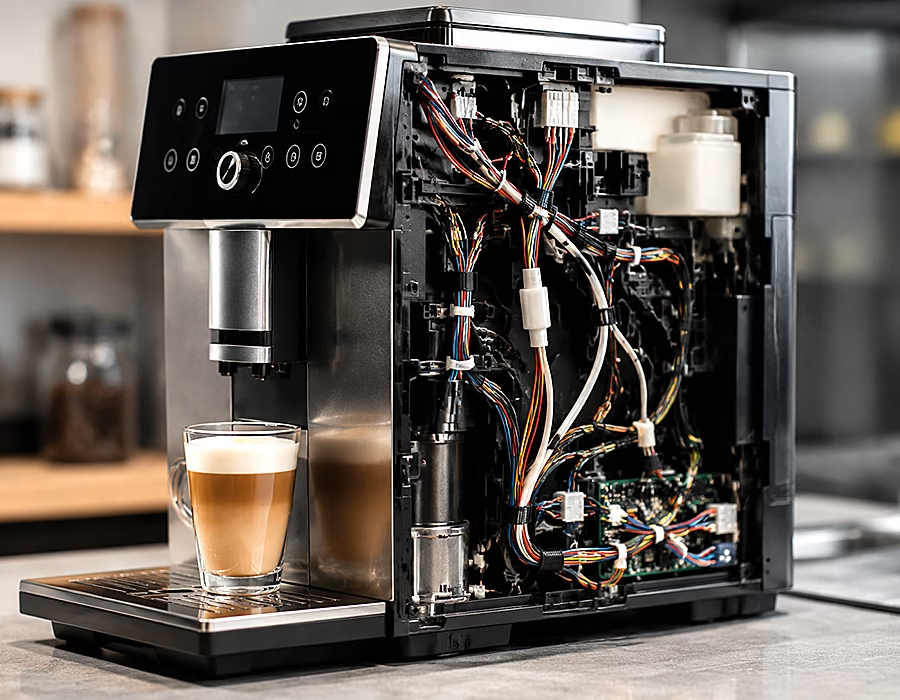
High-Heat Power Wiring and Precision Signal Cabling in One Build
A coffee machine wire harness must carry sustained current to a boiler or thermoblock without the insulation breaking down, while keeping the low-voltage brew-control and display wiring completely isolated from that heat and noise. A digital printing machine cable assembly faces a similar split, just with stepper motors and printhead data lines standing in for the boiler.
We build custom wire harnesses for both categories: commercial espresso and bean-to-cup machines, as well as production-grade digital and inkjet printers. Each harness is engineered around its actual duty cycle — whether that’s a café machine running twelve hours a day or a printer cycling thousands of jobs a month.
With 29 years of OEM/ODM manufacturing experience, our HMLV production line handles a single heating-element harness and a full internal wiring package with the same level of process control.
- UL 60335 series design awareness for heating-element insulation and creepage clearances, per the household and commercial appliance standard maintained by UL Solutions.
- IPC/WHMA-A-620 Class 2/3 workmanship on every harness.
- ISO 9001 certified, with full batch traceability.
- RoHS-compliant materials.
- Three-gate testing: continuity, dielectric withstand, mechanical pull.
Coffee Machine Wire Harness Technical Specifications
| Parameter | Capability |
|---|---|
| Heating element wiring | Silicone or PTFE insulation, rated 200°C+ |
| Boiler/thermoblock harnesses | Heavy-gauge copper, UL 60335 series design awareness |
| Printhead & motor cabling | Shielded ribbon and twisted-pair, low-capacitance |
| Stepper motor harnesses | Braided shielding against drive-noise interference |
| Connectors | JST, Molex, locking wire-to-board series |
| Testing | Continuity, dielectric withstand, mechanical pull, full batch traceability |
What We Build
- Boiler and thermoblock power harnesses — heavy-gauge, high-temp wiring for sustained heating current. This is the core of any coffee machine wire harness build.
- Brew control and touchscreen wiring — low-voltage lines for sensors, valves, and displays, isolated from the power side.
- Printhead and carriage motor cabling — shielded, flex-rated cable for high-speed data on a moving carriage. See our ribbon cable assemblies.
- Stepper and servo motor harnesses — braided shielding isolates motor noise from sensor lines.
- Internal power distribution wiring — one custom harness in place of point-to-point wiring, similar to our broader appliance wire harness work.
Two Failure Modes We Design Around
Heat degradation near the heating element. Standard PVC insulation hardens and cracks after months next to a heat source, eventually shorting. To prevent that, we use silicone or PTFE insulation on any run close to the boiler in every coffee machine wire harness we build.
Signal noise in printer motor lines. Motor cabling routed too close to unshielded data lines can cause dropped steps or corrupted print data, which appears as banding or misalignment. As a result, we shield and physically separate motor and signal lines to prevent it.
Frequently Asked Questions
A: Commercial units run far more duty cycles, so the harness needs heavier-gauge conductors, higher-temperature insulation, and connectors rated for continuous thermal stress.
A: Standard PVC breaks down under sustained heat near a boiler. Silicone or PTFE insulation is standard for that application.
A: Motor drive noise bleeding into unshielded data lines, which corrupts the signal to the printhead and shows up as banding or misalignment.
A: Equipment sold in North America generally needs to meet UL 60335 series requirements, which set the insulation and clearance standards a coffee machine wire harness has to follow.
A: Yes — both applications combine high-current heating or motor wiring with low-voltage control and signal cabling in a compact chassis, so the same engineering skill set covers both.
Put Our Team to Work
Upload your wiring prints, BOM, or drawings to our Engineering Hub. Our engineers run a DFM audit and return a production quote within 24 hours.