


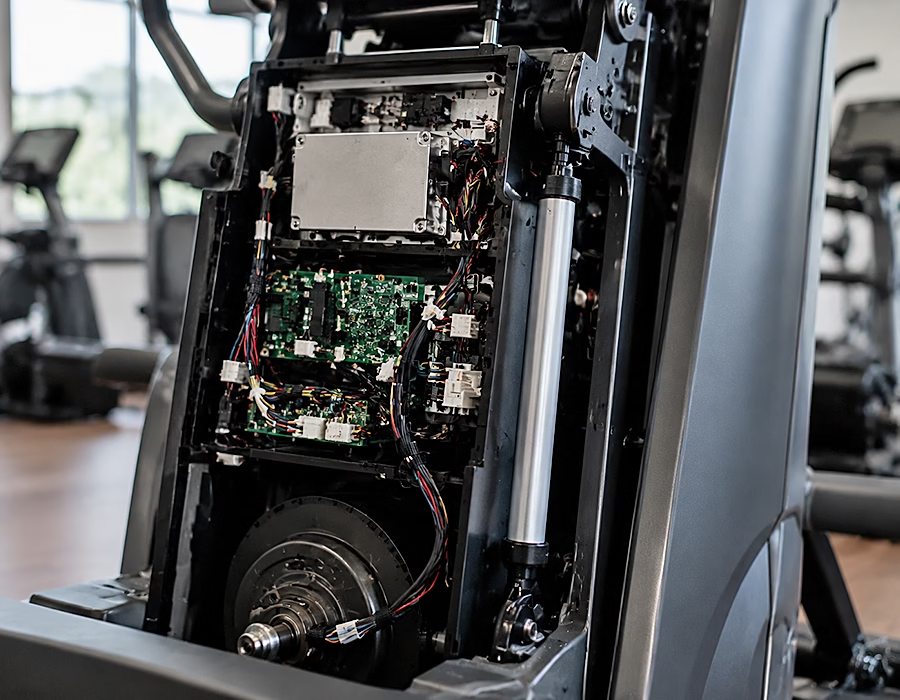
Built for Constant Motion, Sweat Exposure, and Years of Daily Use
A fitness equipment wire harness undergoes more mechanical cycles in a single day at a commercial gym than most consumer electronics do in a year. A treadmill motor harness carries continuous current through a belt drive that ramps speed dozens of times an hour, while the console cabling right next to it has to stay clean for heart-rate sensors, touchscreens, and Bluetooth modules.
Add in constant flexing at the fold-and-recline joint on smart home units, plus sweat and moisture exposure on every handgrip contact, and a commercial machine puts more stress on its wiring than almost any other consumer-facing product.
We build custom wire harnesses for treadmills, ellipticals, stationary bikes, rowers, and multi-station strength machines, covering both commercial gym-grade builds and connected smart home units. Every harness is engineered around its actual duty cycle, whether that’s a 24-hour commercial gym floor or a smart treadmill logging workouts to an app.
With 29 years of OEM/ODM manufacturing experience, our HMLV production line can handle either a single motor harness or a complete console-to-drive wiring package on the same line.
- UL 1647 design awareness, the UL standard governing motor-operated exercise machines, shapes our wiring and clearance decisions.
- IPC/WHMA-A-620 Class 2/3 workmanship on every harness.
- ISO 9001 certified, with full batch traceability.
- Moisture-resistant connector options for handgrip and console contact points.
- Three-gate testing: continuity, dielectric withstand, mechanical pull.
Fitness Equipment Wire Harness Technical Specifications
| Parameter | Capability |
|---|---|
| Drive motor wiring | Heavy-gauge copper, flex-rated for continuous duty cycling |
| Console & touchscreen cabling | Shielded low-voltage lines, isolated from motor EMI |
| Heart-rate & sensor cabling | Low-capacitance twisted-pair, moisture-tolerant contacts |
| Fold/hinge point wiring | Dynamic flex cable rated for repeated bend cycling |
| Connectors | JST, Molex, sealed wire-to-board series |
| Testing | Continuity, dielectric withstand, mechanical pull, full batch traceability |
What We Build
- Drive motor and incline actuator harnesses — heavy-gauge wiring for the treadmill motor and incline drive, the core of any fitness equipment wire harness build.
- Console and touchscreen wiring — shielded low-voltage cabling for displays, controls, and connectivity modules, kept clear of motor noise.
- Heart rate and sensor cabling — handgrip contacts and chest-strap receivers wired for reliable signal despite exposure to sweat.
- Safety key and emergency-stop wiring — dedicated, fault-tolerant circuits for the physical safety cutoff.
- Fold-point and hinge cabling — dynamic flex cable that survives repeated fold-and-recline cycling on smart home units. See our ribbon cable assemblies for related flex-cable builds.
Two Failure Modes We Design Around
Cable fatigue at fold and hinge points. Standard wire cracks after repeated flexing at a treadmill’s fold joint or an elliptical’s pivot arm, eventually causing an intermittent connection. To prevent that, we specify dynamic-flex conductors and strain-relief routing at every fold point in a fitness equipment wire harness.
EMI interference between motor and sensor wiring. Drive motor current running too close to unshielded heart-rate or console cabling introduces noise that shows up as erratic readouts or console freezes. As a result, we shield and physically separate motor and signal lines throughout the chassis.
Frequently Asked Questions
A: Commercial fitness equipment runs continuous duty cycles with constant motor vibration, repeated fold-point flexing, and sweat exposure at contact points, so the harness needs flex-rated conductors and moisture-tolerant connectors that standard appliance wiring doesn’t require.
A: Yes. UL 1647 covers motor-operated massage and exercise machines, including motorized treadmills, and its wiring and clearance requirements apply regardless of whether the unit has smart connectivity features.
A: Repeated flexing at a fold or hinge joint fatigues standard wire over time, eventually cracking the conductor. Dynamic-flex cable rated for continuous bend cycling is the standard fix.
A: Electromagnetic noise from the drive motor bleeding into unshielded sensor or console wiring is the most common cause, which shielding and physical separation between motor and signal lines resolve.
A: Yes — both categories combine high-current motor wiring with low-voltage sensor and connectivity cabling in a compact chassis, so the same engineering approach applies to each.
Put Our Team to Work
Upload your wiring prints, BOM, or drawings to our Engineering Hub. Our engineers run a DFM audit and return a production quote within 24 hours.