


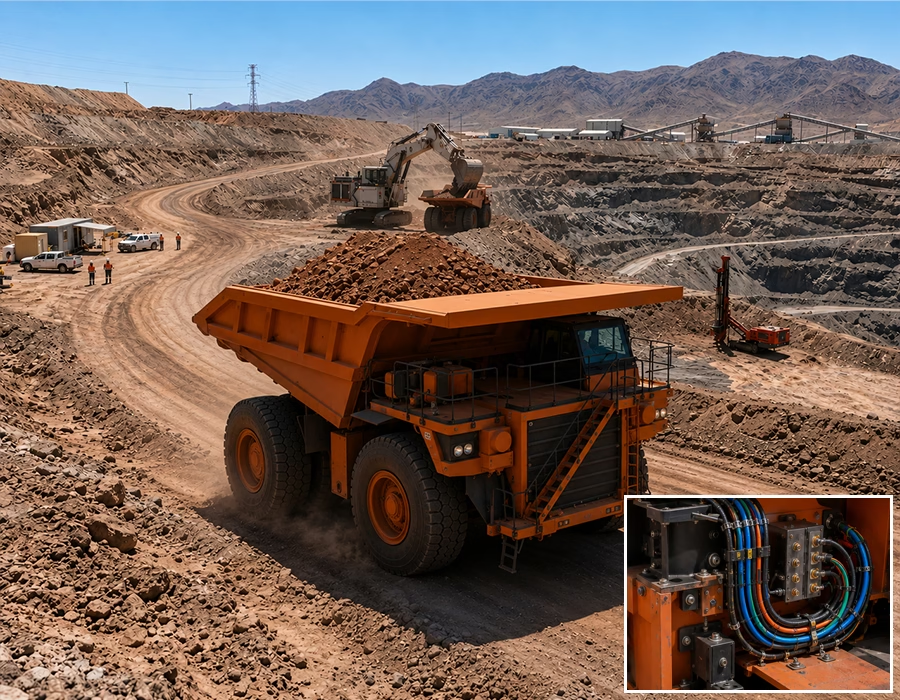
A Mining Equipment Wire Harness Has to Survive the Pit
Standard automotive wiring doesn’t stand a chance in a mining pit. A mining equipment wire harness must withstand abrasive rock dust, hydraulic oil, and aggressive degreaser wash-downs. On top of that, it takes constant mechanical shock, shift after shift.
Think about an underground continuous miner chewing through rock all day. Or picture a surface haul truck running 24/7 in a dust storm. Both machines push their wiring to the limit.
Here’s the real risk. If a control harness on a hydraulic power unit fails, your whole operation grinds to a halt. A single worn wire jacket or a leaking connector seal is enough to cause costly downtime.
That’s exactly why Romtronic builds every mining equipment wire harness around one goal: eliminating the failure points that standard wiring can’t handle. It doesn’t matter if it’s going into an open-pit haul truck or deep underground equipment.
Built from 29 Years of Heavy Equipment Wiring Experience
We bring 29 years of hands-on OEM and ODM engineering experience to the heavy equipment sector. If you’re managing high-mix, low-volume (HMLV) custom production runs, we make it easy.
Mining assets go through constant field modifications. Because of that, we build directly from your custom schematics instead of forcing you into a fixed catalog part.
You can browse our broader capabilities on our custom wire harness manufacturing page. We also run a dedicated industrial machinery wiring harness line. Or head straight to our Engineering Hub to start a project.
The result: pre-tested, plug-and-play internal sub-assemblies delivered straight to your facility. No in-house wiring headaches.
What you get with every build:
- ISO 9001 Factory Quality — Every battery and control harness runs through our certified quality management pipeline. See our full certifications and qualifications for details.
- IPC-A-620 Class 3 Specs — Every crimp and internal wire route meets the highest workmanship standard defined by IPC’s official specifications.
- 300% Layered Inspection — An optical sweep after termination, an automated insulation test, and a final pull-force check. Three gates, every build.
- Tough Insulation Materials — Our jackets resist chemical degradation. They handle long-term exposure to battery fluids, cooling agents, and high heat without cracking.
IP68 and IP69K Sealing for a Mining Equipment Wire Harness
Standard conduit and electrical tape fail fast in a mining pit. Raw grit chews through flimsy materials in weeks, not years. That’s why we build in layers of mechanical armor and chemical barriers, whether the harness runs on a haul truck chassis or sits buried in underground equipment.
- True IP68 & IP69K Submersible Sealing — We process heavy-duty Deutsch connectors, like the HD/DT series, with custom-engineered fluorosilicone seals rated to the IEC 60529 ingress protection standard. High-pressure water jets and fine dust simply can’t get through. Quick reference: IP68 confirms full submersion resistance. IP69K confirms the harness survives high-pressure, high-temperature wash-downs. Most mining fleets need both.
- Abrasion-Resistant Braided Textile Armor — To counter sharp rock debris and constant frame rubbing, we wrap harnesses in heavy-duty nylon 66 or Kevlar. This tough outer skin resists cut-through over years of grinding service.
- Overmolded Junction Hubs — We skip leak-prone heat shrink boots at breakout points. Instead, we use solid polyurethane overmolding to permanently seal multi-branch junctions. The entire harness becomes one watertight, vibration-resistant piece.
Material & Compliance Matrix for Mining-Grade Wiring
| Equipment Sub-System | Material Solution | Why It Matters |
|---|---|---|
| Engine Bay & Turbo Proximity Control | Tefzel/ETFE insulated hookup wire inside a braided fiberglass silicone sleeve | Handles temperatures from -65°C to +200°C without going brittle near hot exhaust manifolds. |
| Chassis Articulation & Pivot Joints | High-flex PUR jacketed cables with ultra-fine copper stranding | Survives millions of twisting cycles at freezing temperatures without jacket splitting. |
| Electro-Hydraulic Valve Control | Dual-wall adhesive-lined polyolefin heat shrink over gold-plated Deutsch DT terminals | Stops hydraulic oil from wicking down wire strands into the solenoid. |
| Telemetry, GPS & Remote Guidance | Double-shielded, low-loss coax and twisted pairs with 100% foil + tinned copper braid | Blocks EMI from high-power alternators and electric wheel motors. |
Fixing the Real Engineering Problems in Heavy Equipment Wiring
How Do You Stop Terminal Back-Outs from Severe Vibration?
Automated crimp-force monitoring, plus strain-relief backshells and Wedgelock connectors. That’s the short answer.
Heavy machinery runs under constant, low-frequency vibration. That shaking easily backs standard pins out of their connector housings. If the crimp-to-terminal interface isn’t perfect, micro-arcing follows. Over time, this breaks down the contact material and causes intermittent sensor drops.
We catch this right at the press. Automated crimp-force monitoring (CFM) verifies exact gas-tight compression on every termination. Combined with strain-relief backshells and active Wedgelock connectors, the wires stay locked in place under serious mechanical impact — on a haul truck, a continuous miner, or any other piece of underground equipment.
How Do You Prevent Corrosive Moisture and Fluid Wicking?
Glue-lined potting at breakout points, plus true overmolded connector interfaces. That stops it cold.
Machinery runs hard, then sits overnight in a freezing pit. That temperature drop creates an internal vacuum effect. If a cable jacket gets nicked anywhere along the chassis, moisture and corrosive fluids get pulled straight through the wire strands. Within months, green copper corrosion destroys the main control module pins.
We build in glue-lined potting at critical breakout transitions to stop this. We also use overmolded connector interfaces throughout. This creates a solid chemical bond between the wire insulation, the potting compound, and the connector shell. Moisture never gets a path to track down the conductors.
Common Questions About a Mining Equipment Wire Harness
A: IP68 and IP69K are the ratings to look for. IP68 confirms full submersion resistance. IP69K confirms the harness survives high-pressure, high-temperature wash-downs. Both are standard for haul trucks and underground equipment dealing with mud, slurry, and daily cleaning.
A: Deutsch connector families, especially the HD/DT series with custom fluorosilicone seals, are the go-to choice. They handle vibration, moisture, and repeated connect/disconnect cycles far better than standard automotive-grade connectors.
A: Yes. Most corrosion failures trace back to moisture wicking through a nicked jacket. Glue-lined potting at breakout points and overmolded connector interfaces block that path before it starts.
A: Abrasive rock dust and constant frame rubbing chew through unprotected jackets fast. A braided nylon 66 or Kevlar outer layer resists cut-through and extends harness life in high-abrasion environments.
A: Underground equipment deals with confined spaces, higher humidity, and tighter bend radius needs. Haul trucks face more direct UV exposure, thermal cycling, and chassis flex. Both need IP68/IP69K sealing and vibration-resistant terminations, but routing and jacket selection get tailored to the duty cycle.
A: Send your 2D routing prints, connection schematics, or BOM to our Engineering Hub. Our team runs a full DFM audit and gets a quote back within 24 hours.
Put Our Heavy Equipment Interconnect Lab to Work
Chasing a ghost sensor fault? Fighting premature harness wear on your haul truck fleet? Getting a new autonomous mining platform ready for production? This is exactly what we do.
Take a look at our broader industrial cable assembly and wire harness solutions if you’re sourcing for other severe-duty applications too.
Send your BOM, drawings, or photos straight to our Engineering Hub. Our 12 wiring engineers will run a DFM audit and get you a clean quote within 24 hours, with expert feedback within 12 hours.