


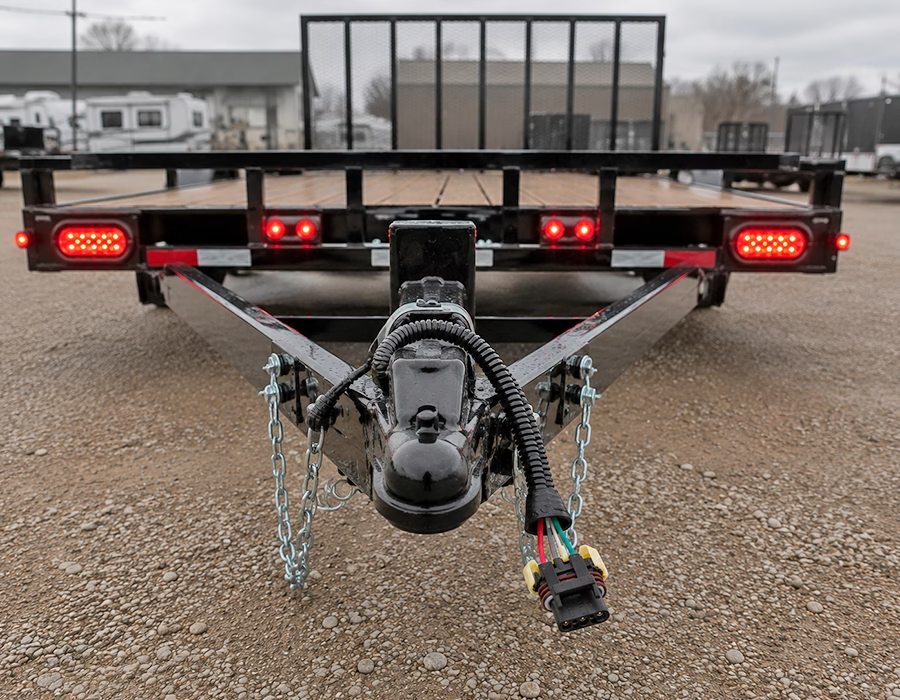
Why a Trailer Lighting Wire Harness Has to Survive Road Salt and Vibration
A trailer lighting wire harness lives in one of the harshest electrical environments outside of marine wiring. It sits exposed under a chassis, takes a constant spray of road water and salt brine, and vibrates against frame rails at highway speed for hours at a stretch.
A single failed ground connection or a corroded pin can result in a non-functioning brake light, which is both a safety issue and a roadside inspection failure. Automotive exterior lighting deals with the same combination of moisture and vibration, just in a tighter space — an off-road light bar and an OEM tail lamp assembly both face it.
We build custom wire harnesses for trailer tail lights, stop/turn/marker lighting, 4-way and 7-way connector systems, and off-road auxiliary lighting, as well as OEM automotive exterior lighting assemblies. For every build, we seal and route the harness to match the exposure level of its mounting location, whether that’s an open trailer frame rail or a sealed OEM lamp housing.
With 29 years of OEM/ODM manufacturing experience, our HMLV production line can handle either a single lighting sub-harness or a full trailer wiring kit on the same line.
- SAE J1128 primary wire construction, the automotive industry standard for low-tension primary cable used in this kind of wiring.
- IP67/IP69K sealed connectors at every exposed splice and connection point.
- Corrosion-resistant, tin-plated copper terminals that resist salt spray and moisture over years of outdoor exposure.
- FMVSS 108 design awareness, since federal lamp and lighting requirements shape connector and circuit design on road-legal lighting.
- Three-gate testing: continuity, dielectric withstand, mechanical pull.
Trailer Lighting Wire Harness Technical Specifications
| Parameter | Capability |
|---|---|
| Primary wire | SAE J1128-compliant, cross-linked polyethylene (XLPE) insulation |
| Connector sealing | IP67/IP69K sealed splices and connector housings |
| Terminals | Tin-plated copper, corrosion-resistant |
| Jacketing | UV-stable, abrasion-resistant outer jacket for exposed underbody routing |
| Connectors | 4-way flat, 7-way RV blade, sealed Deutsch/Molex series |
| Testing | Continuity, dielectric withstand, mechanical pull, full batch traceability |
Trailer Lighting Wire Harness Types We Build
- Sealed LED tail, stop, and turn light harnesses — waterproof wiring for trailer and OEM rear lighting, and the core of any trailer lighting wire harness build.
- 4-way and 7-way trailer connector wiring — pre-terminated harnesses that match standard tow vehicle connector configurations.
- Off-road and auxiliary light bar harnesses — sealed cabling and relay wiring for LED light bars and driving lights.
- Underbody and chassis lighting sub-harnesses — routed and sealed to handle direct road spray and debris.
- OEM automotive exterior lighting cable assemblies — custom builds that match specific lamp housing and connector designs.
Two Failure Modes Every Trailer Lighting Wire Harness Must Resist
Moisture ingress and corrosion at connector points. Road spray and salt brine work their way into unsealed splices over time, corroding the contact surface until the connection fails intermittently or drops out completely. To prevent that, we use IP67/IP69K sealed connectors and adhesive-lined heat-shrink splices at every exposed joint.
Vibration and abrasion from underbody routing. Constant vibration against a frame rail or suspension component wears through the standard jacketing over months of highway driving, eventually exposing the conductor and causing a short. As a result, we route with abrasion-resistant jacketing, secure clip points, and enough slack to absorb suspension movement without chafing.
Frequently Asked Questions
A: Trailer wiring sits lower and more exposed than most vehicle circuits, so it takes more direct road spray, salt exposure, and vibration. That’s exactly why sealed connectors and corrosion-resistant terminals matter more here than in most other automotive wiring.
A: IP67 protects against temporary water submersion, while IP69K adds resistance to high-pressure, high-temperature washdown. In practice, that makes IP69K the better fit for underbody components exposed to pressure washing or heavy road spray.
A: Yes. FMVSS 108 governs lamps, reflective devices, and associated equipment on trailers and other vehicles, so its requirements shape circuit and connector design for any road-legal lighting harness.
A: SAE J1128 primary wire with cross-linked polyethylene insulation is the industry standard, mainly because it resists heat, abrasion, and chemical exposure in automotive environments.
A: Yes — 4-way flat and 7-way RV blade connectors are the most common configurations, and we can build or adapt a harness to match either one directly.
Put Our Team to Work
Upload your wiring prints, BOM, or drawings to our Engineering Hub. Our engineers run a DFM audit and return a production quote within 24 hours.