


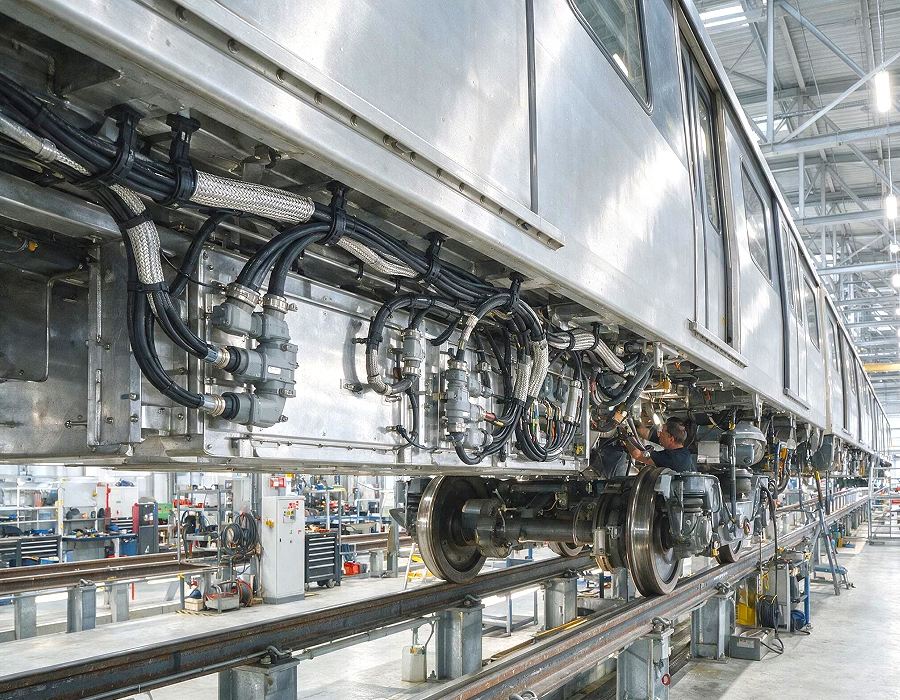
Why Railway Cable Assembly Design Starts with Fire Codes and Vibration
A railway cable assembly gets judged against a tougher bar than most industrial cabling. It has to survive decades of vibration, temperature swings, and constant flexing at the coupling points, all under some of the strictest fire codes in manufacturing. A cable fault on a factory floor is a bad day. Inside an occupied train car, it’s a life-safety event, which is exactly why fire behavior matters as much as electrical performance here.
We build custom railway cable assemblies and wire harnesses for locomotives, metro cars, light rail, and transit signaling systems. That covers traction power, control, HVAC, door actuation, and passenger network cabling. Every assembly ships low-smoke and halogen-free where the application calls for it, and is engineered for a service life measured in decades rather than years.
With 29 years of OEM/ODM experience and an HMLV production model, we handle anything from a single traction jumper to a full car-set wiring package, so a transit build doesn’t end up split across several vendors.
- ISO 9001 certified, with IPC/WHMA-A-620 Class 2/3 workmanship on every harness.
- Built to EN 45545-2 fire behavior requirements, using low-smoke, zero-halogen materials for cabin and enclosure cabling.
- Engineered around EN 50155 rolling stock practice, accounting for vibration, shock, and temperature range.
- Three-gate testing, covering continuity, high-voltage dielectric, and mechanical pull, on every unit before it ships.
Railway Cable Assembly Technical Specifications
| Parameter | Capability |
|---|---|
| Workmanship | IPC/WHMA-A-620 Class 2/3, ISO 9001 certified |
| Fire safety | Low-smoke, zero-halogen (LSZH) jacketing per EN 45545-2 |
| Rolling stock design | Vibration/shock/temperature per EN 50155, rated -40°C to 85°C |
| Traction power | Heavy-gauge copper, insulation rated to 3kV+ |
| Control & signal | Shielded twisted-pair, CAN-bus, RS-485, braided/foil EMI shielding |
| Connectors | Circular locking, crimped ring terminals, sealed IP67 blocks |
| Testing | Automated continuity, dielectric, and pull testing with full batch traceability |
Railway Cable Assembly Types We Build
- Traction and power distribution harnesses — heavy-gauge copper from pantograph or third rail through to propulsion, built for sustained heat and current.
- LSZH control and signal cabling — door control, braking, and diagnostics wired so a fault doesn’t turn into a smoke event.
- HVAC and door actuation harnesses — fatigue-resistant conductors built for tens of thousands of open-close cycles.
- Passenger network cabling — CCTV, PA, Wi-Fi backhaul, and displays, shielded against nearby traction noise. For related builds, see our custom Ethernet cable assemblies.
- Undercarriage and inter-car jumpers — sealed against moisture and debris, built to flex at the coupling point without cracking.
Because each rail program has its own car geometry and duty cycle, most of these builds start as a custom cable assembly design rather than an off-the-shelf part.
Two Failure Modes We Design Every Railway Cable Assembly Around
Fire and smoke inside an occupied cabin. The wrong jacketing material can make smoke and toxic fumes more dangerous than the fire itself, which is the reason EN 45545-2 exists. As a result, we default to LSZH materials for cabin and signal cabling, and we keep power and signal lines separate so that one fault doesn’t cascade into another circuit.
Vibration fatigue and connector back-out. Over decades of track vibration and shock, standard friction-fit connectors gradually loosen, causing intermittent faults that are brutal to diagnose in the field. To prevent that, we use locking connectors, crimp-force-monitored terminations, and strain-relief routing, as detailed in our failure analysis guide.
Frequently Asked Questions
A: EN 45545 is the European fire protection standard for rail vehicles. Part 2, specifically, sets material requirements for fire behavior, smoke density, and toxicity, which is why a railway cable assembly typically uses low-smoke, halogen-free (LSZH) jacketing instead of standard PVC.
A: EN 45545 covers fire safety and materials, while EN 50155 covers how electronic equipment on rolling stock performs under vibration, shock, and temperature extremes. Consequently, a railway cable assembly usually needs to satisfy both standards at once.
A: Not every cable, but it’s standard practice for anything in occupied areas or enclosed cabinets where a fire could release toxic smoke. Exterior and undercarriage runs, on the other hand, sometimes use different material specs.
A: Rolling stock is typically designed for 25 to 30 years, so the cable assembly inside it has to match that timeline without a mid-life replacement. That’s why we use heavier-gauge conductors and locking connectors rather than commercial-grade parts.
A: Circular locking connectors are standard for traction power and jumpers, sealed IP67 blocks handle exterior runs, and crimped ring terminals cover high-current traction connections.
Put Our Railway Cable Assembly Team to Work
Whether you’re speccing a new metro car build, sourcing EN 45545-compliant harnesses for a refurbishment, or need a full car-set wiring package, our railway cable assembly team can help.
Upload your wiring prints, BOM, or drawings to our Engineering Hub. Our engineers will run a DFM audit and return a production quote within 24 hours.