


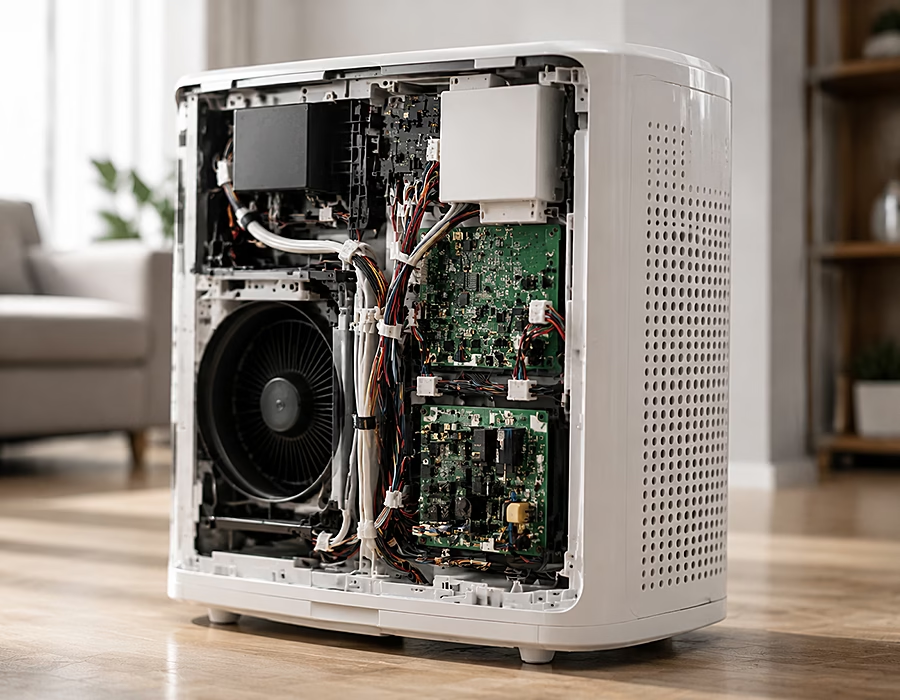
Wiring That Keeps Wi-Fi, Sensors, and Power Electronics from Fighting Each Other
A smart appliance wire harness has to solve a problem that older appliances never had: a Wi-Fi or Bluetooth radio module now sits inches away from a motor driver, compressor, or switching power supply inside the same compact housing.
That radio module is sensitive to electrical noise, and the power electronics right next to it generate plenty of it. Add in temperature sensors, humidity sensors, and touch controls all sharing the same harness, and a modern connected appliance packs more distinct signal types into one chassis than a traditional appliance ever did.
We build custom wire harnesses for smart refrigerators, connected ovens, robotic vacuums, smart washers, and other IoT-enabled home devices. Every harness accounts for the specific mix of high-current power lines, low-voltage sensor cabling, and RF-sensitive wireless modules in that particular product.
With 29 years of OEM/ODM manufacturing experience, our HMLV production line can handle either a single sensor harness or a full board-to-board wiring package on the same line, which matters for products that iterate on hardware quickly.
- FCC Part 15 design awareness, since unintentional radiators like motors and digital control boards fall under these RF emission rules, and our harness routing accounts for that.
- IPC/WHMA-A-620 Class 2/3 workmanship on every harness.
- ISO 9001 certified, with full batch traceability.
- RoHS-compliant materials.
- Three-gate testing: continuity, dielectric withstand, mechanical pull.
Smart Appliance Wire Harness Technical Specifications
| Parameter | Capability |
|---|---|
| Power & motor wiring | Heavy-gauge copper, rated for compressor and motor duty cycles |
| Wireless module interconnect | Shielded, low-noise routing for Wi-Fi/Bluetooth radio boards |
| Sensor cabling | Low-capacitance twisted-pair for temperature, humidity, and motion sensors |
| Board-to-board harnesses | Compact, low-profile connectors for tight PCBA layouts |
| Connectors | JST, Molex, board-to-board wire harness series |
| Testing | Continuity, dielectric withstand, mechanical pull, full batch traceability |
What We Build
- Power and motor/compressor harnesses — heavy-gauge wiring for the appliance’s primary drive or heating load, the core of any smart appliance wire harness build.
- Wireless module interconnect cabling — shielded, low-noise routing that keeps Wi-Fi and Bluetooth radios clear of power-side interference.
- Sensor and control cabling — temperature, humidity, motion, and touch-sensor wiring routed separately from high-current lines.
- Board-to-board harnesses — compact interconnects between control PCBAs, power boards, and display modules in tight enclosures.
- User interface and display wiring — touch panel and status-light cabling for the appliance’s front-facing controls.
Two Failure Modes We Design Around
RF interference disrupting Wi-Fi or Bluetooth connectivity. A motor driver or switching power supply routed too close to a wireless module’s antenna feed introduces noise that manifests as dropped connections or intermittent device offline events. To prevent that, we shield power lines and maintain physical separation from RF-sensitive cabling throughout the harness.
Connector mismatch across rapid hardware revisions. Connected appliances iterate their control boards and sensor packages faster than traditional appliances, and a harness built around one board revision often doesn’t fit the next. As a result, we design connector layouts with revision flexibility in mind and keep tooling adaptable for fast-turn engineering changes.
Frequently Asked Questions
A: A smart appliance harness has to isolate RF-sensitive wireless modules from the same power and motor noise that traditional appliance wiring never had to account for, on top of handling more distinct sensor types in a smaller footprint.
A: Yes. Motors, digital control boards, and other components that generate radio-frequency energy as a byproduct of operation are classified as unintentional radiators under FCC Part 15, and harness routing helps keep the emitted noise within limits.
A: The most common cause is electrical noise from a nearby motor or power supply bleeding into the wireless module’s antenna feed, which shielding and physical cable separation typically resolve.
A: By using connector layouts and tooling built for fast iteration, so a control board or sensor package revision doesn’t require an entirely new harness design from scratch.
A: Yes — both draw on the same underlying skill set of routing high-current and low-voltage lines together without interference, so a single engineering team can manage the full harness package.
Put Our Team to Work
Upload your wiring prints, BOM, or drawings to our Engineering Hub. Our engineers run a DFM audit and return a production quote within 24 hours.