


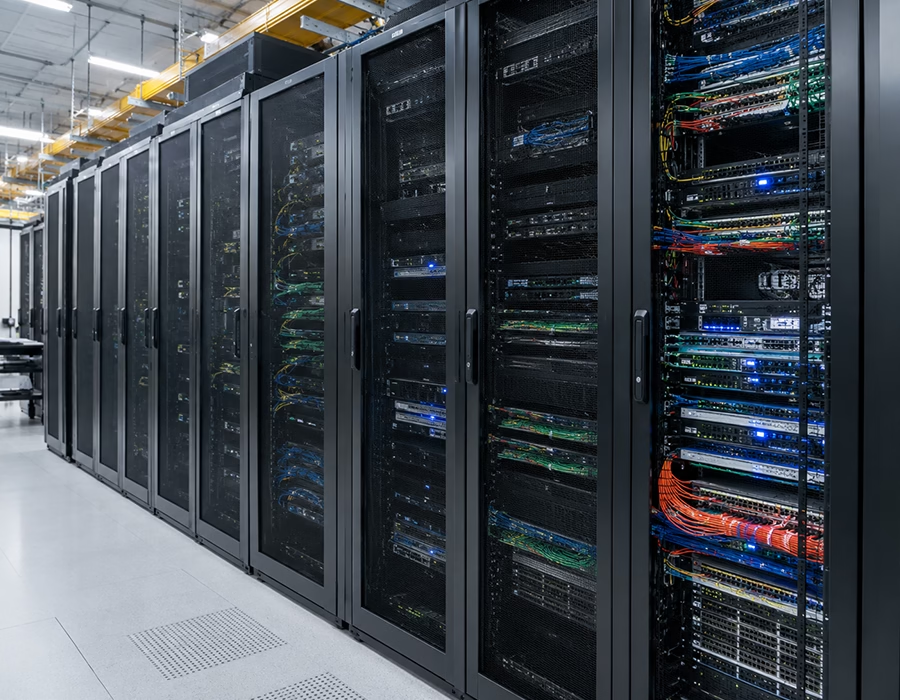
High-Density Switching Where Airflow and Bandwidth Both Matter
A data center networking rack has to do two things that fight each other. It needs to pack in as much bandwidth as physically possible, but it still has to leave enough open air path to keep everything from overheating. Push either one too far, and you get a real problem. Too much bulky copper chokes airflow and drives up cooling load. Too little cable management turns a routine port swap into an hour of untangling a rat’s nest behind the switch.
We design and manufacture cable assemblies specifically for high-density data center networking racks. That covers fiber, copper, and hybrid builds. Our custom interconnects deliver maximum port density, clean signal integrity at multi-gigabit and terabit speeds, and airflow-friendly routing.
We bring 29 years of OEM/ODM experience to network infrastructure projects. As a high-mix, low-volume (HMLV) contract manufacturer, we handle everything from a single custom trunk run to a full rack-and-stack cabling kit. So you’re not stuck sourcing five different vendors for one deployment.
- ISO 9001 factory validation. Every data center rack assembly runs through our certified quality pipeline before it ships.
- IPC-A-620 Class 2/3artistryp. Fiber termination, copper crimping, and cable harness assembly meet a documented, repeatable quality standard, not just “whatever the line happens to produce that day.”
- Three-gate testing, every unit. We run insertion loss and return loss testing on fiber assemblies, continuity and TDR impedance testing on copper, and a final functional check before packing.
- Built to ANSI/TIA-942 cabling guidance. Our rack-level cabling recommendations align with the industry’s own infrastructure standard for data centers. So what you deploy actually matches what auditors and colo providers expect to see.
Technical Specifications and Manufacturing Matrix
| Parameter | Manufacturing Capability | Validation / Material Standards |
|---|---|---|
| Artistry standard | IPC/WHMA-A-620 Class 2/3 | Certified IPC workmanship |
| Quality management | ISO 9001 factory certified | Third-party audited and documented |
| Fiber connector types | LC, SC, MPO/MTP, duplex and multi-fiber trunks | Insertion loss ≤0.3dB typical, return loss ≥50dB |
| Copper cable types | Cat6a/Cat7 patch cords, twinax DAC/AOC assemblies | Rated for 10G to 400G short-reach links |
| Hybrid cable builds | Combined fiber + copper power/data runs | Single-jacket delivery for remote switches and access points |
| Shielding performance | Braided + foil shielded copper for high-EMI rack rows | Minimizes crosstalk in dense patch panel zones |
| Cable management | Low-profile jacketing, color-coded, laser-marked runs | Reduces airflow blockage and troubleshooting time |
| Functional verification | Automated Cirris continuity, TDR impedance, and OTDR fiber testing | Full traceability per batch |
Five Data Center Networking Rack Cabling Types We Build For
We design, tool, and assemble interconnects across five core categories for data center networking racks:
- Fiber optic trunk and patch assemblies. Single-mode and multimode fiber builds handle backbone and server uplinks. MPO/MTP trunks bundle dozens of fibers into one plug, which maximizes port density in a compact chassis.
- Copper patch cords and DAC/AOC assemblies. Cat6a and Cat7 patch cords cover short in-rack runs and PoE delivery. Twinax DAC and AOC cables handle 10G-to-400G links between adjacent switches, without the cost of a full optical transceiver setup.
- Hybrid power-and-data assemblies. A single jacket carries DC power over copper cores alongside fiber data lines. That’s the standard way to feed remote access points or top-of-rack switches without pulling two separate cable runs.
- High-density MPO/MTP trunk cabling. Purpose-built for spine-leaf architectures and hyperscale rows, these trunks dramatically cut cable count. That’s a big win compared to running individual duplex fiber patches to every port.
- Custom rack-and-stack cabling kits. Pre-terminated, labeled, and length-matched cable sets ship ready to install. That cuts on-site labor and reduces the chance of a mismatched or mislabeled run during deployment.
Two Failure Modes We Design Every Data Center Networking Rack Around
Airflow Blockage from Cable Clutter
Dense racks generate serious heat. Every bulky, poorly managed cable bundle blocks the airflow path that would otherwise carry that heat away. Over time, that shows up as thermal throttling or unexplained hardware faults that have nothing to do with the electronics themselves.
We handle this with slim-profile fiber trunks and low-bulk jacketing wherever copper is still the right call. We also use length-matched, laser-labeled runs that route cleanly, instead of coiling up and getting zip-tied into a mess. Getting the bend radius right in a dense patch panel matters here too. Over-tight bends in high-count fiber trunks can quietly degrade signal without any obvious sign of damage.
EMI and Crosstalk in High-Density Copper Runs
Pack enough copper Cat6a or twinax runs into a single tray, and crosstalk between adjacent cables becomes a real signal integrity problem, especially at 10G and above. We handle this with braided and foil-shielded copper builds where rack density calls for it. That keeps high-speed links clean, without forcing every single run over to fiber.
Frequently Asked Questions
A: Fiber is the standard choice for high-speed backbone and spine-leaf uplinks (40G and above). It’s thinner, doesn’t conduct heat, and is immune to EMI. Copper still makes sense for short in-rack runs under 100 meters, PoE delivery, and connections where the extra cost of fiber transceivers isn’t justified for the speed you actually need.
A: A hybrid cable combines fiber strands for data and copper conductors for power in a single jacket. It’s most useful for feeding remote equipment, like a ceiling-mounted access point or a top-of-rack switch. One cable run does the job instead of pulling separate power and data lines.
A: MPO/MTP trunks bundle multiple individual fibers, commonly 8, 12, or 24 per connector, into a single plug. Using wavelength-division multiplexing and modern transceivers, a single trunk can support aggregate speeds well into the terabit range. That’s why they’re standard in hyperscale and spine-leaf deployments.
A: Dense bundles of bulky cables physically block the airflow path that would otherwise carry heat away from switches and servers. The electronics themselves may work fine, but restricted airflow around them still causes thermal throttling or intermittent faults that look like a hardware problem
A: LC and SC connectors are standard for individual duplex fiber patch cords. MPO/MTP connectors handle high-density trunk cabling that needs to move dozens of fibers through a single connection point.
A: ANSI/TIA-942 is the primary telecommunications infrastructure standard for data centers, covering cabling topology alongside power, cooling, and physical infrastructure requirements. Aligning cable assembly design with it helps ensure compatibility with colocation providers and infrastructure audits.
Put Our Data Center Networking Rack Cabling Team to Work
High-density switching leaves zero room for signal loss, airflow-blocking clutter, or mismatched cable runs. Whether you’re speccing a new spine-leaf deployment, upgrading legacy copper to fiber, or need a full rack-and-stack kit shipped ready to install, we can help.
Upload your rack elevation drawings, port count, or BOM directly to our Engineering Hub. Our team of 12 wiring engineers will run a full DFM audit and send a clean production quote within 24 hours.
For a broader look at fiber, copper, and hybrid tradeoffs in dense rack environments, check out our earlier piece on cable assemblies for high-density data center racks. And if your project spans custom Ethernet cabling more broadly, our custom Ethernet cable page covers the wider product range. Our product range.