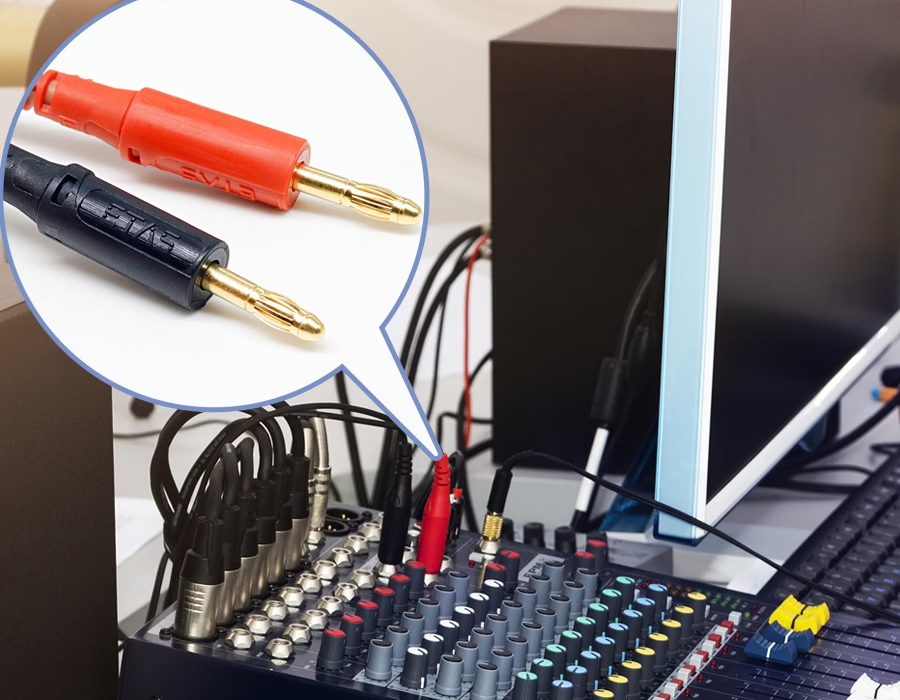
Compared with the past, modern engineered systems are becoming more complex due to the use of separate cables for power, control signals, data, and other signals. This added complexity arises from multiple installation paths, which lengthen installation, require more space, and create more opportunities for failure. To eliminate this “cable spaghetti” issue, many engineers are now using custom hybrid cables.

Hybrid cables integrate power, signal, and data transmission into a single, well-engineered assembly, simplifying installation, improving reliability, and enabling compact, high-performance designs across a wide range of industries.
What Is a Custom Hybrid Cable?
A custom hybrid cable is a multi-function cable assembly that integrates multiple transmission media within a single outer jacket. Instead of using separate cables for electrical power, low-voltage signals, and high-speed data, all required functions are combined into a single, unified structure.
In simple terms, a custom hybrid cable replaces multiple individual cables with one integrated solution.
In most applications, these assemblies are developed as part of a broader
custom cable assembly solution to meet specific electrical, mechanical, and environmental requirements that off-the-shelf cables cannot satisfy.
Typical configurations include:
- Power + signal
- Power + data (Ethernet or fibre)
- Power + signal + data
Key Components and Their Functions
A custom hybrid cable may integrate several of the following elements:
Power Conductors
Stranded copper conductors are designed to deliver electrical power and are sized based on current, voltage, and thermal requirements.
Signal Conductors
Low-voltage wires are used for control, audio/video, or sensor signals. These are commonly arranged as twisted-pair or coaxial cables to maintain signal stability.
Data Conductors
High-speed communication channels, such as Ethernet pairs or fibre-optic links, support reliable data transmission even in electrically noisy environments.
Control Wires
Dedicated conductors for system control, automation logic, and feedback processes.
Optional Media Tubes
Some hybrid designs also integrate pneumatic or fluid tubes, allowing air or liquid supply alongside electrical and data functions.
All internal elements are carefully arranged and isolated to ensure consistent performance without interference.
Why Use a Hybrid Cable Instead of Separate Cables?
Simplified Installation
One hybrid cable replaces multiple individual cables, reducing routing complexity, installation time, and wiring errors.
Space and Weight Savings
Fewer cables mean smaller cable trays, tighter bend paths, and cleaner layouts—especially important in compact or mobile equipment.
Lower System Cost
Although custom hybrid cables require upfront design effort, they often reduce total system cost by minimising labour time, connectors, and overall bill of materials.
Easier Maintenance
A single, organised cable assembly is easier to identify, inspect, clean, and replace than multiple separate cables.
Improved Reliability
Fewer connection points reduce the risk of mechanical failure, signal loss, and long-term electrical issues.
Common Applications of Custom Hybrid Cables
Custom hybrid cables are widely used in systems where performance, space efficiency, and reliability are critical:
- Industrial automation and robotics
Powering motors while transmitting encoder feedback and Ethernet communication through one highly flexible cable. - Medical equipment
Combining power, signals, and data in compact devices that require cleanliness and reliability. - Automotive and EV systems
Reducing wiring complexity for instrument panels, sensors, cameras, and control modules.
In many cases, hybrid designs are integrated into larger wire harness assemblies to simplify routing and improve durability. - Telecommunications infrastructure
Power-and-data hybrid cables are used in antenna systems, base stations, and remote radio equipment. - Audiovisual and building systems
Integrating power, control, and signal lines for displays, HVAC controls, and innovative building solutions.
Critical Design Considerations
Designing a reliable hybrid cable requires careful engineering trade-offs:
Electromagnetic Interference (EMI)
High-power conductors can introduce noise into signal and data lines. Proper shielding, conductor separation, grounding strategies, and fibre-optic cabling are essential.
Flex Life and Mechanical Stress
For applications involving constant bending, torsion, or drag-chain motion, all internal components must share compatible bend radii and mechanical properties.
Environmental Conditions
Cable jackets and insulation must withstand temperature extremes, oils, chemicals, moisture, UV exposure, or abrasion, depending on the operating environment.
Connector and Overmolding Design
Hybrid connectors often combine multiple electrical functions into a single interface. From a manufacturing perspective, proper strain relief and
Overmolded cable designs are critical for long-term performance, especially in motion-intensive applications.
Engineering Selection Checklist for Custom Hybrid Cables
Before finalising a custom hybrid cable design, engineers should evaluate the following key points:
Electrical Requirements
- ☐ Power voltage and current ratings
- ☐ Signal type (analog, digital, audio, video, sensor)
- ☐ Data protocol (Ethernet, fibre, fieldbus) and bandwidth
- ☐ Shielding and isolation between power and data
Mechanical Performance
- ☐ Minimum bend radius
- ☐ Flex life (static vs. dynamic, drag chain, torsion)
- ☐ Tensile strength and strain relief design
- ☐ Vibration and shock exposure
Environmental Conditions
- ☐ Operating temperature range
- ☐ Exposure to oil, chemicals, moisture, or UV
- ☐ Indoor vs. outdoor use
- ☐ Flame resistance or safety compliance needs
Cable Construction
- ☐ Conductor types and sizes (power, signal, data)
- ☐ Shielding method (foil, braid, individual pair shielding)
- ☐ Jacket material (PVC, PUR, TPE, PTFE, etc.)
- ☐ Overall diameter and weight constraints
Connector & Production
- ☐ Hybrid or multi-pin connector selection
- ☐ Pin assignment and insulation coordination
- ☐ Prototype testing requirements
- ☐ Scalability from prototype to mass production
Final Thoughts
With the Custom Hybrid Cable, it is now possible to integrate power and signal/data into a single, reliable unit, improving efficiency. Custom Hybrid Cables also enable engineers to reduce the number of wires required in their designs and improve overall system performance. The result is a cleaner, smaller, and more reliable design for the engineers who create them.
By working with an experienced custom cable manufacturer, you can ensure the required electrical performance and mechanical durability and account for potential environmental challenges before moving from prototype to full-scale production.
.avif)
Sam Wu is the Marketing Manager at Romtronic, holding a degree in Mechatronics. With 12 years of experience in sales within the electronic wiring harness industry, he manages marketing efforts across Europe. An expert in cable assembly, wiring harnesses, and advanced connectivity solutions, Sam simplifies complex technologies, offering clear, actionable advice to help you confidently navigate your electrical projects.