


Why an Industrial PC Wire Harness Needs to Be Different
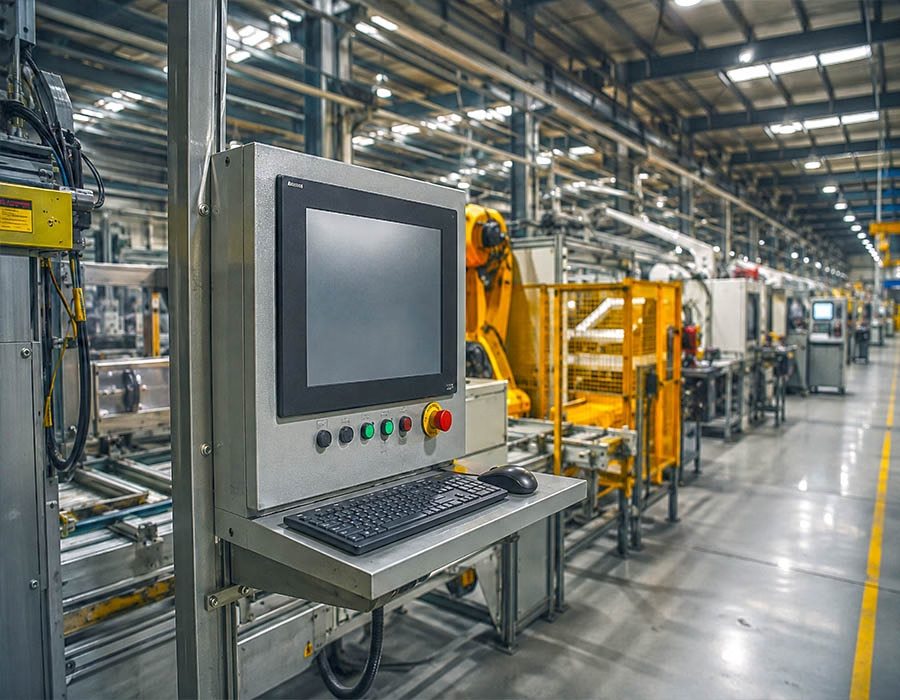
Putting an industrial PC right next to a heavy stamping press sounds great for low-latency edge computing. However, standard commercial-grade cabling simply can’t handle it. That’s exactly where an industrial PC wire harness built for the real factory floor makes the difference.
Inside these compact, fanless metal enclosures, wiring faces harsh realities. For example, there’s persistent high-frequency vibration. On top of that, nearby heavy machinery causes massive voltage drops. And dense component packing traps heat with nowhere to go.
Here’s the risk. If your internal SATA data ribbons, PCIe power jumpers, or I/O panel harnesses use standard consumer construction, you’re on a fast track to field failures. Dropped data packets, loose connections, and heat-induced insulation failure will freeze your software and halt your lines. As a result, Romtronic designs ruggedized internal interconnect systems specifically engineered to keep industrial computers running 24/7 in the dirtiest plant environments.
Built from 29 Years of Ruggedized Cabling Experience
We bring nearly three decades of OEM and ODM manufacturing experience to embedded and industrial computing. Therefore, if you’re managing high-mix, low-volume production runs, we take the guesswork out of sourcing.
Browse our broader capabilities on our custom wire harness manufacturing page, including our industrial machinery wiring harness line. Or head straight to our Engineering Hub to start a project.
What you get with every build:
- ISO 9001 Factory Quality — Every IPC harness runs through our certified quality management pipeline. See our full certifications and qualifications for details.
- IPC-A-620 Class 3 Specs — Every crimp and internal wire route meets the highest workmanship standard in the industry, covering crimp quality, wire prep, and termination reliability for high-reliability electronics.
- 300% Layered Inspection — An optical sweep after termination, an automated insulation test, and a final pull-force check. Three gates, every build.
- Laser-Marked Branch Layouts — Every conductor gets alphanumeric tags every 20mm, so field repairs never turn into guesswork.
Space Optimization for a High-Density IPC Wiring Harness
Squeezing a full logic board, power conversion, and multiple I/O expansion cards into a sealed, dust-tight IP65 chassis means every millimeter of airflow matters. That’s especially true for boards built to PICMG’s embedded computing form factor specifications, where board layout leaves almost no room for bulky wiring. That’s why we build pre-formed, compressed wiring setups that drop straight into your Advantech, Siemens, or custom single-board computer (SBC) form factors.
- Low-Profile, High-Temperature Routing — We replace bulky standard cables with thin-wall, high-temperature Teflon (FEP) or XLPE insulated wire. This lets us bundle critical power lines into micro-spaces without risking a thermal meltdown.
- Positive-Latching Crimp Connections — To keep data lines from vibrating loose inside a rattling chassis, we skip friction-fit terminals entirely. Instead, we use positive-locking connectors with active latches on every internal header, USB panel, and power port.
- Laser-Marked Branch Layouts — Every wire conductor gets laser-marked with alphanumeric schematics every 20mm, pre-bound into organized branches that drop right onto your board headers.
Material & Compliance Matrix for Industrial PC Cabling
| IPC Sub-System Cabling | Material Solution | Why It Matters |
|---|---|---|
| Internal Power & ATX Jumpers | UL 1007/UL 1015 tinned copper with flame-retardant PVC, sized per NEMA enclosure protection guidelines | Rated for continuous 105°C. Resists flame propagation inside sealed, unventilated cases. |
| High-Speed Internal Storage (SATA/PCIe) | Twinaxial/shielded ribbon cables with 100% foil + drain | Prevents electromagnetic crosstalk between data pathways and nearby DC-DC converters. |
| External I/O Panel Harnesses | Rugged PUR jackets with overmolded strain reliefs | Seals chassis cuts against splashed cutting fluids, water jets, and industrial dust. |
| Chassis Grounding Circuits | Ultra-flexible, heavy-gauge flat tinned copper braid | Bleeds off sudden ESD and voltage spikes away from sensitive CPU chipsets. |
Fixing the Real Engineering Problems in IPC Deployments
Why Does an Industrial PC Lose Storage Connection Randomly?
Crimp creep from vibration is usually the culprit. That’s the short answer.
Heavy factory floor machinery creates a continuous, low-frequency hum that vibrates everything nearby. In standard PC builds, this endless shaking causes fine copper strands to slowly shift and back out of loose crimp pins inside storage or power headers. This hidden defect spikes electrical resistance. The result: mysterious blue screens, drive disconnection errors, and corrupted boot files.
We wipe this out at the source. Every industrial PC wire harness we build goes through strict IPC-A-620 Class 3 processing, with automated crimp-force monitoring (CFM) locking in a gas-tight cold weld. As a result, our terminations lock out oxygen and survive continuous vibration without losing connectivity.
How Do You Prevent EMI from Corrupting I/O Signals?
Wrap every I/O breakout in multi-layer shielding. That’s the fix.
When an IPC controls nearby variable frequency drives (VFDs) or robotic actuators, the surrounding air fills with electromagnetic interference. If external COM, Ethernet, or USB panel wires aren’t properly isolated, that noise sneaks right past the chassis walls. As a result, it corrupts serial data streams, causing communication timeouts and random system freezes.
To prevent this, we wrap all internal and external I/O breakouts in custom multi-layer shielding. Specifically, we pair 100% coverage aluminum-mylar foil with a high-density tinned copper braid, over 95% coverage. This creates a solid Faraday cage, keeping automation data clean right up to the processor pin.
Common Questions About an Industrial PC Wire Harness
A: Continuous low-frequency vibration from nearby factory machinery slowly shifts copper strands inside a crimp terminal. Over time, that shifting increases contact resistance, which shows up as intermittent storage errors or random reboots.
A: Class 3 is the standard to specify for industrial and embedded computers running mission-critical processes. It’s the highest workmanship class in the IPC spec, covering crimp quality and termination reliability for high-reliability electronics.
A: Shield the cable in high-coverage tinned copper braid backed by foil, then ground it properly. This blocks electromagnetic noise from nearby VFDs and motors before it reaches the I/O ports.
Positive-locking connectors with active latches hold up far better than friction-fit terminals in a vibrating chassis. They’re standard on every internal header and I/O panel we build for industrial computers.
A: Send your 2D wiring schematics, enclosure blueprints, or BOM to our Engineering Hub. Our team runs a full DFM audit and gets a quote back within 24 hours.
Challenge Our Embedded Interconnect Lab
High-performance edge computing leaves zero room for flimsy ribbon wires, loose crimps, or unshielded data runs. Fighting random system freezes? Struggling with heat buildup inside your fanless chassis? Preparing to scale a rugged hardware platform? Let’s optimize your layout.
Take a look at our industrial cable assembly solutions if you’re sourcing for other factory-floor applications, too.
Send your 2D wiring schematics, enclosure blueprints, or BOM to our Engineering Hub. Our 12 wiring engineers will run a deep DFM analysis and get you a tailored quote within 24 hours.