


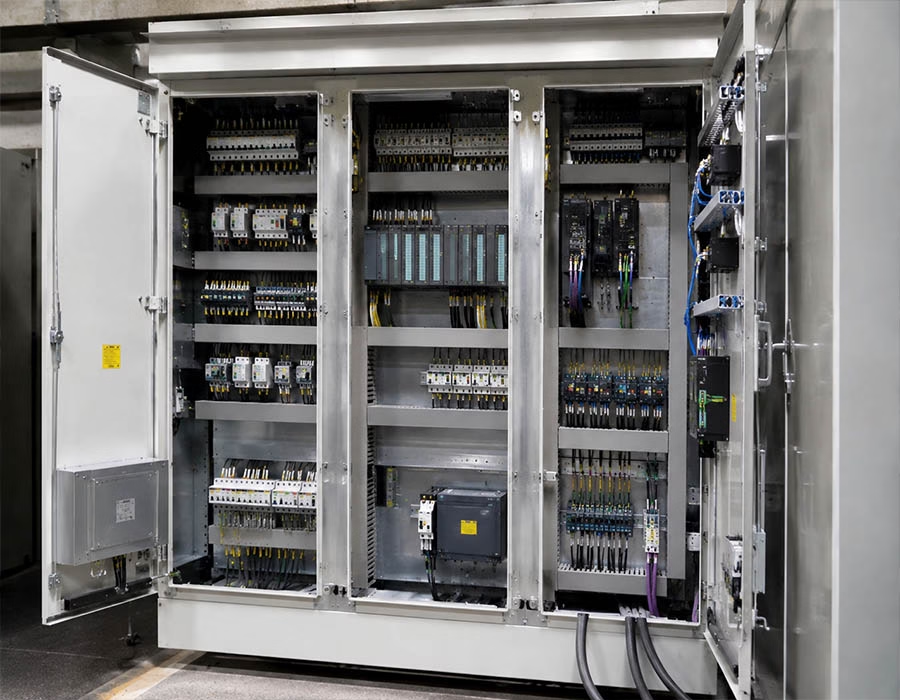
If you’re building or sourcing PLC control cabinets for a factory floor, this is exactly the kind of wiring that keeps them running. Industrial control panel wiring, DIN rail harness kits, and point-to-point assemblies built for factories that can’t afford downtime.
The Space Problem Inside Every Modern PLC Control Cabinet
First things first: if you want an automated line that actually stays up, wiring your PLC control cabinets right is step one, not step ten. Open up any modern control cabinet, and here’s what you’re looking at: main power lines, relays, safety modules, and a logic controller that’s twitchy about noise, all crammed into a footprint that keeps shrinking with every product cycle. In other words, that’s just where factory automation is headed: more function, less space.
Naturally, less space means more heat, more crosstalk, and a lot less margin for error. So, when a cheap crimp or thin insulation shows up inside your PLC control cabinets, it isn’t just an inconvenience. Instead, it’s the kind of thing that takes down a whole line or, worse, starts a fire.
Why Romtronic Builds PLC Control Cabinets Differently
That’s exactly the gap Romtronic fills. Specifically, we build heavy-duty wire harnesses and point-to-point wiring assemblies for PLC control cabinets, engineered to shrug off vibration, electrical noise, and the kind of ambient heat you get standing next to a bank of VFDs. Because we’ve been at this for 29 years across OEM and ODM programs, if you’re running high-mix, low-volume production, that’s basically our whole lane. In short, hand us a messy schematic, and we hand back a pre-tested, plug-and-play sub-assembly. For a broader look at how we support factory automation builds, check out our industrial cable assembly page.
A few things that back that up:
- ISO 9001 certified, top to bottom. Every harness is built and inspected under the same certified quality system, no exceptions.
- IPC-A-620 Class 3 standards. Every crimp, terminal, and routing path is held to the toughest tier in the IPC wiring harness standard, the one aerospace and mil-spec buyers ask for.
- 300% multi-gate testing. For instance, a post-termination optical check, an automated electrical test, and a pull-force test — three separate checkpoints before anything ships.
- Built to shrug off oil and chemicals. Whether it’s cutting oil, hydraulic fluid, or industrial solvents, our insulation doesn’t swell, crack, or peel when splashed.
What Good Wiring for PLC Control Cabinets Actually Looks Like
Sloppy wiring inside a panel isn’t just ugly. Rather, it blocks airflow and, as a result, turns a five-minute field fix into a half-day teardown. That’s why, for every set of PLC control cabinets we wire, we build structured, pre-tested harness kits that drop directly onto your DIN rails and terminal blocks:
- Gas-tight crimps, monitored automatically. Every crimp gets checked with crimp-force monitoring (CFM), so nothing shakes loose on a vibrating shop floor.
- Thin-wall, high-temp insulation. Because of this, XLPE and TEFZEL fluoropolymer let us pack high-current conductors into tight bundles without cooking themselves.
- Every wire labeled, every 20mm. It’s also laser-marked, alphanumeric, and pre-sorted to match your Siemens, Rockwell/Allen-Bradley, or Mitsubishi panel layout right out of the bag—no guessing, no re-labeling on install day.
Material & Compliance Cheat Sheet for PLC Control Cabinets
| Cabinet Sub-System | Wire & Material Spec | Why It Matters on the Floor |
|---|---|---|
| Main power & relay jumpers | UL 1007 / UL 1015 tinned copper, flame-retardant PVC | Rated 600V, 105°C. Handles oil and acid exposure and resists flame propagation up an enclosed duct. |
| Sensitive I/O / data loops | Twisted pair + 100% foil shield + drain wire | Keeps low-voltage sensor signals clean next to high-current contactor coils. |
| Cabinet door grounding straps | High-strand-count flat tinned copper braid | Survives tens of thousands of door-open cycles without losing ground continuity. |
| Harsh-environment patch cables | PUR-jacketed multi-conductor | Shrugs off splashed cutting oil and hydraulic fluid without swelling. |
For the full spec sheet behind these choices, our Standards & Compliance page breaks down every certification we build to.
The Two Failures That Take Down Most PLC Control Cabinets
Contactor Cross-Talk (a.k.a. Ghost Signals)
For example, run a high-voltage AC motor line through the same duct as a 24V DC input wire, and you’re inviting trouble. Because when a big contactor drops out, its collapsing magnetic field throws a voltage spike onto whatever’s sitting next to it. Consequently, that spike shows up on your PLC input card as a false trip, or as a random reset nobody can reproduce on demand.
So, we kill this at the source: custom-shielded multi-core branch harnesses, tinned copper braid at 95%+ coverage, and dedicated ground drain wires. As a result, the signal stays quiet even sitting an inch from a contactor coil.
Crimp Creep (the Slow-Motion Failure)
Meanwhile, stamping presses, motors, and forklifts mean a factory floor never really stops shaking. Over months, that low-frequency vibration lets copper strands migrate inside a loose crimp barrel. Consequently, resistance climbs, hot spots form, and you get intermittent faults that vanish the second a tech walks over with a meter.
Our fix, however, is boring — but it works. Specifically, for every job on PLC control cabinets, we apply IPC-A-620 Class 3 crimping with calibrated pneumatic tooling, producing a gas-tight cold weld that keeps oxygen out for good. In short, that’s the difference between a harness that lasts a season and one that lasts a decade.
Point-to-Point Wiring vs. Pre-Assembled Harness Kits
So, which one fits your PLC control cabinets? Here’s a quick side-by-side:
| Point-to-Point Wiring | Pre-Assembled Harness Kit | |
|---|---|---|
| Best for | One-off panels, prototypes, low volume | Repeat builds, panel builders scaling up |
| Install time | Longer — wired in place, on-site | Fast — drops onto DIN rail, plug-and-play |
| Consistency | Depends on the tech doing the wiring | Identical every time, factory-tested |
| Upfront cost | Lower for a single unit | Lower per-unit at volume |
| Field service | Easier to modify on the fly | Swap the whole sub-assembly, less guesswork |
Not sure which one your build needs? Honestly, that’s a five-minute conversation. So, send us your panel layout through our Engineering Hub, and we’ll tell you straight, or take a look at our Design for Manufacturability guide first.
FAQ: PLC Control Cabinets
What causes random resets on my PLC input card? Nine times out of ten, it’s electromagnetic interference — usually from an AC contactor or motor line running too close to your DC signal wiring. Therefore, the fix is a shielded, twisted-pair signal cable with a proper drain wire, routed away from power conductors.
What’s the difference between IPC-A-620 Class 2 and Class 3? Class 2 is the general industrial standard. Class 3, however, is the tightest tolerance tier, meant for high-reliability builds where a failure isn’t an option, such as aerospace, medical, or mission-critical PLC control cabinets. That said, we build every job to Class 3 regardless of what’s specified, since it’s not much more work and it means far fewer callbacks.
Do I need UL 508A rated wiring for my control panel? If your panel is headed to the US or Canadian market and needs UL listing, then yes — your internal wiring and components need to meet UL 508A requirements. We can spec and document to that standard from the start.
How long does a DFM review for PLC control cabinets take? Send over your BOM, wiring schematic, or even a rough panel photo, and our engineering team will return a tailored quote and DFM feedback within 24 hours.
Can you match my existing Siemens/Rockwell/Mitsubishi terminal layout? Yes. We pre-sort and label harnesses to match your existing panel layout, so it’s a drop-in replacement, not a redesign. Also, check our Certifications & Qualifications for the full list of standards we build against.
Send Us Your Schematic
To summarize, if your PLC control cabinets are running hot, resetting for no reason, or you just want your assembly line to stop bottlenecking on hand-wired panels, let’s fix it together. So, upload your 2D wiring schematic, panel layout, or BOM straight to our Engineering Hub, or check our FAQ for quick answers first. Afterward, twelve of our industrial wiring engineers will run it through a DFM review and get you a real quote within 24 hours. Of course, you can also reach out directly through our Contact page.