Customer-supplied vs turnkey cable assembly comes down to one question: who buys the parts? Choose turnkey when you want one supplier to own sourcing, lead time, and material shortages. If you must use parts you already own, or parts you buy under your own contract, customer-supplied fits better. When you need both, a partial split works. Whatever you pick, write down who covers shortages, scrap overage, incoming inspection, and defects before the PO goes out.
What customer-supplied and turnkey cable assembly mean
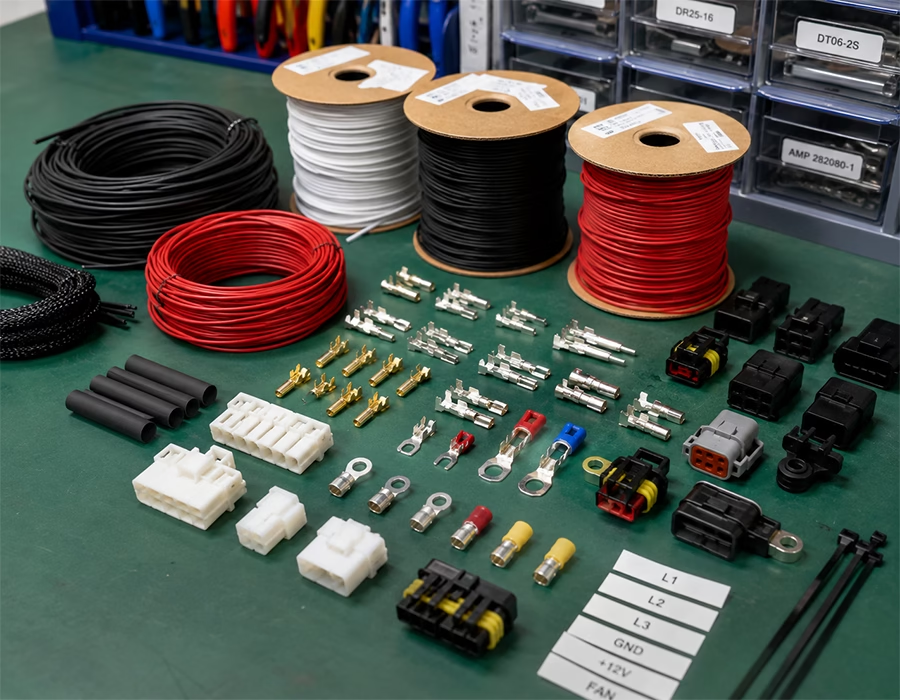
Customer-supplied means you buy some or all of the wire, terminals, connectors, and hardware, then ship them to the factory. The factory cuts, crimps, assembles, tests, and ships. You pay for labor and processing, not for those parts. Suppliers also call it client-supplied, free-issue, or consigned materials.
However, “consigned” can also mean consignment stock, where a supplier keeps inventory at your site until you use it. On a cable assembly quote, it usually means customer-supplied materials, but confirm which one your supplier means.
Turnkey means the factory buys every material on your BOM, builds the assembly, tests it, and ships it. You get one price and one party to answer to.
Partial turnkey splits the BOM. You supply some lines, and the factory buys the rest.
Customer-supplied vs turnkey cable assembly at a glance
| Customer-supplied | Turnkey | |
|---|---|---|
| Who buys the parts | You | The factory |
| Shortage risk | Yours. Production waits for your parts | The factory’s |
| Scrap overage | You ship extra to cover setup and process losses | The factory absorbs it and prices it in |
| Lead time | Starts when complete, usable materials arrive | Includes the factory’s purchasing time |
| Cost visibility | You know every part price | Parts are bundled into the unit price unless you ask for a BOM-level quote |
| Defect accountability | Can get murky when a supplied part is the suspected cause | One party answers for the finished assembly |
| Best for | Specified parts, existing stock, early prototypes | Speed, fewer moving pieces, repeat orders |
How a turnkey cable assembly differs from board assembly
Most articles on this topic cover circuit boards, but cable assembly has its own quirks:
- Wire is used by length, not by count. Every harness needs cut length plus strip allowance, and machine setup consumes some wire. A reel that looks like enough on paper may not be.
- Crimp setup eats terminals. Operators use the first pieces off a machine to dial in crimp height and verify the crimp.
- Terminal and wire have to match. Terminal manufacturers publish the wire range and crimp specs for each terminal, and crimp tooling usually matches a specific terminal and wire size. Your factory may not already have the tooling for the connector you chose. Our guide to connector and termination design explains how to avoid that mismatch.
- Packaging matters. Automatic crimping equipment can run terminals on a reel. Loose terminals often mean slower, more manual work.
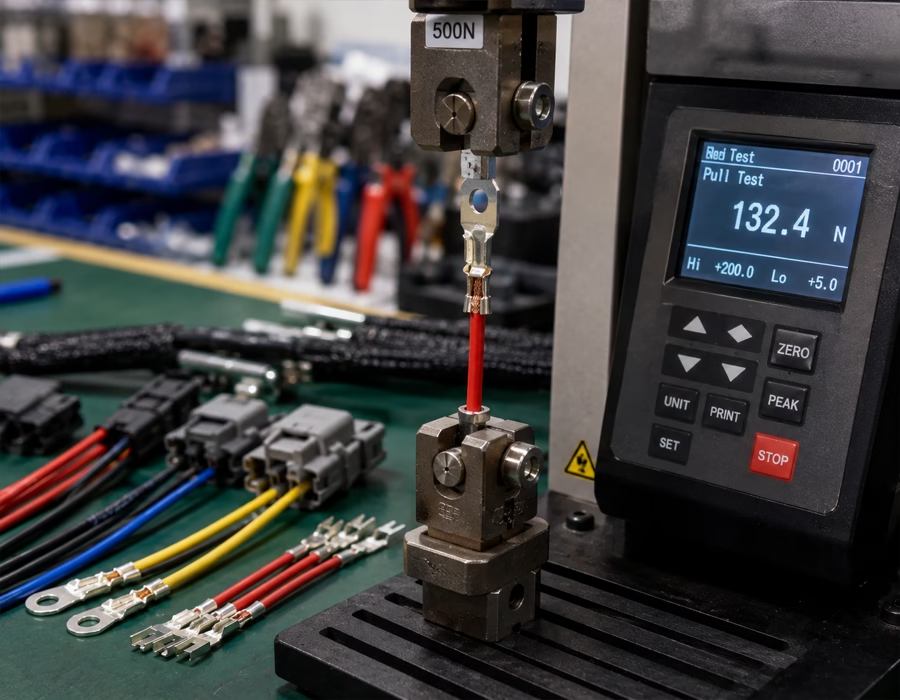
- Testing uses parts up. Pull tests and cross-section analysis destroy the sample. See our testing and validation pages for how factories verify crimps.
When customer-supplied is the right call
- Your own customer or approved vendor list requires a specific connector or wire.
- You already own the stock, or you have a supply agreement the factory can’t easily match.
- You have secured scarce or long-lead parts yourself.
- You are running early prototypes with parts in hand, and you plan to move to turnkey once the design settles.
When turnkey is the right call
- Time to market matters more than controlling every purchase.
- You place small, frequent orders, and kitting parts for each one eats your team’s time.
- Most of the BOM is commodity: standard wire, sleeving, labels, and common terminals.
- You want one party accountable for the finished assembly.
The hidden costs of turnkey cable assembly and customer-supplied builds
Customer-supplied: Overage, freight, and kitting time add up. Shipping parts across borders also adds paperwork and days, so ask your freight forwarder how customs will treat the parts. Compare total cost and total lead time, not just unit price.
Turnkey: Expect a markup or handling fee on parts. Substitutions are the other risk. If a part goes obsolete or unavailable, the factory may propose an equivalent. Therefore, agree up front that any substitute needs your written approval. For connectors in particular, end-of-life notices can quickly change your plan. Our article on managing cable BOM changes without delays shows how to handle substitutions.
A common middle path: partial turnkey
Partial turnkey keeps your control where it matters. In a typical split, the factory buys wire, terminals, sleeving, and labels, while you supply a specified connector or a proprietary housing. This cuts your kitting work and keeps the one or two parts you care about under your own contract. It also needs the clearest written split of any option on this page.
Seven things to settle in writing for any cable assembly order
- A line-by-line BOM. Include manufacturer part numbers and mark each line “buyer” or “factory.” Our RFQ checklist covers what else belongs in the package.
- A part-number review before you buy. Send the part numbers to the factory first, so the team can confirm wire range, crimp tooling, and fit before you spend money.
- Overage per part. No universal number exists, because it depends on the part, the process, and the order size. Ask the factory to state it in writing.
- When the clock starts. With customer-supplied parts, lead time usually starts when complete, usable materials arrive, not when you place the order. Our process and services page shows where lead time goes.
- Packaging and labeling. Specify reel or tray, with part number and lot or date code on every package.
- Incoming inspection. Decide who checks supplied parts, to what criteria, and what happens to rejected material.
- Defect responsibility and leftovers. Agree how you will decide whether a failure traces to a supplied part or the assembly process, and whether the factory returns or scraps leftover material.
On number 7, if your drawing calls out a workmanship class under IPC/WHMA-A-620, inspectors judge the finished assembly. A supplied part that doesn’t suit the process can still put the build out of spec. Because the buyer names the class, say which one applies. For a practical overview, read our IPC/WHMA-A-620 guide.
Quick decision guide
- Specified parts or stock on hand? Go customer-supplied, or partial turnkey with you supplying those lines.
- Short schedule and mostly commodity parts? Go turnkey.
- Prototype with parts in hand, volume later? Start customer-supplied, then move to turnkey.
- Frequent small orders? Go turnkey, or partial turnkey, supplying only the critical parts.
FAQ: customer-supplied vs turnkey cable assembly
Is “consigned” the same as customer-supplied?
Usually, in an assembly quote. Elsewhere in the supply chain, however, consignment can mean supplier-owned stock held at your site. Confirm the term in writing.
Does customer-supplied cost less?
Sometimes, because you control the purchase price. Still, add overage, freight, kitting time, and delay costs before you compare.
How much extra material should I send?
Ask the factory for a per-part overage in writing before you order. A fixed rule of thumb would be a guess.
Who is responsible if a supplied terminal fails a crimp pull test?
It depends on your agreement, which is why you should write defect rules in advance. Reviewing part numbers and wire range before you order also catches many mismatches early.
Can I start customer-supplied and switch to turnkey later?
Yes, buyers often do. Update the BOM and get approvals through your normal change control.
Get a quote for your turnkey cable assembly
Send your BOM through our quote page, with each line marked buyer or factory. Romtronic’s engineers give feedback within 12 hours, and our high-mix, low-volume orders start from 10 pieces or a $100 total order value. Browse our custom cable assemblies and custom wire harnesses to see what we build.
.avif)
Sam Wu is the Marketing Manager at Romtronic, holding a degree in Mechatronics. With 12 years of experience in sales within the electronic wiring harness industry, he manages marketing efforts across Europe. An expert in cable assembly, wiring harnesses, and advanced connectivity solutions, Sam simplifies complex technologies, offering clear, actionable advice to help you confidently navigate your electrical projects.