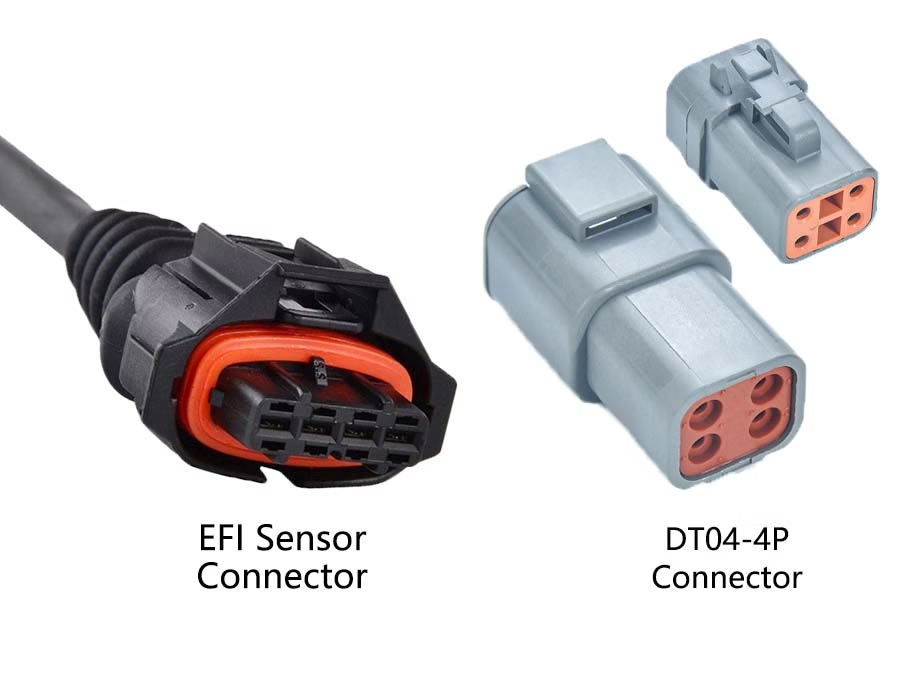
If you’ve pulled a connector off a Bosch ECU, an ignition coil, or a throttle position sensor, you may be holding a JPT connector. It has a squarish, sealed housing with two locking tangs. It’s also one of the more confused connectors in automotive wiring, mostly because people mix it up with its older sibling, the JT connector, or with unrelated series like JST.
This guide covers what a JPT connector actually is, the specs that matter when you spec one into a harness, how to tell it apart from a JT connector at a glance, and where it fits against alternatives like JST and Molex Mini-Fit/Mega-Fit.
What Is a JPT Connector?
JPT stands for Junior Power Timer. AMP — now part of TE Connectivity — originally developed this sealed, automotive-grade connector series for circuits that need real current while surviving vibration, heat, and moisture under the hood.
JPT and the Bosch Kompakt Connector
Bosch uses the same physical connector on many of its Jetronic fuel-injection and sensor components. Distributors and specialty resellers call it the Bosch Kompakt connector, also written “Compact.” Motorsport-connector suppliers document two physical formats: Kompakt I (Code 1), which uses a side-entry locking tab, and Kompakt II (Code 2), which uses a top-entry tab. The housings look similar, but they aren’t interchangeable. So before you order replacement pins, match the part number or check the markings on the connector body — don’t assume two similar-looking housings take the same terminal.
Common JPT Applications
Documented uses of the JPT/Kompakt connector include:
- Ignition coils and coil packs
- Throttle position sensors (TPS)
- Camshaft position sensors on some BMW/VAG platforms
- MAP/boost pressure sensors, and oil or fuel pressure sensors
- Coolant/oil temperature sensors and knock sensors
- Idle control valves and some brake pressure sensors
- ECU/DME harness branches
TE Connectivity’s own Junior Power Timer portfolio, along with Digi-Key and Mouser listings, also places the broader JPT pitch family in consumer appliance and industrial control wiring. In other words, it shows up in OEM harnesses more often than most people realize — even outside the engine bay.
JPT Connector Specifications
JPT isn’t one part with a single fixed current rating. It’s a family of housings and terminals, and the rating changes with the contact and wire gauge you choose. So instead of repeating the flat figure many sites use, we pulled individual TE Connectivity and distributor datasheets for real part numbers.
Why There’s No Single Current Rating
| Spec | Documented Value | Confidence |
|---|---|---|
| Series name | Junior Power Timer (JPT) | Confirmed — TE Connectivity, Digi-Key, Mouser, RS, element14 |
| Manufacturer | TE Connectivity (formerly AMP/Tyco) | Confirmed |
| Terminal width | 2.8 mm | Confirmed — TE distributor listings (contacts and secondary locks) |
| Current rating, by contact/wire size | Roughly 3 A on small-signal contacts (13–20 AWG, low-current variant), up to 30 A on standard mid-size contacts (17–24 AWG), and up to 40 A on heavy-gauge contacts (11–13 AWG) | Confirmed on individual TE part datasheets (Farnell/element14, RS Components) — varies by contact, not one series-wide number |
| Housing-level current/voltage rating (example) | 30 A / 28 V on a 21-position TE JPT housing (part 1-967625-1) | Confirmed on that specific TE datasheet |
| Wire range across the terminal family | As small as 24 AWG on light-duty contacts, up to 11 AWG on heavy-duty ones; most common mid-size terminals cover roughly 13–20 AWG | Confirmed across multiple TE terminal datasheets — no single number covers the whole family |
| Contact plating | Tin, silver, or gold, depending on part number | Confirmed |
| Pin count | 2-way housings at the low end; TE’s catalog confirms at least 21-way housings (multi-row) | Confirmed for 2-way through 21-way; higher counts may exist but weren’t independently confirmed here |
| Sealing | Sealed, with wire seals/interface seals, and unsealed/standard variants | Confirmed |
| Related name | Bosch Kompakt I (Code 1, side-entry lock) and Kompakt II (Code 2, top-entry lock), also listed as “Compact” | Confirmed — motorsport/specialty connector suppliers |
Choosing the Right Terminal for Your Load
Because the rating depends on the exact terminal and wire gauge, always pull the datasheet for your specific TE part number. Don’t assume a flat “up to X amps” figure applies to your build. If your application needs a guaranteed current rating with margin — not just a catalog figure for one contact — ask your cable assembly partner to run a temperature-rise check. That check should use your exact wire gauge, circuit count, and ambient conditions.
JPT vs. JT Connector: How to Tell Them Apart
This question trips up a lot of people. JPT and the older JT (Junior Timer) connector look almost identical from a distance: same general size, same automotive gray housing. TE’s own catalog lists them as related but distinct series.
Automotive-electronics repair and motorsport-wiring forums share a more detailed visual distinction, based on hands-on teardown notes rather than an official TE datasheet. Treat it as a helpful field guide, not a confirmed spec:
- JPT connector: typically has a plus-sign-shaped (+) terminal opening, with two slots for extracting the two-tang terminal.
- JT connector: typically has a T-shaped opening, with a single slot, since JT terminals reportedly use one latching tang instead of two.
Terminals aren’t interchangeable between the two families, and forum reports say the crimp orientation on the receptacle differs too. If you’re repairing a harness or sourcing replacement pins, confirm the housing type against the part markings on the connector body itself. Matching a known part number beats guessing from the opening shape alone.
JPT vs. JST vs. Molex: Which Connector Fits Your Design?
These three names get lumped together a lot, but they solve different problems:
| Connector | Best Suited For | Typical Current | Notes |
|---|---|---|---|
| JPT | Automotive power and signal circuits, engine management | Roughly 3–40 A depending on contact and wire gauge | Sealed, vibration-rated, Bosch-compatible |
| JST | Consumer electronics, drones, robotics, low-voltage prototyping | Generally lower, series-dependent | J.S.T. Mfg. makes dozens of series (PH, XH, VH, etc.) for board-to-wire and wire-to-wire use — not a single “type,” so ratings vary widely by series |
| Molex Mini-Fit / Mega-Fit | PC power supplies, appliances, industrial power distribution | Mini-Fit Jr. handles higher-density power; Mega-Fit steps up further for heavier current | Not automotive-sealed by default; better suited to indoor, controlled environments |
If you’re weighing JPT against other options for a new harness design, our breakdown of Molex Mini-Fit, Micro-Fit, and Nano-Fit connectors is a useful next read. Our guide to choosing the right connector for a custom wiring harness also walks through the broader decision process step by step.
How to Spec a Custom JPT Cable Assembly
If you’re ordering a custom JPT cable or wiring harness — rather than buying loose connectors — these details actually affect fit, function, and cost:
- Circuit count and current draw. Match the wire gauge and terminal size to your real current. JPT terminals range from roughly 3 A signal contacts to 40 A power contacts, so the right choice depends on the load, not the series name alone.
- Sealed vs. unsealed housing. Engine bay and exterior locations need the sealed variant with wire/interface seals. Dry interior locations usually don’t.
- Contact plating. Tin works fine for most automotive circuits. Silver or gold plating is worth the upcharge for low-signal, high-reliability, or high-cycle applications.
- Mating connector on the other end. Many JPT harnesses terminate to an M8, M12, or M16 circular connector for panel mounting — see our guide to M8/M12/M16 cable connectors if that’s your setup.
- Vibration and thermal environment. Under-hood routing near the engine or exhaust needs a wire insulation and strain-relief spec matched to the ambient heat, not just room temperature.
For a broader look at how automotive connector families fit into a full harness build, our automotive wire harness connectors guide covers the rest of the system. If you’re comparing JPT against smaller signal-level options, our Dupont connector guide is worth a look too.
FAQ
What does JPT stand for in a connector? JPT stands for Junior Power Timer, a connector series TE Connectivity (formerly AMP) developed.
What’s the maximum current a JPT connector can handle? It depends on the specific terminal and wire gauge. TE datasheets show individual contacts rated from about 3 A on small-signal terminals up to 40 A on heavy-gauge power terminals, with 30 A common for mid-size contacts. Always check the datasheet for the exact part number.
Is a JPT connector the same as a Bosch Kompakt connector? Yes, in most cases. Bosch Kompakt (also marketed as “Compact”) names the same JPT-style connector, in two documented formats: Kompakt I (Code 1, side-entry lock) and Kompakt II (Code 2, top-entry lock), used on many Bosch Jetronic and Motronic engine control components.
Can I use JT terminals in a JPT housing? No. Field reports describe JPT terminals as using two latching tangs, versus one tang for JT terminals, and the housings aren’t cross-compatible. If you’re unsure which you have, match the part number rather than relying on appearance alone.
Where are JPT connectors most commonly found? Mainly in automotive engine management — ignition coils, throttle position sensors, and crank/cam sensors — plus industrial and appliance control circuits.
Get a Custom M12-to-JPT Cable
At Romtronic, we build custom M12-to-JPT cable assemblies and full wiring harnesses to match your exact circuit count, wire gauge, and sealing requirements — not a generic catalog part. If you’re specifying JPT connectors for an engine harness, sensor cable, or industrial control panel, get a free quote and our engineers will confirm the right build for your application.

M12 to JPT cable assembly with 4-pin M12 male connector and Bosch Kompakt-style JPT connector.avif)
Sam Wu is the Marketing Manager at Romtronic, holding a degree in Mechatronics. With 12 years of experience in sales within the electronic wiring harness industry, he manages marketing efforts across Europe. An expert in cable assembly, wiring harnesses, and advanced connectivity solutions, Sam simplifies complex technologies, offering clear, actionable advice to help you confidently navigate your electrical projects.