


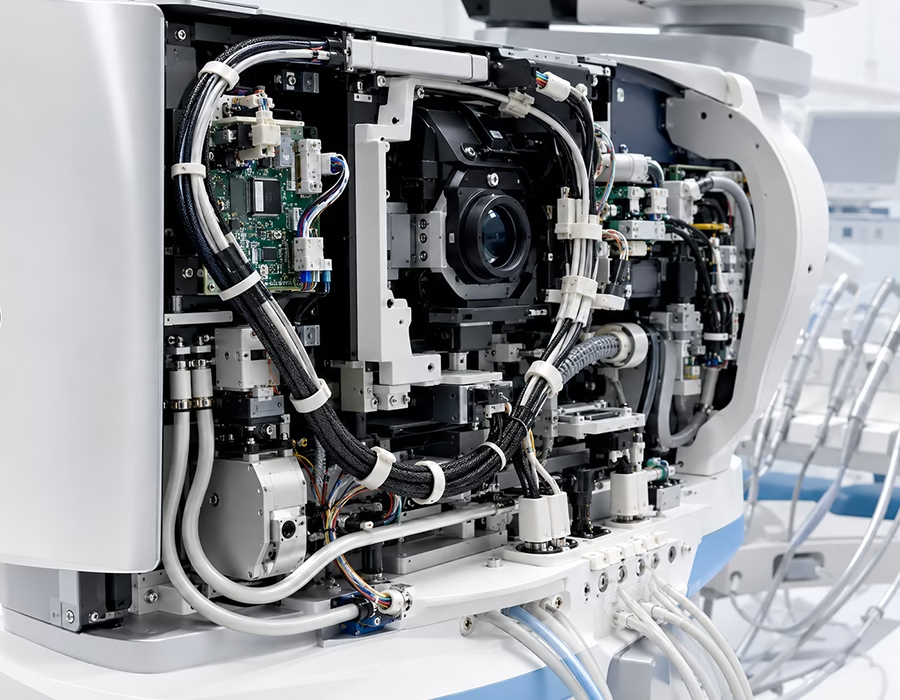
The Reality of Precision Surgical Operatories
Dental and ophthalmic equipment shares one unforgiving engineering challenge: it all operates in ultra-confined spaces where mechanical movement has to be completely fluid and silent. Dental chairs, clinical handpieces, and ophthalmic diagnostic lasers all live by this rule.
If a dental tool delivery arm jerks because of stiff internal cabling, the clinician’s precision suffers. If an ophthalmic scanning laser picks up even minor electromagnetic jitter, the diagnostic topography map drifts off. Neither is acceptable in a clinical setting.
We design internal wiring specifically for medical wire harness applications that demand zero fluidic leakage, ultra-low torsional resistance, and serious high-frequency signal isolation, so dental and ophthalmic equipment performs the way clinicians expect, every single time.
Fluidics, Flex, and Footprint: The Real Engineering Constraints
Unlike stationary medical monitors, dental and ophthalmic equipment is constantly moving, articulating, and routing liquid or air lines right alongside sensitive data wires. That combination makes this category tricky to wire correctly.
- Co-axial hybrid cable bundling. We integrate high-pressure polyurethane air and water lumens, high-speed digital lines, and low-voltage power conductors into a single, cohesive, jacketed umbilical cable.
- Whisper-quiet torsional flex. Stiff wire bundles fatigue the clinician’s wrist and generate micro-vibrations. We solve this with ultra-fine copper strandings wrapped in slippery PTFE tape, so the assembly slides smoothly with almost no internal friction.
- Non-magnetic ophthalmic signal paths. For advanced optical coherence tomography (OCT) and laser eye surgery platforms, we build non-magnetic, triple-shielded coax sub-assemblies that keep RF noise away from ultra-sensitive optical encoders.
Material and Compliance Reference for Dental and Ophthalmic Equipment
| Target Sub-System | Material Solution | Why It Matters |
|---|---|---|
| Dental handpiece & tool lines | Custom-extruded medical silicone or high-durometer TPU | Withstands continuous twisting and thousands of 134°C autoclave sterilization cycles without cracking |
| Ophthalmic laser articulating arms | High-flex tinsel conductors jacketed with low-friction FEP | Prevents internal wire binding and cuts mechanical resistance in tight slip rings and pivot joints |
| Foot control switch modules | Heavy-duty overmolded strain reliefs with IPX7 polyurethane potting | Resists floor-level impacts, heavy stepping, and constant exposure to floor sanitizers or fluids |
| High-resolution retinal camera links | Micro-coaxial bundles or low-loss micro-twinax cabling | Preserves large image data streams without signal degradation or cross-channel noise |
We build all of this to ISO 13485 quality management standards, which is the baseline most clinical device manufacturers require from any interconnect supplier. If you want the fuller picture on what that standard actually covers for wire harnesses specifically, we’ve got a breakdown of medical wire harness standards and certifications worth reading.
Two Design Flaws We Engineer Out of Every Assembly
The Kinking and Flow Restriction Problem
When a hybrid dental cable bends, the internal electrical wires and fluidic tubes compress unevenly. In poorly designed assemblies, the electrical conductors end up pinching the water or air lines. That restriction reduces fluid pressure and wears down the insulation faster than it should.
We counter this with structured planetary cabling. By twisting the conductors and fluid lines symmetrically around a central strain-relief core, the whole assembly keeps its round shape and resists kinking, even under tight, repeated bends. Getting the bend radius right matters as much as the material choice.
Eliminating Optical Jitter in Laser Tracking
Ophthalmic diagnostic systems rely on incredibly weak sensor signals to map the human retina. When internal stepper motors fire to adjust the machine’s position, they throw off strong electromagnetic fields. Run those motor lines parallel to the camera data lines, and you get digital noise, screen flicker, or pixel drift on the diagnostic output.
To stop that cross-talk, we wrap sensitive signal paths in high-coverage (95%+) tinned copper braid, combined with conductive aluminum foil. That keeps data lines quiet, so the diagnostic image stays clean. (We’ve written more on copper vs. aluminum foil shielding tradeoffs if you want the deeper mechanics.)
Frequently Asked Questions
A: Medical-grade silicone or high-durometer TPU is standard for dental handpiece and tool cabling. Both hold up through thousands of 134°C autoclave sterilization cycles and resist cracking under the continuous twisting a handpiece cord goes through daily.
A: This is almost always electromagnetic interference from nearby stepper motors. When motor control lines run parallel to sensitive camera or sensor data lines without shielding, the resulting noise shows up as pixel drift or flicker on the diagnostic output. Shielded cabling with high-coverage braid solves it.
A: Yes, for anything that contacts the patient or gets sterilized between uses. Medical silicone and certain high-durometer TPU compounds are built specifically to survive repeated 134°C steam sterilization cycles without degrading or cracking.
A: Stiff internal cabling is the usual culprit. If the wire bundle inside the arm resists twisting, it fights the clinician’s hand movement and transmits that resistance directly to the tool. High-flex, low-torsion cable construction is the fix.
A: Space is the main driver. Dental delivery systems and handpieces run air, water, and electrical power through the same narrow channel, so a hybrid umbilical cable that bundles all three keeps the assembly compact enough to fit the mechanism. Done poorly, though, this bundling can pinch the fluid lines when the cable bends, which is why the internal layout matters as much as the materials.
Challenge Our Medical Cabling Lab
Clinical operatory gear needs a careful balance of mechanical freedom and high-speed signal integrity. Whether you’re dealing with handpiece cable stiffness, fluid leakage near a wire connection, or optical signal noise on a diagnostic platform, we can help you sort it out.
Upload your 2D wire schematics, mechanical drawings, or BOM directly to our Engineering Hub. Our engineering team will run a full DFM (Design for Manufacturability) analysis, flag potential wear points, and deliver a tailored production quote within 24 hours.
If your project also touches surgical or biocompatible device interconnects, our page on surgical devices and biocompatible interconnects covers that adjacent engineering in more depth. And for the broader design picture, our comprehensive guide to custom wire harness design for medical devices is a solid next read.