


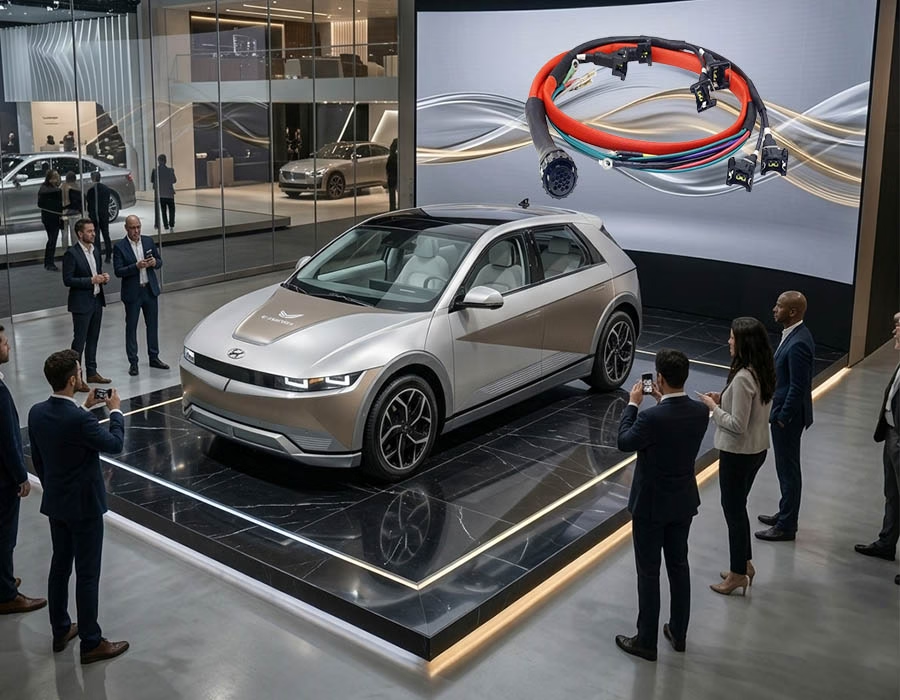
An EV Battery Wire Harness Is a Different Ballgame
Wiring an EV battery wire harness is nothing like a standard 12V automotive job. Specifically, it has to route lethal high-voltage busbars just millimeters from hyper-sensitive microvolt cell-monitoring lines.
Inside a sealed pack, everything works against the wiring. For instance, it takes constant road vibration. On top of that, it goes through intense thermal spikes during fast charging. As if that weren’t enough, it also sits inside a massive electromagnetic field from the traction inverter.
Here’s the real risk. If a single voltage-sense wire cracks from fatigue, or rubs raw against a sharp module edge, the BMS goes blind on cell balance. As a result, that’s a fast track to a thermal runaway event or a bricked powertrain.
That’s exactly why Romtronic builds ruggedized BMS cell-monitoring loops, high-voltage safety interlocks (HVIL), and balancing harnesses engineered around a properly built EV battery wire harness that actually handles the abuse.
Built from 29 Years of High-Voltage Wiring Experience
We bring 29 years of OEM and ODM manufacturing experience to the table. Therefore, if you’re managing high-mix, low-volume builds, we take the pain out of sourcing.
Mining, medical, industrial — we’ve built harnesses for all of it. However, EV battery packs are where precision matters most. Simply send us your pack schematics, and we’ll deliver pre-tested, drop-in internal sub-assemblies.
Browse our full range on our custom wire harness manufacturing page, including our automotive wiring harness line. Or head straight to our Engineering Hub to start a project.
What you get with every build:
- ISO 9001 Factory Quality — Every battery harness runs through our certified quality management pipeline. See our full certifications and qualifications for details.
- IPC-A-620 Class 3 Specs — Every micro-miniature crimp and internal wire route meets the highest workmanship standard defined by IPC’s official specifications.
- 300% Layered Inspection — An optical sweep after termination, an automated insulation test, and a final pull-force check. Three gates, every build.
- Tough Insulation Materials — Our jackets resist chemical degradation. They handle long-term exposure to battery fluids, cooling agents, and high heat without cracking.
Clean Routing for an EV Battery Wire Harness in Tight Cell Layouts
Packing hundreds of lithium-ion cells into a tight module enclosure rules out bulky wire bundles. Instead, you need clean, low-profile layouts that plug straight into your cell supervisory circuits (CSC) and master controllers.
- Up to 1000V DC Isolation — We use premium silicone, XLPE, or fluoropolymer jackets to stop high-voltage creepage and electrical shorts before they start. Our jacket selection follows the insulation coordination principles set out in IEC’s international standards.
- Zero-Slippage Latching Connectors — Road shock kills basic friction-fit plugs fast. That’s why we exclusively source automotive-grade connectors with active positive locks and TPA (Terminal Position Assurance) retainers.
- Sonic-Welded Junctions — For multi-cell taps, we rely on high-precision ultrasonic wire bonding alongside automated crimp-force monitoring (CFM). This keeps resistance low and stops hot spots before they start.
Material & Compliance Matrix for EV Battery Wiring
| BMS Sub-System | Material Solution | Why It Matters |
|---|---|---|
| Cell Voltage & Temperature Sensing | Radox/XLPE insulated wire with flame-retardant, halogen-free jackets | Rated for -40°C to +125°C. Won’t release toxic gases or melt during thermal spikes. |
| High-Voltage Safety Interlock (HVIL) | Double-shielded twisted pairs with a bright orange, high-visibility PUR jacket | Triggers instant hardware-level fault detection if a high-voltage connector is unlatched. |
| Master-to-Slave BMS Data Links | Shielded CAN-Bus/automotive Ethernet cabling with 100% foil + drain | Blocks high-frequency inverter switching noise from corrupting cell-telemetry data. |
| Module-to-Module Grounding Straps | Ultra-flexible, high-strand flat tinned copper braid | Manages structural chassis grounding and absorbs multi-axis twisting without snapping. |
Fixing the Real Engineering Problems in BMS Wiring
How Do You Stop Inverter Noise on BMS Sensor Lines?
Shield the sensitive lines in a high-density copper braid backed by foil. That’s the short answer.
When a driver hits the accelerator, the traction inverter switches massive currents at high frequency. That creates a huge electromagnetic field inside the vehicle. If your BMS communication lines or voltage-sense wires aren’t seriously shielded, that EMI injects ghost voltage drops right into your telemetry.
The result: your master controller catches false over-voltage codes. The vehicle loses power suddenly or throws error lights. We handle this by designing custom-shielded BMS branches. We isolate the sensitive lines inside a high-density tinned copper braid, over 95% coverage, backed by a conductive aluminum-mylar foil wrap. This builds a solid Faraday cage, keeping cell readings clean even under full acceleration.
How Do You Stop Vibration from Wearing Through Insulation?
Run the harness through an IPC-A-620 Class 3 build process with braided sleeves and molded strain reliefs. That’s the fix.
EV battery packs live in a high-vibration world. They take non-stop road chatter and sudden pothole shocks. If the internal wiring layout is sloppy, wire jackets slowly grind against sharp module brackets or busbar corners. Over time, insulation wears down to raw copper. That causes a catastrophic short circuit straight to the chassis ground.
To avoid this, every EV battery wire harness we build goes through an IPC-A-620 Class 3 workflow, with high-durability braided textile sleeves and anti-abrasion conduits. This keeps the internal copper isolated, so the pack survives years of rough driving.
Common Questions About EV Battery Wire Harnesses
A: HVIL stands for High-Voltage Interlock Loop. It’s a safety circuit that runs through every high-voltage connector in the pack. If any connector gets unlatched or disconnected, the HVIL loop breaks and instantly shuts down the high-voltage system before anyone gets hurt.
A: Shield the sensor and communication lines in high-coverage tinned copper braid backed by foil, then ground it correctly. That combination blocks the electromagnetic noise thrown off by the traction inverter before it reaches the BMS controller.
A: Usually it traces back to a damaged voltage-sense wire — either fatigue cracking or insulation wearing through from vibration. Once that wire’s readings drift, the BMS can’t balance the cells accurately, which shortens pack life and increases the risk of thermal runaway.
A: HVIL is a dedicated safety interlock circuit that only monitors connector integrity. General BMS wiring handles cell voltage sensing, temperature monitoring, and controller communication. Both run through the pack, but they serve completely different functions.
A: Simply send your 2D schematics, pack drawings, or BOM to our Engineering Hub. Our team runs a full DFM audit and gets a quote back within 24 hours.
Put Our EV Interconnect Lab to Work
High-voltage battery packs leave zero room for error, loose crimps, or unshielded data runs. Chasing a ghost sensor fault? Fighting space issues inside your cell modules? Getting a new EV platform ready for production? This is exactly what we do.
Take a look at our automotive wiring harness solutions if you’re sourcing for other vehicle platforms too.
Send your 2D schematics, pack drawings, or BOM to our Engineering Hub. Our 12 wiring engineers will run a DFM audit and get you a clean quote within 24 hours, with expert feedback within 12 hours.