LVDS vs eDP is the first decision most engineers face when wiring a TFT panel to a driver board. Both are differential-signaling interfaces, but they solve different problems. LVDS — usually implemented as FPD-Link or OpenLDI — favors long cable runs and mature low-cost silicon. It also has a multi-decade track record in harsh environments. eDP builds on DisplayPort technology as a VESA standard. It favors higher bandwidth over very short internal connections, and it’s the default choice in modern laptops and tablets.
So which one fits your project? As a rule of thumb: if your panel sits more than about a meter from its driving board, LVDS is usually the practical choice. If the panel and driver board share a short internal cable or flex run, eDP is usually the better fit.
This article focuses on that LVDS vs eDP interface decision. Once you’ve already chosen LVDS, you may need connector, shielding, or length guidance. In that case, see Custom LVDS Cables product page.
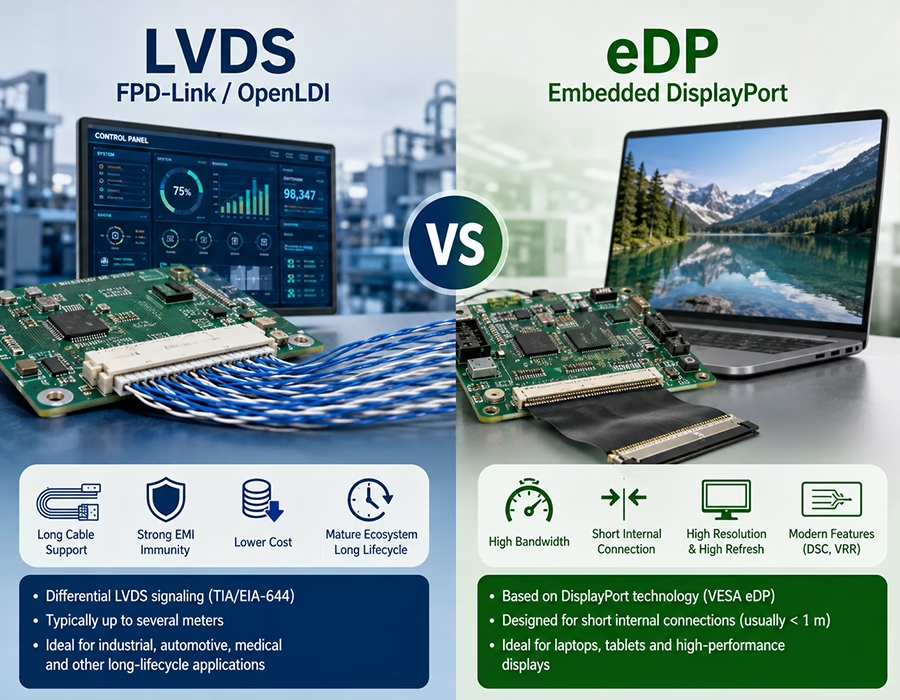
LVDS vs eDP at a Glance
The table below summarizes the LVDS vs eDP trade-off across the six factors that matter most for a TFT display design. Treat these as general, standards-referenced ranges rather than exact numbers. Always confirm final specs against your chosen panel and transceiver IC datasheet.
Quick Comparison Table
| Factor | LVDS (FPD-Link / OpenLDI) | eDP (Embedded DisplayPort) |
|---|---|---|
| Governing standard | Built on the LVDS electrical standard (TIA/EIA-644 / IEEE 1596.3); display implementations are commonly called FPD-Link or OpenLDI | VESA Embedded DisplayPort standard, based on DisplayPort |
| Typical bandwidth | Roughly 1.5 Gbps per differential pair in common single-link implementations. Multi-pair, dual-link chipsets can aggregate to several Gbps. This varies by transceiver chipset generation, so always check the specific IC’s datasheet | VESA’s published eDP 1.4b specification defines 4 HBR3 lanes at 8.1 Gbps/lane, for a theoretical maximum payload around 25.92 Gbps after 8b/10b coding overhead |
| Typical cable length | Commonly used from tens of centimeters up to several meters. Some dual-link/LDI implementations are documented up to roughly 10 m | Designed as a short internal connection, typically well under 1 m between the graphics source and the panel |
| EMI behavior | Differential signaling provides strong inherent noise immunity, which is why LVDS remains common in industrial and automotive environments | Also uses differential signaling with good noise immunity, but eDP usually runs inside a shielded chassis rather than as an external cable, so real-world EMI exposure differs by design |
| Ecosystem maturity / cost | Very mature, with broad multi-vendor silicon support and generally lower BOM cost. Long available product lifecycles are a common reason it remains standard in industrial and automotive designs with 10+ year lifecycles | Newer, higher-performance ecosystem centered on consumer computing (laptops, tablets). It’s more capable, but offers fewer long-lifecycle industrial options |
| Typical applications | Industrial HMI panels, machine vision monitors, automotive dashboards and infotainment, medical monitors, and embedded systems with longer or externally-routed cable runs | Laptops, tablets, all-in-one PCs, and other short-run internal display connections |
What Is LVDS?
IEEE 1596.3 and TIA/EIA-644 first defined LVDS (Low-Voltage Differential Signaling) as a general-purpose differential electrical signaling standard. For display applications, engineers most often implement it as FPD-Link or OpenLDI. FPD-Link is a naming convention that originated with Texas Instruments, while OpenLDI is the VESA-defined open version. Both layer a display-specific protocol — serialized pixel data plus clock — on top of the base LVDS electrical layer. When engineers say “LVDS cable for a TFT panel,” this is usually the interface they mean.
The underlying electrical standard has been in volume production since the late 1990s. As a result, LVDS/FPD-Link benefits from a deep, multi-vendor supplier base for transceiver ICs, connectors, and cable. That supply-chain depth is a major reason LVDS remains the default choice for industrial and automotive panels with long product lifecycles.
What Is eDP?
VESA adapted eDP (Embedded DisplayPort) from DisplayPort for embedded, internal display connections. VESA originally developed it to replace LVDS inside laptops and tablets. It carries more bandwidth per physical lane than typical LVDS implementations. That said, it uses a packetized protocol instead of LVDS’s simpler serialized-pixel approach. That protocol difference enables features like variable refresh rate and display stream compression. In practice, it also increases design complexity on both the source and sink side.
LVDS vs eDP: Bandwidth & Resolution
On paper, eDP wins the bandwidth comparison outright. VESA’s published link-rate specification gives it a clear advantage. That’s why eDP became the standard for high-resolution laptop and tablet panels. Engineers designed LVDS, by contrast, around the resolution and refresh-rate needs of industrial and automotive panels. Most LVDS implementations comfortably cover Full HD, and some multi-pair configurations reach higher resolutions still.
In practice, this LVDS vs eDP bandwidth gap rarely matters for industrial designs. If your project genuinely needs 4K or high refresh rates, eDP (or an alternative such as MIPI DSI) deserves evaluation. However, if your resolution requirement sits at Full HD or below, that’s not a real concern. LVDS bandwidth is very unlikely to become the limiting factor in your design.
LVDS vs eDP: Cable Length & Routing
Cable length is where these two interfaces diverge the most. VESA designed eDP for very short, fixed internal routing. That typically means the connection between a mainboard and a panel inside the same enclosure. Engineers, meanwhile, designed LVDS/FPD-Link with longer, sometimes external, cable runs in mind. Documented implementations extend to several meters, and some dual-link configurations reach roughly 10 m.
Does your panel sit any meaningful distance from its driver board? For example, think of a vehicle dashboard powered from a central unit. Similarly, picture an industrial control cabinet with a remote-mounted display, or equipment where the panel and controller live in separate enclosures. In each of these cases, LVDS remains the more proven option. It also typically needs simpler, lower-cost cable and connector hardware to route reliably over that distance.
LVDS vs eDP: EMI & Signal Integrity
Both interfaces use differential signaling, so both offer a real advantage over single-ended parallel interfaces in noise immunity. The deciding factor is rarely “which interface performs better in a lab.” Instead, it usually comes down to field track record for your specific environment. LVDS has a long, well-documented history in electrically noisy environments like automotive engine bays and industrial machinery. Widely available shielded twisted-pair and shielded ribbon cable constructions support that track record.
For a noisy or vibration-heavy application, cable shielding, connector selection, and impedance control matter just as much as the interface choice. Overall, see Custom LVDS Cables for the cable-level factors that affect real-world signal integrity.
LVDS vs eDP: Cost & Ecosystem Maturity
Multiple vendors broadly source LVDS/FPD-Link transceiver ICs, connectors, and cable, and they have done so for decades. This generally keeps bill-of-materials cost lower and supply risk lower for long-lifecycle industrial and automotive programs. eDP’s ecosystem, by comparison, is newer and centers on the consumer computing supply chain. That supply chain runs deep for consumer volumes. That said, it has historically offered fewer options specifically qualified for 10+ year industrial or automotive lifecycles.
In short, this cost and supply-chain gap is a common practical reason engineering teams still choose LVDS for new industrial and automotive designs. That holds true even though eDP is the more modern, higher-bandwidth standard.
When to Choose LVDS vs eDP
Use the table below as a quick decision guide once you understand the LVDS vs eDP trade-offs above.
| Your Situation | Recommended Interface |
|---|---|
| Panel is more than ~1 m from the driver board | LVDS |
| Design needs a 10+ year supply lifecycle with multi-vendor sourcing | LVDS |
| Application is industrial, automotive, or medical with a proven LVDS panel already qualified | LVDS |
| Panel and driver board share a short internal connection (laptop, tablet, all-in-one) | eDP |
| Project requires 4K, high refresh rate, or DisplayPort-native features (variable refresh, display stream compression) | eDP |
| You’re designing a new consumer computing product with access to the modern eDP supply chain | eDP |
Sometimes the decision isn’t clear-cut. For example, a ruggedized tablet or a compact industrial panel could technically work with either interface. In that case, the practical tie-breaker usually comes down to supply chain. Ask which interface your chosen panel already supports, and which one has qualified, long-lifecycle components available from your preferred suppliers.
FAQ
A: Yes. LVDS-to-eDP and eDP-to-LVDS bridge and converter ICs exist. Engineers commonly use them when a panel uses one interface but the available driver board uses the other. That said, this adds cost and board space. As a result, it’s usually only worth it when you can’t change the panel or driver board selection.
A: No. eDP has replaced LVDS in most modern laptops and tablets. That said, industrial, automotive, and medical display designs still widely rely on LVDS/FPD-Link, which remains in active production and support. Its long cable-length support, mature multi-vendor supply chain, and long product-lifecycle availability keep it relevant.
A: Not usually. Engineers typically route eDP as a very short internal connection inside a shielded enclosure. As a result, they rarely specify the external shielded-cable constructions that LVDS designs commonly use. If your eDP routing is unusually long or exits the enclosure, that changes the calculus. In that case, evaluate shielding and impedance control the same way you would for any high-speed differential interface. Overall, check your panel and connector supplier’s design guidelines too.
A: Common LVDS cable connectors include JAE, Hirose (DF13/DF14 series), Molex, and I-PEX, depending on the panel manufacturer’s design.
Need a custom LVDS cable built to your panel’s exact connector and pinout? Get a free engineering review and quote → Our team works from your BOM, drawing, or panel model number, and responds within 12 hours.
.avif)
Sam Wu is the Marketing Manager at Romtronic, holding a degree in Mechatronics. With 12 years of experience in sales within the electronic wiring harness industry, he manages marketing efforts across Europe. An expert in cable assembly, wiring harnesses, and advanced connectivity solutions, Sam simplifies complex technologies, offering clear, actionable advice to help you confidently navigate your electrical projects.