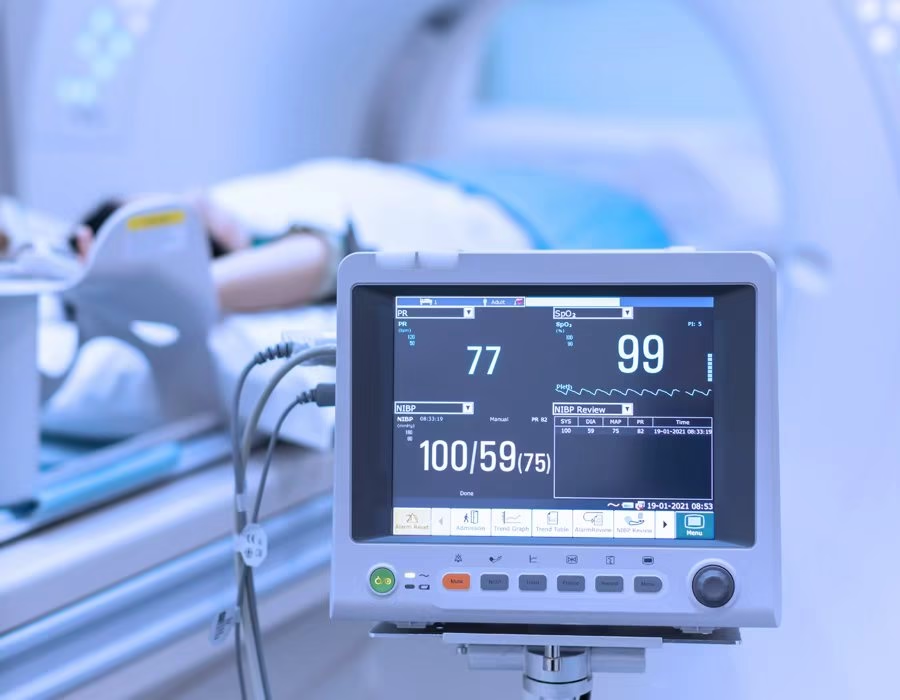
Modern bedside monitors are becoming smaller, smarter, and safer, mainly due to USB-C Power Delivery (PD).
By adopting a single USB-C connection for both power and data, medical device developers can simplify compliance, reduce design time, and enhance usability while meeting IEC 60601-1 safety standards.
💡 Looking for IEC 60601-1 certified USB-C solutions?
Romtronic offers medical-grade PD cable assemblies and adapters ready for compliance.
👉 Contact our team for details →
Key Takeaways
- Simplify power and compliance: Certified USB-C PD adapters already meet IEC 60601-1 isolation and leakage requirements.
- One cable, multiple functions: Power, data, and video can be shared through a single standardized interface.
- Reduce design risk: PD negotiation ensures automatic and correct voltage/current delivery.
- Future-proof integration: USB-C PD 3.1 supports up to 240 W for next-generation bedside equipment.
1. Why USB-C PD Matters in Medical Devices
Traditional bedside monitors used unique DC inputs and proprietary connectors. Each required its own set of adapters, cables, and safety certifications.
USB-C PD changes that. A single reversible cable may deliver up to 100 W (20 V × 5 A) with clever, bidirectional power negotiation. Devices request the voltage they require—5 V, 9 V, 15 V, or 20 V—and the adapter dynamically adjusts its output accordingly.
This versatility implies that a single medical-grade PD adaptor can safely power various monitor models.
2. How USB-C PD Works
Power Delivery incorporates a digital handshake layer into the USB-C specification.
When the cable is connected:
- The sink device (e.g., bedside monitor) sends a request for power.
- The source (adapter) confirms it can supply that level.
- Voltage and current ramp up safely after both ends agree.
Every authorized USB-C cable has an e-marker chip that indicates its rating (3A or 5A).
This prevents overcurrent and overheating, even when using higher-power PD 3.1 profiles (up to 240 W).
3. Meeting IEC 60601-1 Safety Requirements
IEC 60601-1 establishes a universal baseline for medical electrical safety.
Patient-connected equipment (Type BF or CF) must meet the following key requirements:
| Category | Requirement | Description |
|---|---|---|
| Isolation | 2× MOPP | Double insulation between input and output |
| Leakage Current | < 100 µA (BF) | Prevents current flow to patient contact points |
| Dielectric Strength | 3000–4000 VAC | Tested between AC input and DC output |
| Risk Management | ISO 14971 | Evaluates potential hazards in system design |
When you utilize a medical-grade USB-C PD adapter, these safeguards are already included.
For example, several 60 W–140 W USB-C PD adapters certified to IEC 60601-1 feature 2× MOPP isolation and minimal leakage (< 100 µA) by design.
That means your monitor’s internal electronics see only low-voltage DC.
You don’t need to install high-voltage isolation barriers inside the monitor, which saves board space, components, and compliance effort.
4. Cable and Connector Standards
A conventional USB-C connector contains 24 pins—including four VBUS and four ground contacts—to handle high currents safely.
It’s reversible, compact, and rated for up to 10,000 insertion cycles, making it ideal for daily use in hospitals.
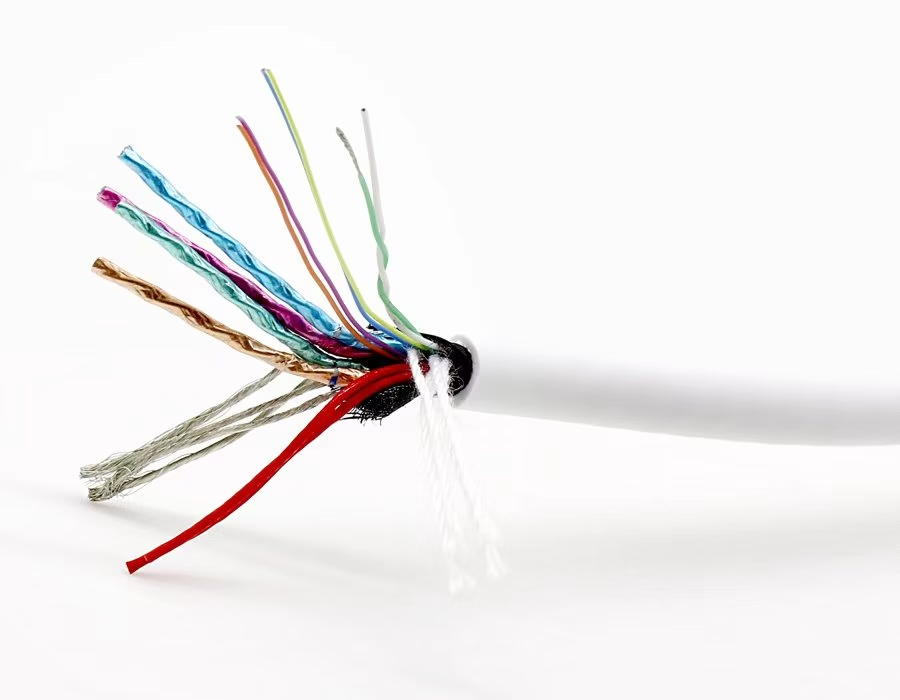
Medical-grade USB-C cables add:
- UL94 V-0 flame-retardant jackets
- Biocompatible insulation materials
- Double shielding to minimize EMI
- IEC 60601-1 (2× MOPP) certification
These characteristics assure patient safety and signal integrity.
A single USB-C PD cable may thus power a bedside monitor while also connecting diagnostic peripherals—all without compromising safety.
5. Simplifying Design and Compliance
With USB-C power delivery, compliance becomes modular:
- Power adapter → already tested to IEC 60601-1
- Cable assembly → tested to 2× MOPP and UL standards
- End device → needs only low-voltage verification
This section enables design teams to utilize approved components instead of conducting full-system high-voltage testing on each new model.
Other benefits:
- Lower leakage current: isolation handled externally by the adapter.
- Reduced EMC risk: shielded cables minimize noise coupling.
- Faster certification: shorter test cycles and documentation reuse.
⚙️ Need pre-certified medical cable assemblies?
Romtronic’s USB-C PD cables meet IEC 60601-1 and UL standards for safe, fast integration.
📩 Get in touch →
6. Power, Data, and Display in One Connection
In addition to electricity, USB-C supports data and video transmission via DisplayPort Alternate Mode.
This allows a bedside monitor or patient-vital device to transmit real-time data to a central station via the same connection that powers it.
Example: A handheld ECG module can charge and stream patient signals through a single USB-C link, reducing cable clutter at the bedside and simplifying disinfection.
As USB4 and Thunderbolt compatibility grow, developers can create medical interfaces that are ready for next-generation PD and data rates without having to redesign the port.
7. Implementation Guidance for Engineers
| Design Aspect | Recommendation |
|---|---|
| Power Input | Use off-the-shelf IEC 60601-1 certified USB-C PD adapters (≥ 2× MOPP) |
| Cable | Choose medical-grade, e-marked 5 A USB-C cables with shielding |
| PD Controller | Integrate a sink controller IC (e.g., STUSB4500 or Cypress CYPD3177) |
| EMI/ESD | Add ferrite beads and common-mode filters near the USB-C receptacle |
| Risk Analysis | Follow ISO 14971 to document residual electrical and mechanical risk |
This checklist technique minimizes both time to market and safety-testing costs.
8. Frequently Asked Questions
A: No, only adapters with IEC 60601-1 certification and validated leakage limits are appropriate for patient situations.
A: Yes. Medical cables require passing two MOPP dielectric tests, insulation thickness checks, and flammability testing (UL 94 V-0).
A: Use certified PD modules, verify system leakage, and maintain documentation in accordance with ISO 14971 and IEC 60601-1 Clause 4.
A: Choose double-shielded cables to isolate noisy digital lines. Certified PD adapters already meet the EN 60601-1-2 EMC restrictions.
9. Final Thoughts
USB-C PD technology is altering the medical power architecture, not only streamlining consumer gadgets. For bedside monitors, it provides:
- A single, reversible, standardized interface
- Reduced electrical risk through modular compliance
- Faster product certification
- Improved user experience at the point of care
In summary, USB-C PD makes bedside monitor design safer, more efficient, and future-ready, according to IEC 60601-1.
✅ Explore Romtronic’s certified USB-C PD cable assemblies for medical and smart devices.
🔗 Visit Romtronic’s Medical Solutions page →
.avif)
Sam Wu is the Marketing Manager at Romtronic, holding a degree in Mechatronics. With 12 years of experience in sales within the electronic wiring harness industry, he manages marketing efforts across Europe. An expert in cable assembly, wiring harnesses, and advanced connectivity solutions, Sam simplifies complex technologies, offering clear, actionable advice to help you confidently navigate your electrical projects.