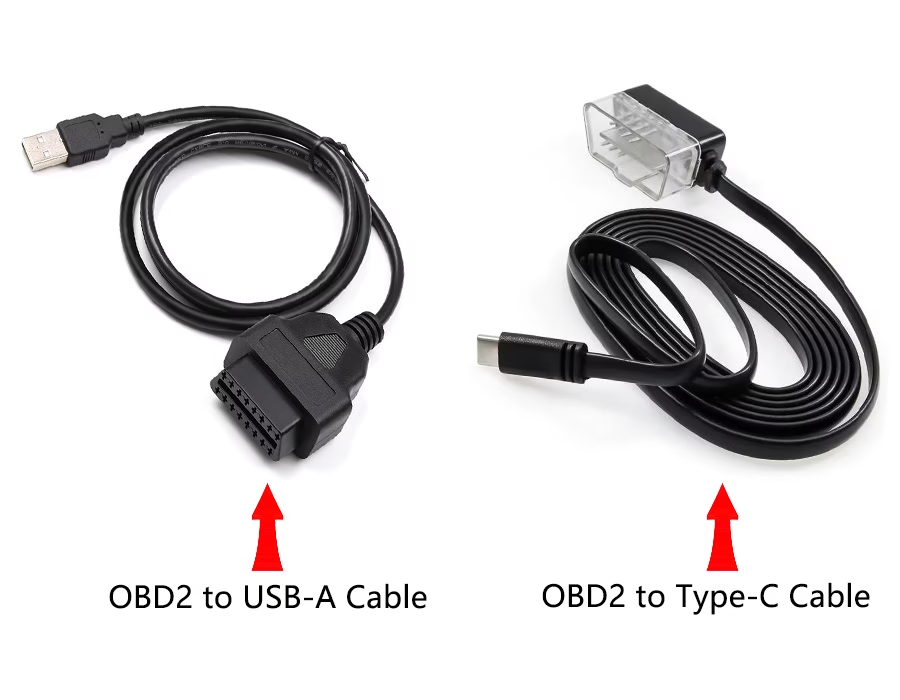
The current trend in the medical devices industry is that USB Type-C cables aren’t just another accessory; they have become an important piece of hardware in clinical settings for OEMs (Original Equipment Manufacturers) and procurement teams. A small device, such as a USB controller, can deliver power consistently, transfer data at high speeds, ensure patient safety, meet EMC (Electromagnetic Compatibility) regulations, and continue to function reliably long after installation in a patient’s home.
As you develop any portable diagnostic device, such as a patient monitor or imaging device, your choice of components is extremely important. To maintain high-quality connectivity with your products, consider which type of medical-grade USB Type-C cable supplier you will work with; it will directly affect the quality of your products, the time it takes to complete your FDA or CE certification, and your Total Cost of Ownership (TCO).
Finding an average manufacturer for bulk sourcing is only one of the challenges that procurement managers face. Plenty of facilities can create molded standard USB-C wires with ease, but that’s not where the real challenge lies — the true challenge is finding a manufacturer that specializes in medical devices or equipment. To that end, you must have a manufacturer with experience in medical compliance, rigorous process validation, low defect rates in high-mix, low-volume (HMLV), and full component traceability.

This comprehensive guide outlines and clarifies the critical engineering, materials science, and compliance criteria that OEM purchasing agents should use in their evaluation process. In addition to this guide, you will find several other helpful resources in this post with the information you need to source certified medical-grade Type-C cables in bulk by 2026.
Why Medical Grade USB Type-C Cables Are Fundamentally Different
A standard consumer smartphone and a medical-grade Type-C cable will look alike at first glance; they share similarities, such as being a standard, generic 2m USB-C to USB-C cable typically used in a corporate IT environment.
However, the internal engineering, materials science, and manufacturing protocols used in the production of a medical-grade Type-C cable are of a completely different standard from those used in the manufacture of a consumer or standard commercial-grade cable.
In a hospital, ICU, or clinical environment, the failure of just one cable can cause significant problems, such as interruptions to critical diagnostics, corrupted patient data sent to/from the device, and costly equipment downtime. Therefore, the performance vectors of medical devices must be significantly higher than those of both consumer and standard commercial-grade cables.
Micro-Ampere Leakage Current Control
To maintain compliance with stringent patient safety standards, medical equipment manufacturers must limit leakage currents to microamperes through superior dielectric insulating materials and precision shielding. Shielding systems provide complete protection from microelectric shock for the patient and operator alike, even during a single-fault condition.
ISO 10993 Biocompatibility Compliance
Compared to consumer grade cables, which tend to have low-cost PVC jacketing that frequently contains restricted phthalates or other toxic plasticizers, cables made for the medical market use only biocompatible materials (medical grade) such as TPE, TPU, or modified Silicone, all of which meet strict ISO 10993 standards, thereby passing cytotoxicity, skin sensitization, and intracutaneous irritation tests when used for direct or indirect patient contact.
Sterilization and Chemical Resistance
Clinical cables are frequently deployed in environments where frequent chemical wiping is required to maintain hygiene standards. During routine equipment cleaning and disinfection, healthcare professionals use a variety of chemical agents; isopropyl alcohol, hydrogen peroxide, and high-concentration chlorine-based solutions are just a few examples. In such environments, conventional cable jacket materials often exhibit degradation, cracking, yellowing, or surface tackiness. In contrast, certified medical-grade jacket materials retain their original mechanical properties and physical characteristics, even after repeated sterilization cycles.
Advanced 360° EMI/RFI Shielding
Operating rooms constitute high-density electromagnetic environments, housing a concentration of high-frequency surgical equipment—such as electrosurgical units, ventilators, and telemetry monitors. Consequently, for medical-grade USB-C cables, achieving comprehensive 360° shielding termination is paramount. This concept typically entails combining a wrapped copper foil layer with a high-coverage copper braid shield, with the braid extending across at least 85% of the cable’s length. This combined 360° shielding design effectively prevents signal distortion, thereby ensuring absolute data integrity.
Key Certifications and Compliance Frameworks to Verify
When choosing wholesale USB-C cable suppliers for healthcare environments, words alone won’t suffice. The phrase’ medical grade’ can be misleading marketing jargon, so purchasing teams need to confirm multiple levels of international compliance and audit documentation.
1. ISO 13485 Quality Management System
This standard is the baseline minimum for the industry. Therefore, any compliant supplier should have an active ISO 13485 certificate. An ISO 13485 certificate confirms that the entire ecosystem within which the company’s products were manufactured has been legally established as a medical device component. This system covers everything from incoming materials inspection (also known as “IQC”) to processing in a cleanroom. Therefore, it serves as a guarantee of strict revision control, risk management, and production consistency across large product volumes.
2. IEC 60601-1 Electrical Safety Support
Your choice of cable assembly directly influences your finished medical device approvals. Specifically, it affects compliance with IEC 60601-1 and IEC 60601-1-11 for home healthcare environments. The cable design must support the device’s Means of Patient Protection (MOPP) and Means of Operator Protection (MOOP) requirements. This goal is achieved through appropriate insulation and precise creepage distances.
3. USB-IF Protocol Compliance & Smart Power Delivery (PD)
Modern medical hardware increasingly leverages USB-C for high-wattage charging. Many systems require up to 100W or even 240W via USB PD 3.1. In addition, they require high-bandwidth data. Therefore, the cable must integrate high-quality, heat-resistant E-Marker chips certified by the USB-IF. Uncertified chips can cause catastrophic thermal overruns, voltage negotiation failures, or power fluctuations.
4. Environmental and Chemical Traceability
Compliance with global eco-directives remains mandatory. Therefore, ensure the factory provides verifiable, up-to-date declarations for RoHS 3.0 and REACH. They must also provide documentation for Conflict Minerals and Halogen-Free mandates where required.
Critical Engineering Factors in Medical Type-C Cable Design
Bulk sourcing decisions should never be based on price alone. On the contrary, medical cable failures are usually caused by hidden design weaknesses. These flaws often appear only after deployment in the field. Therefore, buyers should focus on these critical engineering details during evaluation.
Strain Relief and High-Flex Durability
Cables attached to portable medical carts or surgical robots endure constant stress. Handheld diagnostic tools or adjustable equipment also cause continuous bending, pulling, and twisting. Unfortunately, a poorly designed strain relief (SR) is the leading cause of premature failure. Therefore, ensure that your supplier performs rigorous bend-cycle testing. They should also customize the SR durometer and geometry to match your device’s exact mechanical routing.
Precision Overmolding & Industrial Locking Mechanisms
High-quality medical overmolding requires precision mold alignment. This step successfully eliminates internal wire stress at the solder joints. Otherwise, flash, voids, or uneven gating can allow moisture or sanitizing fluids to ingress. This ingress leads directly to latent short circuits. For demanding clinical environments, look for suppliers that offer IP67/IP68 waterproofing. They should also offer screw-locking or retention mechanisms to prevent accidental disconnections.
Connector Hardware Integrity
The connector head itself must be built to industrial-grade standards. Specifically, you should verify the quality of the 24-pin mid-mount or surface-mount Type-C male connector. Ensure that the contacts feature sufficient gold plating. This plating allows the component to withstand rigorous salt-spray testing. Furthermore, it helps maintain stable impedance over 10,000+ mating cycles.
Alternative Sourcing for Component EOL Risks
Many medical designs specify premium connectors from global brands such as Hirose, JST, and Molex. However, extended lead times or sudden End-of-Life (EOL) notices can freeze your production line. Therefore, a superior manufacturing partner must have strong engineering capabilities. They should be able to source or develop fully equivalent, high-quality compatible connectors. Consequently, this de-risks your supply chain and lowers Serial Production Costs (NRE) by 20% to 40%.
Why 100% Quality Assurance and Traceability Matter
Statistical random sampling (AQL), which is widely used in consumer electronics manufacturing, poses a significant compliance risk to manufacturers of medical cables; as a result, two of the industry’s leading manufacturers (e.g., TE Connectivity and Molex) require 100% inspection of every Type-C cable manufactured in mass production.
Every bulk-produced Type-C cable must complete three mandatory inspection processes:
- Continuity and Hi-Pot Testing: This process determines that the wiring is absolutely accurate and that the dielectric insulation has passed its Hi-Pot test
- Advanced Signal Integrity Verification: During this verification, technicians will use either TDR (Time-Domain Reflectometry) or Network Analyzers to ensure 0% packet loss and impedance control with absolute precision.
- AOI-Validated Crimping: The manufacturing facility uses AOI to verify wire stripping, crimp height, and solder joint integrity before the final overmolding.
Additionally, all production lots are tracked using a robust traceability system, typically managed via a sophisticated Manufacturing Execution System (MES). In the event of a field failure many years later, the retrieval of the following critical information can be accomplished in a very short period of time with this system: the exact raw material batch used for the manufacture of the device; the specific operator that manufactured the device; the manufacturing date of the device; and the final inspection report associated with the device.
Sourcing Strategy: Navigating the HMLV vs. Mass Production Dilemma
A common bottleneck for medical OEMs involves manufacturing scale. Specifically, major consumer cable conglomerates often refuse to support custom modifications. They also struggle with High-Mix Low-Volume (HMLV) production schedules. Conversely, small assembly shops lack the proper certification infrastructure. They often miss the engineering depth and testing equipment required for medical-grade hardware.
Therefore, the ideal sourcing strategy is to partner with a flexible, mid-sized direct manufacturer. They should offer an integrated path from prototyping to mass replication.
Rapid Prototyping Support
The supplier should be agile enough to provide 1–3 units of engineering samples or prototypes. These samples should be based on your raw schematics or pinout definitions. Consequently, this allows for early-stage bench testing and DFM validation.
Flexible MOQ and Scalability
Your partner must have the flexibility to handle small-batch custom production runs without massive minimum-order hurdles. However, they must also retain the capacity to scale to tens of thousands of units as your product gains global market share.
Design for Manufacturing (DFM) Collaboration
A true partner does not just unthinkingly take your drawing. On the contrary, their engineering team should actively analyze your layouts. This analysis helps optimize shielding structures, recommend cost-effective equivalent materials, and improve overall harness routing.
Conclusion
In conclusion, bulk sourcing certified medical-grade Type-C cables is a quality-driven strategic decision. It is never a simple procurement transaction. Therefore, aligning your supply chain with the right partner is critical. You need a manufacturer that masterfully balances international medical standards, rigorous signal integrity validation, material biocompatibility, and transparent component traceability to de-risk your device launch.
Partner with Romtronic for Custom Medical Cable Solutions
At Romtronic International Co., Limited, and our state-of-the-art manufacturing facility, Dongguan Hundu Electronic Co., Ltd., we offer clients 29 years of specialized industry experience in providing high-stakes B2B connectivity. As an HMLV Specialist (High-Volume/Low-Volume) and Expert in Small Batch Customization, we close the gap between rigid engineering standards and flexible manufacturing solutions.
We work with OEMs (Original Equipment Manufacturers) globally to supply certified custom cable assemblies and wire harness solutions to established requirements:
- Full Compliance: We support your requirements for ISO 13485, IEC 60601-1, and ISO 10993 by operating under structured quality frameworks.
- Advanced Testing Suite: Each medical assembly is 100% inspected, including AOI-validated crimping, continuity testing, Hi-Pot safety validation, and high-frequency TDR Signal Integrity Testing.
- Engineering-First Customization: We provide unique locking medical Type-C Connectors, right-angle overmold components, and ultra-flexible Medical TPE/TPU Jacketing options. Furthermore, we can provide alternative sourcing for components to mitigate end-of-life (EOL) risks for connectors.
- End-to-End Traceability: Our team has full lot control, transparent traceability for materials, and documented records through manufacturing execution (digital production records).
Whether you need 1-3 prototypes to validate your new clinical device or 1,000 certified medical USB-C cables for serial production, Romtronic will deliver precision without the chaos.
Contact our engineering and sales teams today to submit your drawings, pinout schematics, or custom RFQ specifications. Get a professional engineering assessment and optimized bulk quotation within 24 hours.
Explore our high-reliability capabilities at Romtronic | Professional Cable Assembly & Wire Harness Manufacturer
.avif)
Sam Wu is the Marketing Manager at Romtronic, holding a degree in Mechatronics. With 12 years of experience in sales within the electronic wiring harness industry, he manages marketing efforts across Europe. An expert in cable assembly, wiring harnesses, and advanced connectivity solutions, Sam simplifies complex technologies, offering clear, actionable advice to help you confidently navigate your electrical projects.