


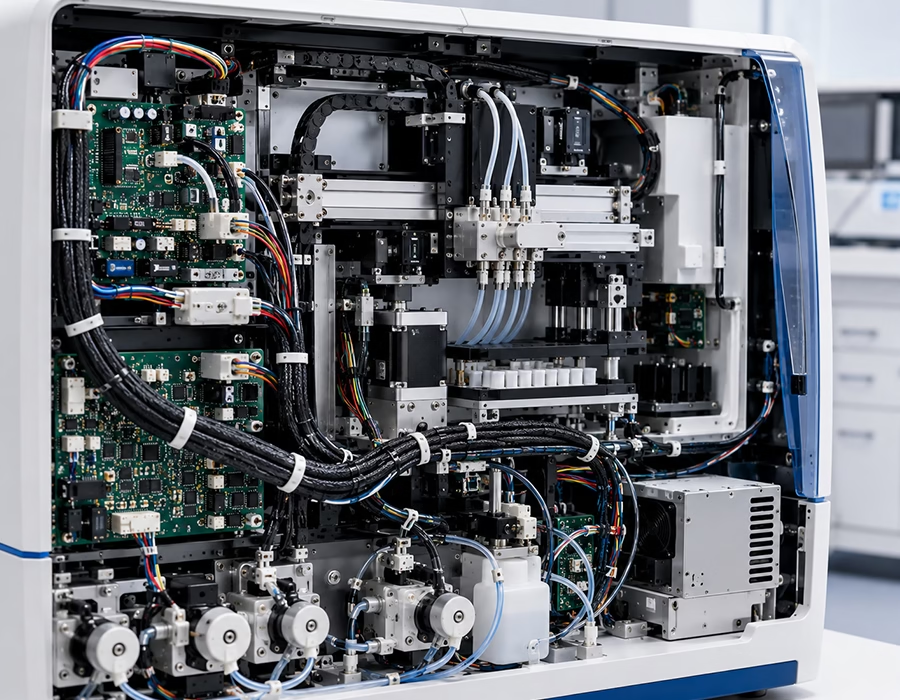
High-Density Signal Resolution and Precision Automation Control
In clinical chemistry and in-vitro diagnostics (IVD), every laboratory analyzer depends on rock-solid baseline stability. That’s true whether you’re building high-throughput immunoassay systems, mass spectrometers, or automated liquid handlers. Even a tiny microvolt spike of electromagnetic interference can skew an optical density or peak reading. That small electronic hiccup can quickly turn into a corrupted test result and a wasted sample re-run.
We design and manufacture laboratory analyzer wire harnesses specifically to prevent that. Our custom interconnects are built for high-density space optimization, clean signal-to-noise ratios, and constant mechanical movement.
We also bring 29 years of OEM/ODM experience to laboratory instrument projects. As a high-mix, low-volume (HMLV) contract manufacturer, we take the procurement headache off your plate. We turn your complex multi-conductor wiring schematics into fully validated, production-ready internal sub-assemblies.
- ISO 13485:2016 certified facility. Every laboratory analyzer assembly is built and audited under strict medical device quality management systems.
- IPC-A-620 Class 3 artistry. All high-density crimping, ribbon wire insulation displacement, and micro-soldering meet the highest international electronics standard.
- Three-gate testing, every unit. We run a 100% post-termination optical sweep, a 100% post-assembly electrical check, and a final 100% functional serialization.
- Chemical and reagent resistant. Our custom-selected jackets shrug off accidental contact with aggressive clinical reagents, solvents, and cleaning buffers without degrading.
Technical Specifications and Manufacturing Matrix
| Parameter | Manufacturing Capability | Validation / Material Standards |
|---|---|---|
| Artistry standard | IPC/WHMA-A-620 Class 3 (high-reliability) | Certified IPC workmanship |
| Quality management | ISO 13485:2016 medical QMS | Third-party audited and documented |
| Connector compatibility | Micro-Fit, AMP, JST, high-density D-Sub, card-edge | Compatible with Molex, TE, Hirose, Samtec, or custom overmolds |
| Conductor architecture | Discrete hook-up wire, shielded twisted pairs, ribbon cables | High-strand-count copper alloys down to 32 AWG |
| Integrated fluidics | Combined electrical lines + polyurethane/Teflon tubing | Co-axial fluidic-electric hybrid routing |
| Shielding performance | 95%+ coverage (braided tinned copper + aluminum foil) | Minimizes cross-talk near high-voltage power supplies |
| Mechanical dynamics | XYZ-axis robotic gantry drag-chain rating | High-flex lifecycle validated, millions of cycles |
| Functional verification | Cirris automated continuity and insulation testing | Precision resistance measurement for sensor accuracy |
Seven Laboratory Analyzer Segments We Build For
We design, tool, and assemble interconnects across seven major laboratory analyzer categories:
- In-vitro diagnostics (IVD) and clinical chemistry harnesses. High-density wire trunks route power and logic signals through complex processing centers, with structured routing that keeps sensitive sensor data separate from noisy motor lines.
- Chromatography and mass spectrometry cabling. Ultra-low-noise assemblies with multi-layered copper shielding protect ultra-weak ion-detector signal currents from surrounding radiofrequency noise.
- Automated liquid handler and pipetting harnesses. High-flex drag-chain cables travel continuously along XYZ axes, keeping power and data delivery steady through relentless robotic sample transfer.
- Hematology and flow cytometry sensor links. High-speed data interconnects carry real-time optical pulse data from laser sensors to processing boards, preserving microsecond cell-counting resolution without latency.
- Centrifuge and sample preparation power lines. Heavy-duty, vibration-resistant cable structures stay anchored through extreme G-force environments and high-speed balancing cycles.
- DNA/RNA sequencer signal interconnects. High-density, multi-position ribbon and micro-coaxial configurations fit tight enclosure spaces while holding signal integrity across multi-layer motherboard links.
- Reagent management and microfluidic valve wiring. Low-voltage control loops interface with delicate solenoid valves and fluidic pumps, built specifically for corrosive chemical control environments.
The Romtronic Medical Engineering Standard
We run Design for Manufacturability (DFM) reviews on every print before tooling starts. That’s how we catch the common laboratory analyzer failure modes early, instead of discovering them after production.
Eliminating Cross-Talk Between Motors and Sensors
Automated analyzers pack high-current stepper motors right next to sensitive microvolt optical sensors. To handle this, we use twisted-pair spacing and isolated shield drain lines. That design keeps the data path clean and stops false sensor triggers and calibration drift before they start. (More on the tradeoffs between copper and aluminum foil shielding, if you want the deeper mechanics.)
Surviving XYZ Drag-Chain Mechanical Fatigue
Robotic gantries put internal wiring through relentless bending, pulling, and twisting. So we source premium high-flex tinsel wire and low-friction insulation jackets, using the same physics behind flex cabling engineered for millions of cycles on collaborative robot arms. This spreads mechanical stress evenly and keeps copper strands from fracturing over millions of cycles. Getting the bend radius right in the initial routing matters just as much as the wire itself, and for drag chain applications specifically, our notes on PUR vs. TPE jacketing cover which one actually holds up longer.
Frequently Asked Questions
A: Micro-Fit, AMP, JST, high-density D-Sub, and card-edge connectors are the most common choices, and most laboratory analyzer builds are compatible with Molex, TE, Hirose, or Samtec parts, or a fully custom overmold if space is tight.
A: This is almost always electromagnetic cross-talk between high-current stepper motors and nearby microvolt-level optical sensors. Twisted-pair spacing and isolated shield drain lines are the standard fix, keeping the noisy motor lines from bleeding into sensitive sensor data.
A: Laboratory automation drag-chain cable typically needs a rating in the millions of cycles, since XYZ robotic gantries move continuously during sample transfer. Under-specifying this is one of the most common causes of premature wiring failure in automated liquid handlers.
A: Yes, in almost every case. Analyzer cabling routinely sees accidental exposure to reagents, solvents, and cleaning buffers. So the jacket material must resist chemical attack without degrading or cracking over the life of the instrument.
A: High-strand-count copper alloy conductors down to 32 AWG are common, especially in DNA/RNA sequencers and other space-constrained analyzers where multiple signal and power lines have to fit inside a tight enclosure.
A: Yes, if the harness is part of a regulated in-vitro diagnostic device. ISO 13485 certification on the manufacturing side gives you the documented quality management trail that regulatory submissions typically require from every component supplier, wiring included.
Engage With Our Medical Engineering Hub
Let’s optimize your laboratory analyzer interconnect architecture. Whether you’re dealing with calibration drift from signal noise, drag-chain cable failures, or you’re prepping to launch a new diagnostic platform, don’t leave your automated interconnects to guesswork.
Upload your 2D wire schematics, manufacturing drawings, or BOM directly to our Engineering Hub. Our team of 12 dedicated wiring engineers will audit your project, and we’ll send a comprehensive technical quote within 24 hours.
If your platform also touches broader medical device wiring standards, our guide to medical wire harness standards and certifications is worth a read. And for adjacent clinical instrument categories, our page on diagnostic imaging equipment interconnects covers similar precision engineering ground.