


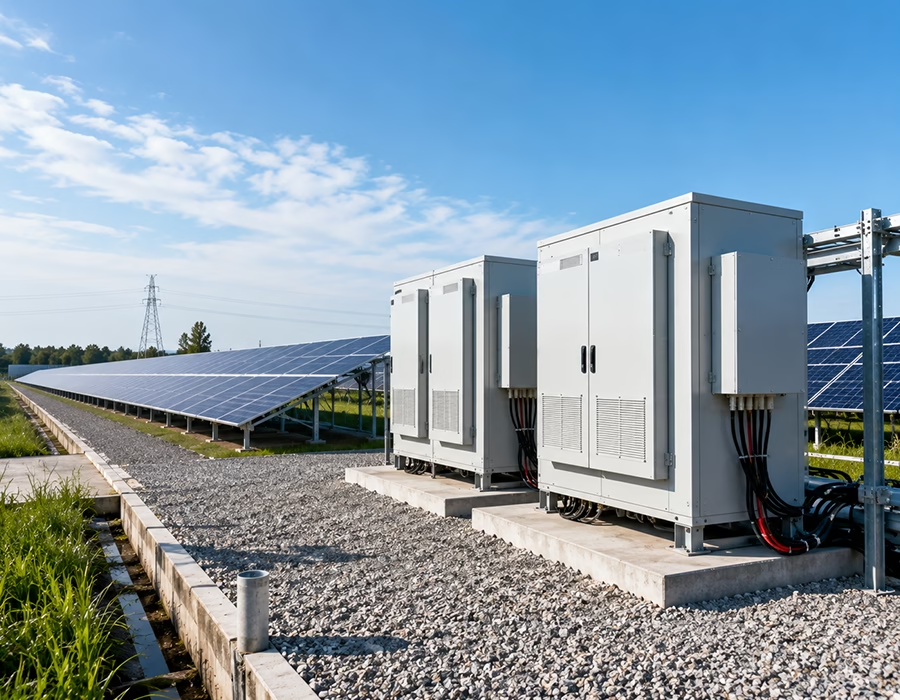
Twenty-Five Years Outdoors Is the Baseline, Not the Goal
A solar PV inverter sits outside for its entire service life, usually with a 25-year warranty riding on it. That means the cabling inside and around it has to survive decades of direct UV exposure, daily thermal cycling, and high DC voltages, without a single field failure quietly cutting into system output.
We design and manufacture cable assemblies specifically for solar PV inverter and balance-of-system applications. Our custom interconnects cover internal inverter wiring, string and combiner cabling, and outdoor communication harnesses, all built for long-term UV and thermal survival.
We bring 29 years of OEM/ODM experience to renewable energy projects. As a high-mix, low-volume (HMLV) contract manufacturer, we handle everything from a single custom inverter harness to a full balance-of-system cabling kit, so integrators aren’t stuck sourcing parts from five different vendors per project.
- ISO 9001 factory validation. Every solar PV inverter assembly runs through our certified quality pipeline before it ships.
- UL 4703 rated PV wire. Our conductors meet the primary safety standard for photovoltaic wire, rated for 600V to 2000V and 25+ years of UV exposure.
- IPC-A-620 Class 2/3 workmanship. DC connector crimping, internal inverter harness assembly, and overmolding all meet a documented, repeatable quality standard.
- Full electrical safety testing. We run hi-pot, continuity, and polarity verification on every finished assembly, since a reversed DC connector can create a dangerous arc fault.
Technical Specifications and Manufacturing Matrix
| Parameter | Manufacturing Capability | Validation / Material Standards |
|---|---|---|
| Workmanship standard | IPC/WHMA-A-620 Class 2/3 | Certified IPC workmanship |
| Quality management | ISO 9001 factory certified | Third-party audited and documented |
| PV wire conductors | UL 4703 rated, XLPE insulation | 600V-2000V, sunlight resistant, 90°C-150°C rated |
| DC connector types | MC4, MC4-Evo, Amphenol H4 | Torque-controlled, corrosion-resistant plating |
| Internal inverter wiring | UL 1015/1028, flame-retardant PVC or XLPE | Handles internal DC bus and AC output distribution |
| Communication cabling | RS-485, CAN bus, Modbus TCP links | Shielded twisted pair for monitoring and grid-tie control |
| Environmental sealing | IP65/IP67 cable glands and connector boots | Rated for outdoor enclosure penetration |
| Functional verification | Hi-pot, continuity, and polarity testing | Full traceability per batch |
Six Solar PV Inverter Cabling Types We Build For
We design, tool, and assemble interconnects across six core categories for solar PV inverter systems:
- Internal inverter wiring harnesses. DC bus bar connections, IGBT driver cabling, and internal AC output wiring inside the inverter enclosure, built to handle continuous thermal cycling from power electronics.
- PV string and DC combiner cabling. UL 4703-rated cable, terminated with MC4 or Amphenol H4 connectors, routes power from panel strings into combiner boxes and on to the inverter’s DC input.
- AC output and grid-tie cabling. Cabling from the inverter’s AC terminals to the grid-tie disconnect, sized and rated for continuous outdoor exposure and local code compliance.
- Monitoring and communication harnesses. RS-485, CAN bus, or Modbus TCP links connect inverters to monitoring platforms and central plant controllers, often daisy-chained across dozens of units.
- Rapid shutdown and safety disconnect wiring. Dedicated signal cabling for module-level rapid shutdown devices, built to meet code requirements for de-energizing rooftop arrays during emergencies.
- Grounding and bonding cable kits. Equipment grounding conductors and bonding jumpers protect inverter electronics and personnel from fault currents and induced surges.
Two Failure Modes We Design Every Inverter Harness Around
UV and Thermal Cycling Degradation of Outdoor Jacketing
Standard PVC insulation embrittles and cracks under years of direct UV exposure, especially combined with the daily heat-cool cycling an outdoor inverter enclosure goes through. Once a jacket cracks, moisture gets in, and that’s when a clean installation turns into a field service call years into a system’s life.
We control this with UL 4703-rated XLPE insulation on all outdoor DC wiring, plus UV-stabilized jacket compounds on internal harnesses that see enclosure heat. That combination is built to outlast the inverter’s own 25-year warranty period, not just meet it on paper.
DC Arc Faults from Connector Mismatch or Reversed Polarity
High-voltage DC doesn’t behave like AC when a connection fails. A DC arc, once it starts, can sustain itself and cause serious equipment damage or fire risk, and it’s often triggered by a cross-mated connector brand or a reversed-polarity termination that should have been caught during assembly.
We prevent this with torque-controlled MC4 and Amphenol H4 crimping, 100% polarity verification on every finished cable, and connector sourcing that avoids the cross-brand mating issues known to cause loose, arc-prone connections in the field.
Frequently Asked Questions
What wire standard applies to solar PV inverter cabling?
UL 4703 is the primary standard for single-conductor photovoltaic wire in North America, covering ratings from 600V to 2000V with sunlight-resistant XLPE insulation rated for 25+ years of outdoor exposure. It’s the standard most integrators specify for string and DC combiner cabling.
Why does solar cable insulation crack after a few years outdoors?
This usually comes down to using standard PVC-insulated wire instead of UV-rated PV wire. Standard insulation embrittles under constant UV exposure and daily thermal cycling, eventually cracking and letting moisture into the conductor. UL 4703-rated XLPE insulation is specifically engineered to resist this.
What causes DC arc faults in solar inverter systems?
Most DC arc faults trace back to a loose or degraded connection, often from cross-mating connectors between different brands, or a reversed-polarity termination that wasn’t caught during installation. Torque-controlled crimping and 100% polarity testing during manufacturing are the standard ways to prevent this at the source.
What connector type is standard for PV string cabling?
MC4 connectors are the industry standard for panel and string-level DC connections, though some manufacturers use proprietary variants like MC4-Evo or Amphenol H4. Mixing connector brands is a known cause of loose, high-resistance connections, so matching connector types across a string matters.
Do inverter monitoring cables need to be shielded?
Yes, in most installations. RS-485, CAN bus, and Modbus TCP links running between inverters and monitoring equipment are vulnerable to electrical noise from nearby DC switching and power electronics, so shielded twisted pair is the standard choice to keep monitoring data reliable.
Why does rapid shutdown wiring need its own dedicated cabling?
Rapid shutdown systems have to reliably de-energize a rooftop array within seconds during an emergency, which means the signal cabling needs to be electrically isolated and reliable independent of the main power wiring. Dedicated, code-compliant cabling is what makes that guarantee possible.
Put Our Solar PV Inverter Cabling Team to Work
A 25-year warranty leaves zero room for cable that fails at year five. Whether you’re building a new string inverter line, retrofitting a central inverter platform, or standardizing cabling across a utility-scale project, we can help.
Upload your inverter wiring diagrams, connector specs, or BOM directly to our Engineering Hub. Our team of 12 wiring engineers will run a full DFM audit and get a clean production quote back to you within 24 hours.
For our broader solar cable assembly product range beyond inverter-specific wiring, our custom solar cable assemblies and wire harnesses page is a good companion read. For navigation and tracking sensor work, our patient monitoring systems page is a related read too.