


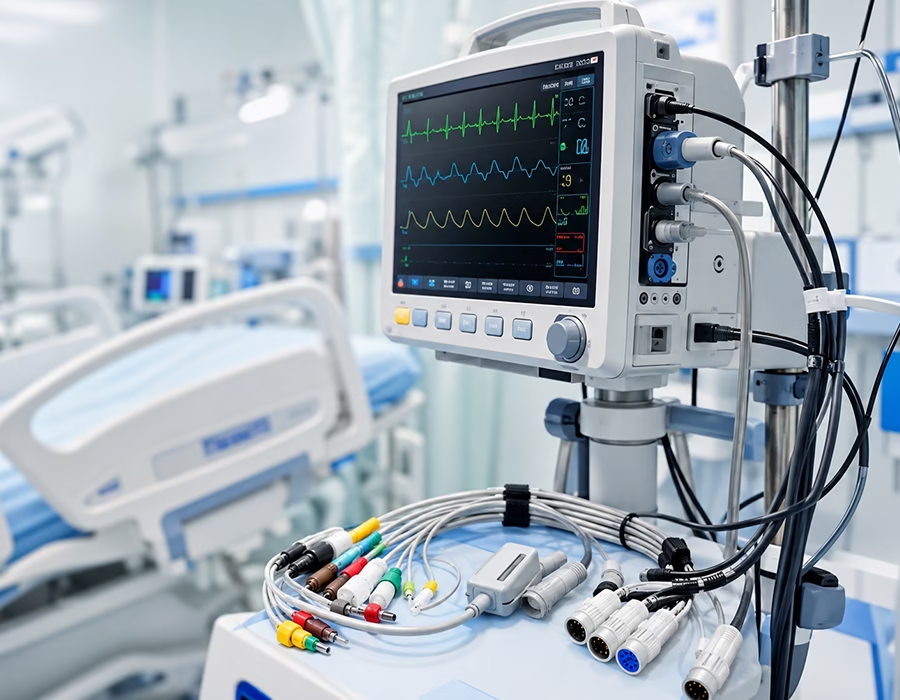
Clinical-Grade Signal Integrity Where Every Millisecond Counts
In critical care, a patient monitoring system must transmit data flawlessly, whether it’s running in a high-acuity ICU or moving in a medical transport vehicle. A single dropped packet or microvolt baseline drift can trigger a false alarm, and that disruption can directly delay a life-saving clinical intervention.
We design and manufacture medical-grade patient monitoring cables specifically to prevent that. Our custom sensor interconnects are built for absolute signal isolation, biocompatibility, and mechanical survival.
We also bring 29 years of OEM/ODM experience to patient monitoring system projects. As a high-mix, low-volume (HMLV) contract manufacturer, we simplify your production. We turn complex electrophysiological concepts into fully validated medical sub-assemblies.
- ISO 13485:2016-certified facility. Every product is built and audited under strict medical device quality management systems.
- IPC-A-620 Class 3 workmanship. All soldering, crimping, and insulation displacement meet the highest international standard for high-reliability medical electronics.
- Three-gate testing, every unit. We run a post-termination optical sweep, a post-overmold dielectric test, and a final functional serialization on every assembly.
- Disinfection-hardened jackets. Our custom-formulated medical TPU and silicone outer jackets survive relentless wiping with 70% isopropyl alcohol, glutaraldehyde, and bleach solutions without cracking.
Technical Specifications and Manufacturing Matrix
| Parameter | Manufacturing Capability | Validation / Material Standards |
|---|---|---|
| Workmanship standard | IPC/WHMA-A-620 Class 3 | Certified IPC workmanship |
| Quality management | ISO 13485:2016 medical QMS | Third-party audited and documented |
| Connector compatibility | Circular push-pull, D-Sub, Micro-D, latching air | Compatible with Lemo, ODU, Molex, TE, Tyco, or custom overmolds |
| Conductor materials | Ultra-flex tinsel wire, silver-plated copper alloy | 26 AWG to 34 AWG, high-strand count |
| Biocompatibility range | ISO 10993 compliant materials | Non-cytotoxic, hypoallergenic skin-contact polymers |
| Ingress protection (IP) | Rated up to IPX7 | Fluid-tight sealed yokes and strain reliefs |
| Shielding architecture | Double-shielded, 95%+ braided copper + conductive foil | Triboelectric noise layer with carbon-coated liners |
| Functional verification | Automated Cirris hi-pot and continuity testing | High-voltage dielectric insulation tests up to 5000V DC |
Seven Patient Monitoring Segments We Build For
We design, tool, and assemble interconnects across seven major patient monitoring system categories:
- Multi-lead ECG and EKG trunk cables. Shielded trunk lines capture microvolt cardiac potentials without baseline drift, and we can embed defibrillation-proof resistors (roughly 1 kΩ to 10 kΩ) inside the overmold to protect monitoring hardware.
- Pulse oximetry (SpO2) sensor links. Ultra-flexible extension leads with low-insertion-force connectors keep data transfer seamless between blood oxygen monitors and patient sensors.
- Capnography (CO2) and respiratory harnesses. Dual-purpose interconnects combine gas-sampling lumen tubes with low-voltage electrical signal wires, built for intensive care telemetry.
- Non-invasive blood pressure (NIBP) interconnects. Dual-lumen polyurethane air hoses with quick-disconnect air-latching connectors handle millions of pressure cycles without leakage.
- Multi-parameter ICU monitor umbilicals. High-density trunk bundles route isolated DC power, sensitive analog biosignals, and high-speed digital telemetry, all while keeping the footprint tight.
- Ambulatory and wearable telemetry harnesses. Lightweight, ultra-fine wire profiles maximize patient mobility and keep wearable patches comfortable with minimal tugging. (We cover the wearable side of this in more depth on our wearable health monitor page.)
- Fetal and neonatal monitoring leads. Ultra-low-noise transducer cables built from hypoallergenic, skin-safe components are tailored for sensitive neonatal intensive care (NICU) use.
The Romtronic Medical Engineering Standard
We run Design for Manufacturability (DFM) reviews on every print before tooling starts. That’s how we catch common clinical failure modes early, instead of finding them after production.
Combating Triboelectric Noise and Artifacts
When a nurse repositions a patient, the cable drags across the hospital bed. That friction generates triboelectric noise, which distorts physiological wave readouts. We counter this with specialized internal carbon layers. These conductive linings absorb static build-up, keeping the baseline clean even under continuous movement.
Hospital-Grade Crush and Flex Resistance
Medical cables face a brutal daily environment. They get stepped on, pinched in bed rails, and rolled over by heavy hospital cart casters. So we build our strain reliefs and yokes with high-pressure vertical injection molding, which spreads mechanical stress evenly away from internal solder and crimp joints. That keeps circuits whole and prevents resistive shorts.
Frequently Asked Questions
What connectors are used in patient monitoring cable assemblies?
Circular push-pull, D-Sub, Micro-D, and latching air connectors are all common, and most builds are compatible with Lemo, ODU, Molex, TE, or Tyco parts, or a fully custom overmold if the application calls for it.
Why do ECG and patient monitor cables cause false alarms?
This is usually triboelectric noise or a shielding gap, not a hardware defect. Cable movement against a bed or clothing generates static that distorts the physiological waveform, and inadequate shielding lets electromagnetic interference bleed into microvolt-level cardiac signals. Carbon-coated conductive liners and proper double shielding fix both.
Do patient monitoring cables need to be defibrillation-proof?
Yes, for ECG and EKG trunk cables specifically. A defibrillation-proof resistor, typically in the 1 kΩ to 10 kΩ range, is embedded inside the overmold to protect sensitive monitoring hardware if a defibrillator discharges through the same leads.
What wire gauge is standard for patient monitoring harnesses?
26 AWG to 34 AWG; high-strand-count conductors are typical, often using ultra-flex tinsel wire or silver-plated copper alloy to withstand repeated flexing and daily handling.
How many pressure cycles should an NIBP cuff hose survive?
Non-invasive blood pressure hoses need to handle millions of inflation and deflation cycles without leaking. Dual-lumen polyurethane construction with quick-disconnect air-latching connectors is the standard way manufacturers meet that lifespan requirement.
Do patient monitoring cables need to resist hospital disinfectants?
Yes. These cables get wiped down constantly with isopropyl alcohol, glutaraldehyde, and bleach solutions between patients, so the outer jacket has to resist that chemical exposure without cracking or degrading over its service life.
Engage With Our Medical Engineering Hub
Let’s optimize your patient monitoring system interconnect architecture. Whether you’re dealing with signal artifacts, field failures from fluid ingress, or you’re prepping to launch a new monitoring device, don’t leave your interconnects to guesswork.
Upload your 2D wire schematics, manufacturing drawings, or BOM directly to our Engineering Hub. Our team of 12 dedicated medical-wiring engineers will audit your project, and we’ll send a comprehensive technical quote within 24 hours.
If your platform also touches diagnostic imaging or surgical-adjacent hardware, our pages on diagnostic imaging equipment cable assemblies and biocompatible surgical device cables cover that adjacent engineering in more depth.