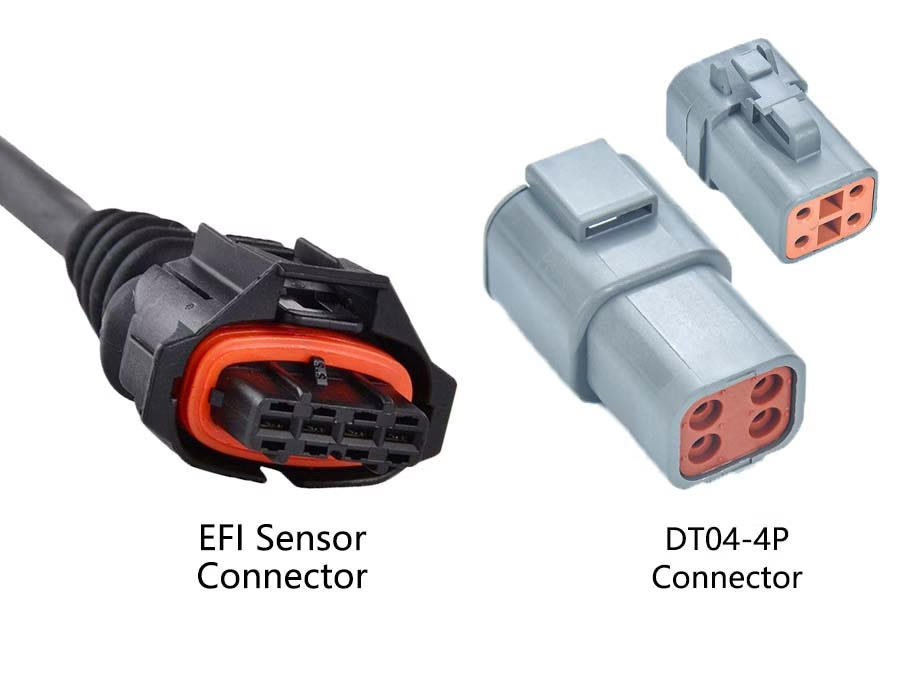
The choice of plating in connector engineering has a direct correlation with the stability of long-term contact resistance, the corrosivity of the plated components, and ultimately, the duration of mating cycles. While many connector failures occur due to failure of conductor size or failure in housing designs, many connector failures are due to deterioration at the interface between two related components – the conductor and the connector contact.

Tin, nickel, and gold are the three most commonly used plating materials, each serving a distinct purpose in engineering. A designer must understand the unique physical characteristics of these materials in relation to their performance under load, vibration, and exposure to weather/environmental conditions when designing a robust cable assembly or wire harness.
Why Plating Matters in Connector Design
Wear and tear from mating comes with every mating cycle, as does oxidation, humidity, and contaminants from their respective environments. Because connector platings are exposed to the interface between mechanical and environmental stresses, they are typically the first layer to degrade under these stress conditions.
Effective plating selection balances three competing factors:
- Cost
- Corrosion resistance
- Durability under mating cycles
No single plating material optimises all three. Plating must therefore be selected based on real application conditions rather than nominal specifications alone.
Tin Plating (Sn): A Mechanically Driven Contact Interface
Cost-effectiveness, excellent solderability, and initial electrical performance have led to the continued use of tin plating. Because tin is a non-noble metal, it tends to oxidise in ambient air. The primary means of establishing reliable electrical contacts is mechanical.
During mating, sufficient contact force and sliding motion (wipe) fracture the thin tin oxide layer, allowing fresh tin beneath to form a metal-to-metal interface. When contact geometry, force, and environment are properly controlled, tin-plated contacts can perform reliably in stable applications.
However, tin is sensitive to micro-motion. Vibration or thermal cycling can cause fretting corrosion, in which repeated microscopic motion generates oxide debris at the interface. Over time, this debris can increase contact resistance and lead to intermittent electrical behaviour, especially in low-force or vibration-prone designs.
Tin plating is generally not recommended for low-contact-force, high-vibration, or signal-critical interfaces.
Best suited for:
- Cost-sensitive designs
- Low to moderate mating cycles
- Stable connections with adequate contact force
Gold Plating (Au): Chemically Stable Performance for High Reliability
Gold plating is widely used in high-reliability and signal-sensitive connectors. As a noble metal, gold does not oxidise or sulfidize under normal operating conditions, allowing it to maintain consistently low, stable contact resistance over time.
Because gold does not rely on oxide disruption to establish contact, it performs well under low contact force and in high-density connector designs. Mating durability depends strongly on gold thickness and hardness: thin flash gold supports limited cycling, whereas thicker, more complex gold layers enable reliable performance across many mating cycles.
Gold is typically applied over a nickel underplate, which improves wear resistance and prevents diffusion of the base metal. Once the gold layer is worn through, long-term performance depends on the integrity of this underlying barrier.
Gold plating may be unnecessary for static, low-cycle power connections where cost sensitivity is the primary concern.
Best suited for:
- High mating-cycle applications
- Low-level or sensitive signal transmission
- Harsh or corrosive environments
Nickel Plating (Ni): A Critical Structural and Diffusion Barrier
Nickel is rarely used as a final contact surface in precision connectors. Although it offers high hardness and good corrosion resistance, nickel forms stable oxides that can increase contact resistance.
Its primary role is as an underplating layer. Nickel acts as a diffusion barrier between the copper alloy substrate and the top plating, preventing copper migration that would otherwise degrade corrosion resistance and electrical stability. Nickel also provides mechanical support, extending the wear life of thin gold layers and improving overall durability.
Nickel-only contact surfaces are typically limited to non-critical or specialised applications where higher contact resistance is tolerable.
Wear, Corrosion, and Mating Cycle Behaviour
Connector plating degradation generally results from a combination of mechanical wear and corrosion mechanisms:
- Fretting corrosion: Micro-motion caused by vibration or thermal cycling accelerates oxide formation, particularly on tin-plated contacts.
- Wear-through: Repeated mating gradually removes the top plating layer, eventually exposing the underplate or base metal.
- Galvanic effects: Mating dissimilar plating systems can accelerate corrosion in humid or contaminated environments.
Gold-plated interfaces are significantly more resistant to these effects than tin, especially in high-cycle or vibration-prone applications.
Selective Plating: Balancing Reliability and Cost
Selective plating is a widely adopted industrial process in which gold is applied only to the critical contact interface, while tin is applied to the solder or crimp termination.
This strategy provides:
- Gold-level corrosion resistance, where electrical performance is most critical
- Tin’s cost efficiency and solderability at the termination
- An optimised balance between reliability and overall system cost
Selective gold/tin designs are common in automotive, industrial, medical, and data connectivity applications.
Practical Application Guidelines
- Use tin plating for low-cycle, cost-sensitive connections with adequate contact force and minimal vibration
- Use gold over nickel for high-cycle, signal-sensitive, or harsh-environment applications
- Avoid mismatched plating systems on mating contacts whenever possible
- Evaluate plating thickness, contact force, vibration exposure, and environment together
Many field reliability issues stem from plating decisions that do not fully reflect real operating conditions.
Conclusion
With respect to system-level Engineering decisions, Connector plating requires a decision. Connector plating (tin) uses mechanical force to overcome oxidation, while gold uses chemical inert (non-reactive) properties to maintain electrical properties. Nickel serves two purposes: it acts as a necessary diffusion barrier and as wear support.
Generally, when choosing a plating for connectors, it is essential to consider the mating and unmating frequencies, thickness, sensitivity to electrical signals, vibration exposure, environmental severity, and the total life-cycle cost of the product. When you select an appropriate plating for any connector based on these factors, you create a strong foundation for long-term connection reliability rather than a limiting factor.
.avif)
Sam Wu is the Marketing Manager at Romtronic, holding a degree in Mechatronics. With 12 years of experience in sales within the electronic wiring harness industry, he manages marketing efforts across Europe. An expert in cable assembly, wiring harnesses, and advanced connectivity solutions, Sam simplifies complex technologies, offering clear, actionable advice to help you confidently navigate your electrical projects.