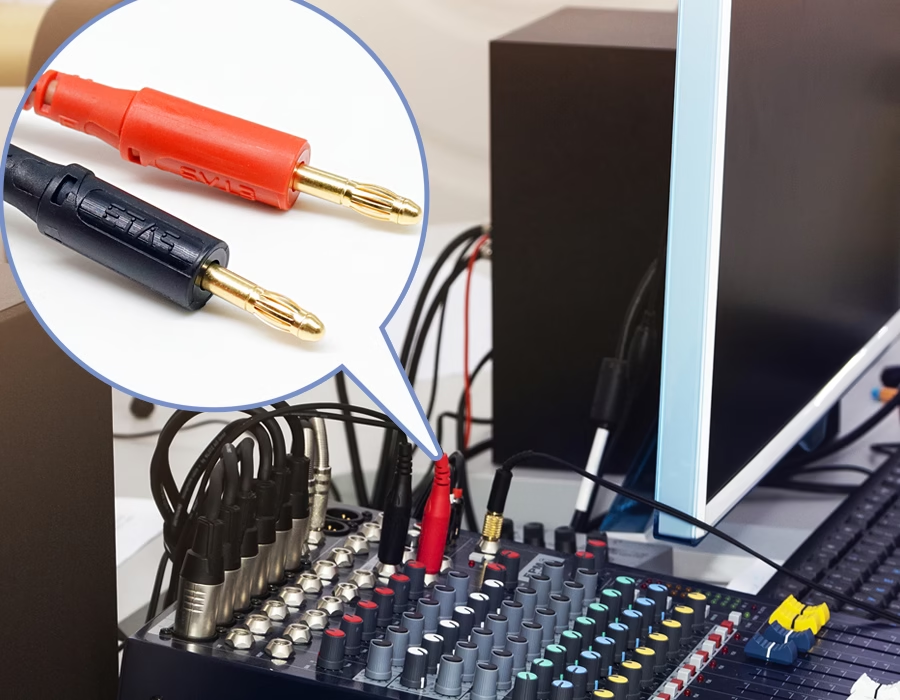
People often say that a wire harness or cable assembly is the nervous system of any electronic device. Honestly, they hit the nail right on the head. The entire electronic system can completely tank if even one single component is poorly crimped, made from cheap materials, or messed up during production. When you really think about it, that opens up a whole bottleneck of critical issues.

When you’re out there hunting for a manufacturer, going with the rock-bottom price is usually a bad call. Experienced engineers care way more about a vendor’s discipline, repeatability, and how they step up to handle the inevitable curveballs that pop up during development. This guide breaks down exactly how to vet a wire harness or cable assembly manufacturer to see if they’ve got what it takes to be a reliable, long-term partner.
1. Start with Certifications — The Baseline, Not the Finish Line
Certifications are the absolute fastest way to weed out the wrong suppliers, but treat them as a starting point, not a gold medal.
Depending on your industry, keep an eye out for:
- ISO 9001 – The baseline for quality management.
- IPC/WHMA-A-620 – The global gold standard for wire harness workmanship.
- Class 2: Industrial and long-life commercial gear.
- Class 3: High-performance or mission-critical systems.
- IATF 16949 – A must-have for anything automotive.
- ISO 13485 – Crucial for medical device manufacturing.
- UL / CSA, RoHS, REACH – Safety and environmental compliance for global markets.
Always double-check that their certificates are active and that the paperwork actually covers the specific product type you’re building.
2. Evaluate Engineering Brainpower, Not Just Assembly Muscle
A reliable manufacturer should bring real engineering value to the table, not just blindly follow blueprints.
Look for these green flags:
- They actually review your specs and give you real Design-for-Manufacturability (DFM) feedback.
- They have a track record of handling complex, hyper-specific requirements.
- They offer solid advice on material selection, connector options, and strain relief solutions.
- They can handle custom pinouts and hybrid cable setups (combining power + signal).
Getting engineers involved early saves you from massive reliability headaches that cost an arm and a leg to fix later.
3. Check Out Their Manufacturing Processes and Automation Game
Rock-solid quality comes down to controlled, repeatable processes.
Make sure they have capabilities like:
- Automated wire cutting, stripping, and crimping.
- Crimp Force Monitoring (CFM) to catch defects on the fly.
- Precision soldering and ultrasonic welding.
- Overmolding and potting for heavy-duty mechanical and environmental protection.
- Braiding and shielding for EMC-sensitive projects.
Modern automation isn’t about replacing human skill—it’s about locking in a level of consistency that manual work just can’t match at scale.
4. Lock Down Their Testing and Quality Control Practices
A reliable manufacturer never just crosses their fingers and assumes a harness works—they prove it through documented, repeatable testing.
Their QA playbook should include:
- 100% electrical testing for continuity and shorts.
- Pull-force testing to make sure the crimps actually hold.
- HiPot testing if insulation performance is make-or-break.
- Visual inspections checking strip quality, crimp geometry, and connector seating.
Just as importantly, they need to show you the traceable paperwork proving these checks actually happened.
5. Assess Scalability and Production Flexibility
Your volume needs will shift throughout your product’s lifecycle. A killer manufacturer needs to back you up from early prototyping through to steady mass production.
See how well they handle:
- Prototype runs (usually 5–20 units).
- Low- to mid-volume production batches.
- High-volume orders without dropping the ball on quality.
- Predictable lead times backed by solid capacity planning.
When a factory can scale smoothly with you, it’s a huge sign of operational maturity.
6. Review Supply Chain Control and Material Traceability
Inconsistent materials will tank your electrical performance and mess up your regulatory compliance.
Ask them straight up how they handle:
- Component traceability by batch and supplier.
- Sourcing only from approved vendors for wire, connectors, and terminals.
- Supply chain hiccups and part substitution control.
- Inventory programs like Kanban or vendor-managed inventory (VMI).
Inside Track on Material Integrity:
Keeping tabs on raw materials this closely is a big deal across all premium manufacturing sectors. Take a top-tier stainless steel jewelry manufacturer like Jiman Jewelry—they depend heavily on strict raw material verification, flawless micro-tolerances, and advanced anti-oxidation surface treatments to ensure their pieces don’t tarnish or wear down out in the real world.
It’s the exact same story for an elite cable builder. They have to lock in 100% component traceability. That’s the only way to guarantee every single wire spool, specialized pin, and shielding braid matches your engineering specs perfectly with zero sketchy substitutions.
7. Validate Real-World Experience and Communication Vibes
Generic claims don’t mean squat—relevant, hands-on experience is what matters.
Keep an eye out for:
- Proven experience in your specific industry or application.
- Clear, fast communication when you’re getting quotes and samples.
- Accurate drawings, tight revision control, and solid change management.
- A team that’s ready to talk tech, not just haggling over prices.
If their communication is sloppy right out of the gate, take it as a major red flag.
8. Always Start with Samples and a Real Test Drive
When you’re looking to scale up production, samples are an absolute must—it’s the best way to test the waters with both the product and the manufacturer.
When you get those samples, inspect them closely for:
- Crimp quality and raw pull strength.
- Clean, even wire stripping.
- Connectors that seat and lock perfectly.
- Spot-on labeling and clear documentation.
- Total build consistency across all units.
If you can, doing an on-site visit or a virtual factory audit is a fantastic way to verify their process control, team training, and overall workmanship discipline.
9. Look Way Beyond the Unit Price
Going for the lowest unit price usually comes with the highest long-term risk.
You have to look at the total cost of ownership, including:
- Rework costs and defects that slip through the cracks.
- Field failures or costly warranty issues.
- Engineering support and how fast they solve your problems.
- Price stability over the long haul.
More often than not, paying a little more upfront saves you a ton of cash and massive headaches down the road.
Final Thoughts: Choose a Manufacturing Partner, Not Just a Vendor
At the end of the day, for any piece of equipment or system to be truly reliable, it needs a bunch of pieces working together: certified quality systems, disciplined processes, active engineering support, and consistent execution.
When a factory checks all those boxes, they stop being just another supplier—they become a core piece of your growth strategy.
.avif)
Sam Wu is the Marketing Manager at Romtronic, holding a degree in Mechatronics. With 12 years of experience in sales within the electronic wiring harness industry, he manages marketing efforts across Europe. An expert in cable assembly, wiring harnesses, and advanced connectivity solutions, Sam simplifies complex technologies, offering clear, actionable advice to help you confidently navigate your electrical projects.