


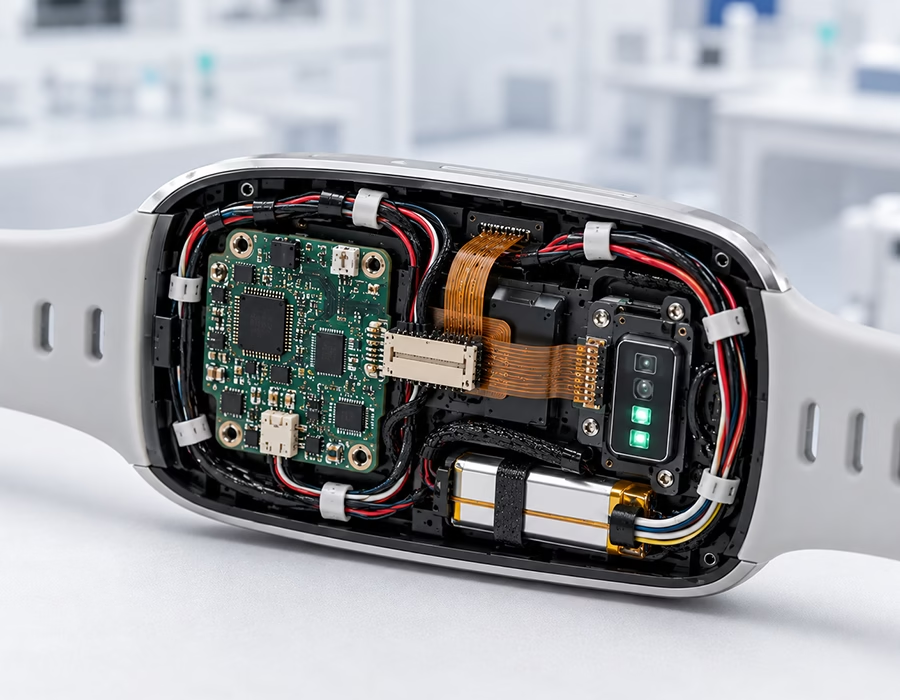
The Brutal Reality of Wearable Device Survival
Most contract manufacturers treat wearable health monitor cabling like a smaller version of industrial wire. It isn’t. Clinical patches, continuous glucose monitors (CGMs), and smart insulin pumps operate in a completely different environment. They don’t just sit inside an enclosure. They live on a moving human body, all day, every day.
So standard micro-wiring fails within days, either from mechanical stress or chemical erosion from everyday use. At Romtronic, we approach wearable health monitoring from a materials-science angle. We focus on three things specifically: space constraints, biocompatibility, and relentless multi-axis bending.
Squeezing Reliability Into Millimeters
When your entire device housing is smaller than a coin, standard crimping is off the table. Here’s how we build interconnects for tightly packed, low-profile medical gear:
- The 40 AWG conductor barrier. Standard copper wire snaps under continuous skin flexing. So we use high-strand-count alloy tinsel wires down to 40 AWG, reinforced with internal Kevlar aramid cores for extra tensile strength.
- Low-profile board-to-FPC interfacing. We terminate ultra-fine wires directly to flexible printed circuits (FPCs) and micro-snap receptors, minimizing Z-axis height.
- True zero-draft overmolding. Our vertical injection tooling handles wall thicknesses as thin as 0.2 mm, isolating sensitive electronics without adding bulk to the wearable patch.
Material and Compliance Reference for Wearable Health Monitor Wiring
| Target Sub-System | Material Solution | Why It Matters |
|---|---|---|
| Skin-contact strain reliefs | Medical-grade LSR (liquid silicone rubber) | Passes ISO 10993-5/10 cytotoxicity and irritation testing so that it won’t trigger chemical dermatitis. |
| On-body telemetry links | Polyurethane (TPU) blended with anti-static carbon liners | Cuts out triboelectric micro-volt spikes caused by clothing friction |
| Shower-proof sealing | Low-temperature polyamide potting before final overmold | Achieves true IPX7/IPX8 hermetic sealing, protecting logic boards from sweat and soapy water |
| High-flex internal jumpers | Silver-plated copper-clad steel (CPCS) wire | Delivers exceptional flex life, surviving millions of micro-bends without trace fracturing |
We build all of this under our broader medical wire harness quality framework, following the same standards we cover in our guide to medical wire harness standards and certifications.
Two Design Problems Nobody Talks About Until They Fail
The Motion Artifact Problem
When someone runs or moves around, their clothing rubs against the wearable monitor. That sliding motion creates static electricity, known as the triboelectric effect. In high-impedance biometric sensors, that static buildup can mimic cardiac or glucose spikes, which is a serious problem if a clinician reads the data as real.
To counter this, we co-extrude our micro-cables with a specialized conductive carbon layer. This lining safely bleeds off static charges to the ground path, so the algorithm reading the sensor gets clean data instead of motion noise.
The Chemical Attack: Sweat and Sebum
Human sweat is genuinely corrosive. It carries sodium chloride, lactic acid, and skin oils that dissolve standard PVC insulation over time. Eventually, the wire turns brittle and cracks.
Because of that, we build all external wearable interfaces using high-durometer fluoropolymers (FEP) or medical TPU instead. Both are chemically inert, so they hold up through years of continuous skin contact and daily alcohol sanitization without peeling or leaking current. If skin-contact material selection is a bigger concern for your device, our notes on biocompatible harnesses for medical catheters cover a lot of the same underlying material science.
Frequently Asked Questions
A: High-strand-count alloy tinsel wire down to 40 AWG is standard for wearable health monitor internals. Standard solid copper wire that thin would snap almost immediately under continuous skin flexing, so tinsel construction, often reinforced with a Kevlar aramid core, is what actually survives daily wear.
A: This is usually the triboelectric effect: clothing rubbing against the device generates static electricity that can mimic a real cardiac or glucose signal on high-impedance sensors. A conductive carbon shielding layer co-extruded into the cable is the standard fix.
A: Medical-grade liquid silicone rubber (LSR) and medical TPU are the two most common choices. Both need to pass ISO 10993-5/10 cytotoxicity and irritation testing before they’re considered safe for prolonged skin contact.
A: Most continuous-wear devices target IPX7 or IPX8 sealing, which covers accidental submersion and showering. That level of protection usually comes from low-temperature polyamide potting applied before the final overmold, not from the outer jacket material alone.
A: Sweat is more corrosive than people expect. Sodium chloride, lactic acid, and skin oils in sweat gradually break down standard PVC, making it brittle and prone to cracking. Fluoropolymers like FEP or medical-grade TPU resist that chemical attack and last years longer in continuous skin contact.
Challenge Our Micro-Wiring Lab
Wearable tech moves too fast for cookie-cutter manufacturing. Whether you’re dealing with a high rate of field returns, signal drift under motion, or you need to shrink your internal wire routing, we can help you figure it out.
Upload your current 2D CAD files or BOM directly to our Engineering Hub. Our specialist micro-wiring team will run a deep DFM (Design for Manufacturability) analysis, flag potential failure spots, and send you a fully customized production plan within 24 hours.
If your project also touches implantable or surgical-adjacent hardware, our page on surgical devices and biocompatible interconnects covers that adjacent engineering in more depth. For a deeper technical dive on this category, see our companion piece on harness solutions for wearable health monitors.