Premier Manufacturer

DuPont connectors are tiny plastic housings that you’ve undoubtedly encountered if you’re working on custom cables or wire harnesses. Despite their small size and simplicity, they have a significant impact. Connectors serve as the bridges that hold a wiring harness together. A wiring harness is essentially a collection of wires arranged to transfer power and communications effectively.
Connectors actually “allow secure and removable connections,” which facilitates cable assembly and maintenance. Connecting several wires would be difficult and prone to mistakes without dependable connectors like DuPont.
Why DuPont Connectors Are So Important in Cable Assemblies
When making custom cables, you’ll need trustworthy points to connect each wire. DuPont connectors are ideal for this purpose because they enable instant connections. Standard pitches (2.54 mm or 2.0 mm) are commonly used for breadboards and PCB headers. You crimp each wire to a metal pin and snap it into the enclosure; no soldering to the board is necessary. This implies you can change wires while testing and debugging.
In reality, DuPont connectors are extensively utilized in this manner: they are excellent for prototype circuits, breadboard connections, sensors, and microcontrollers, which encompasses the majority of bespoke cable applications. Many engineers begin with custom cable assemblies when transitioning from prototypes to small production runs, as DuPont housings expedite the iteration process.
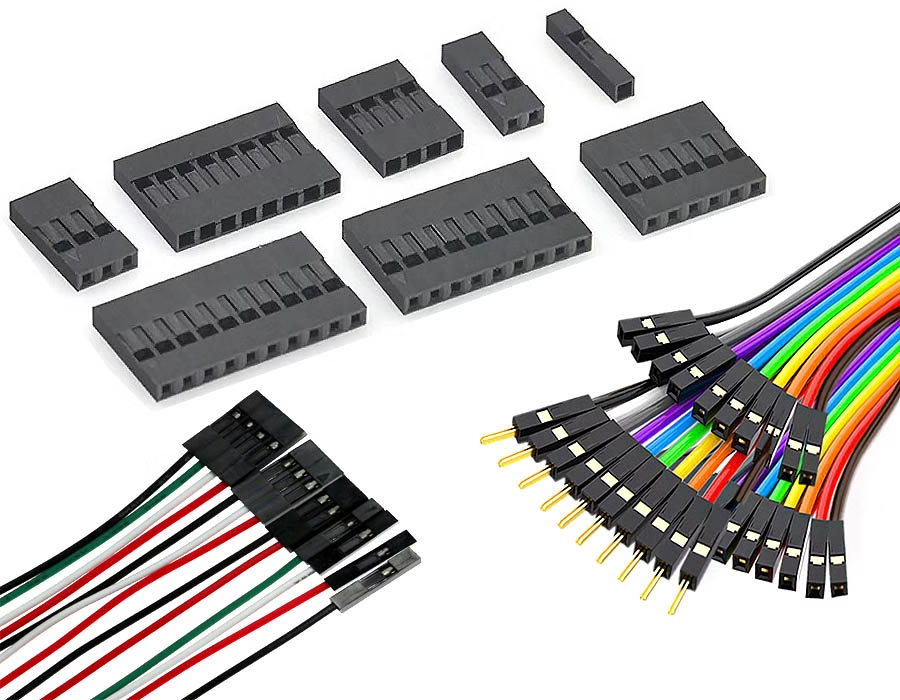
Each DuPont connector has a black plastic shell and metal pins (male or female). There are single-row and dual-row options for bundling as many wires as you require. For example, I combined eight sensor wires and two power lines in a single 10-pin DuPont cable, making rewiring the circuit a breeze. These parts are readily available due to their mass production. Electronics kits often include 40-100 DuPont jumper wires, and you can also purchase strips of 100 or more pre-wired jumpers.
In fact, DuPont cables are preferred for connecting wires to circuit boards and sensors, making them ideal for DIY and prototype projects as well as for certain light-duty applications in wire harness manufacturing.
Versatile Uses of DuPont Connectors
DuPont connections are not limited to hobby projects. They appear in numerous locations where wires must be joined:
- Prototyping & Breadboarding: Suitable for Arduino, Raspberry Pi, and breadboard configurations. Sensors, LEDs, and modules can be readily connected without the need for solder.
- Sensor and Module Connections: Used in robots, drones, and IoT devices to connect sensors, servos, and modules. For example, DuPont jumpers are frequently used in RC models to connect servos and controllers.
- Custom Cable Assemblies: Manufacturers also employ DuPont connectors in production harnesses. Wires can be pre-crimped with DuPont housings, allowing the entire cable to plug into a board or device readily.
- Testing and Development: Engineers use DuPont jumpers for temporary installations. When debugging a circuit, you can reroute signals on the fly by connecting and disconnecting these connectors.
- Low-Current Wiring: DuPont connections have a low current rating of roughly 3A at 250V, making them suitable for signal and low-power applications. They’re a straightforward solution when you require several wires connected in a regulated manner.
In brief, DuPont cables are ubiquitous in electronics, from DIY gadgets to sensor harnesses, since they make cabling more versatile and serviceable.
Significant Advantages of DuPont Connectors
Under the hood, DuPont connectors are made of high-quality, flame-retardant plastic with metal contacts. Yet they deliver pretty significant advantages for any cable assembly:
- Plug-and-Play: Crimp and snap. These connections are “simple and quick to use,” allowing you to swap wires without soldering.
- Standardized & Flexible: They use standard pitches (2.54 mm and 2.0 mm) to accommodate multiple boards. They can be configured in single or dual rows, with a variety of pin counts, to meet a wide range of wiring requirements.
- Durable & Conductive: DuPont connectors have tin-plated copper contacts and flame-retardant housings, ensuring low resistance and strong durability. They resist corrosion and provide dependable connections.
- Cost-Effective: DuPont connectors and jumper wires are pretty affordable, especially when purchased in bulk. Many suppliers supply packs of 40-600 pieces, making it inexpensive to get precisely what you need.
- Space- & Weight-Saving: Their compact profile allows for more room in tight harnesses. Even cable assembly professionals laud DuPont harnesses for their “weight and space-saving” design, which allows for more connections in less space.
These advantages explain why DuPont connectors remain a popular component. They enable you to easily and cost-effectively build and modify wire harnesses while maintaining reliability.
Learn More and Get Started with DuPont Connectors
Are you ready to try DuPont connections on your next project? They are straightforward to find and use. Electronics suppliers and internet markets sell connectors, crimp pins, and cables. Most kits come with color-coded wires (red for +V, black for ground, and so on), making it simple to assemble a harness.
If you desire unique lengths, you can easily crimp your own pins with a basic tool; numerous how-to manuals are available online.
In professional settings, machines can pre-terminate hundreds of wires using DuPont connections, enabling the rapid completion of massive cable assemblies. The idea is to arrange your pinout and double-check connections before powering on.
Please note that DuPont connections are designed for low to moderate current. For high-power or hostile situations, a more robust connector is required.
However, for most electronics hobbyists or those involved in light industrial activities, they provide an excellent blend of simplicity, versatility, and performance.
Frequently Asked Questions
A: It is a tiny wire-to-board connector commonly used in electronics. A DuPont connection is a black plastic shell that houses metal pins (male) or sockets (female) with a 2.54-mm pitch. It allows you to connect wires to headers or link them together without the need for solder. The name is derived from the original manufacturer; however, numerous businesses now produce these standard parts.
A: Select the appropriate pitch, pin count, and gender for your needs. Breadboards and PCBs typically have a 2.54mm pitch. Determine the number of pins (e.g., 1×2, 1×6, 1×8) and housing type (male or female).
Most electronic kits include a variation of them. Consider the appropriate wire gauge (22-26AWG) and insulation type for your application.
A: They typically have a rating of roughly 3 A at 250 V. They are safe to use for low-voltage signals and power (e.g., 5-12 V circuits). They are not designed for high-voltage or high-current power distribution (such as AC mains or motors requiring tens of amps).
A: Yes, they are suitable for their intended purpose. Tin-plated copper connections are commonly used for superior conductivity and corrosion resistance, and the housings are made of flame-retardant plastic. Under normal circumstances, they are relatively strong. Avoid extreme heat and dampness. They stand up well in ordinary electronics and prototypes.
A: Absolutely. You can unplug and reconnect the connectors several times. Plastic housings survive an extended period. If you need to repurpose a pin, use a pin extractor tool to remove the crimped pin and reinstall it on a fresh wire. This reusability is one of their key advantages for evolving projects.
DuPont connectors are a simple yet effective item in every maker’s or engineer’s toolbox. They contribute to the organization and dependability of your projects by streamlining wiring. Best of luck with your next cable assembly!
.avif)
Sam Wu is the Marketing Manager at Romtronic, holding a degree in Mechatronics. With 12 years of experience in sales within the electronic wiring harness industry, he manages marketing efforts across Europe. An expert in cable assembly, wiring harnesses, and advanced connectivity solutions, Sam simplifies complex technologies, offering clear, actionable advice to help you confidently navigate your electrical projects.