


Preventing failures in cable assemblies and wire harnesses requires a proactive, lifecycle-oriented approach. From design and material selection through installation, manufacturing, and routine maintenance, implementing preventive measures helps ensure a longer lifespan, fewer failures, and greater system reliability.
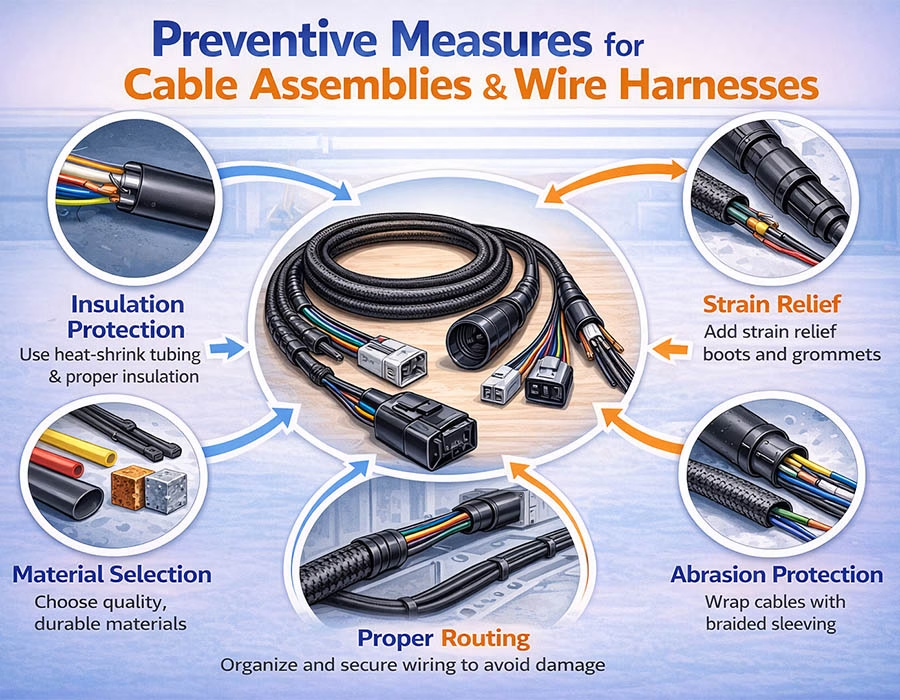
1. Design & Material Selection: Mitigating Risks at the Source
Conductors & Insulation
- High-reliability systems (automotive, aerospace) should use tin- or nickel-plated copper to resist oxidation and corrosion.
- High-temperature environments (engine compartments) benefit from fluoropolymer insulation (FEP/PFA), rated up to 150°C+.
- Vibration-prone applications (doors, movable panels) should use multi-strand conductors to improve flex-life 3–5x.
Protective Materials
| Material | Typical Application | Key Features |
|---|---|---|
| Nylon Corrugated Tubing | Chassis, engine bay | Abrasion-resistant, flame-retardant (UL94 V0), -40~130°C |
| Heat-Shrink Tubing | Connectors & terminals | Waterproof, insulating, heat-stable |
| Rubber Sheath | Pass-throughs | Crush-resistant, sealed (IP67+) |
| Cloth Tape | Interior harnesses | Noise-dampening, vibration reduction |
2. Structural & Environmental Design: Eliminating Built-in Weaknesses
Environmental Adaptation
- Dry/Wet Zones: Dry areas (cabin) use braided or corrugated sleeves; wet zones (chassis) require multi-layer protection (heat-shrink + PVC + rubber).
- Dynamic Stress Relief: Provide 30% extra length at moving points (e.g., door hinges) and flexible tubing.
Connection & Redundancy
- Connector Sealing: Use IP67+ connectors with silicone seals; apply anti-oxidation grease.
- Injection-Molded Clips: Reduce water ingress by ~65% compared to zip ties.
- Error-Proofing: Terminal and connector designs prevent incorrect assembly.
- Critical Systems: Dual wiring for airbags or safety-critical circuits prevents single-point failure.
3. Manufacturing & Process Control: Ensuring Quality
Crimping & Soldering
- Use dedicated tooling; maintain crimp height tolerance ≤0.05mm.
- Apply insulation sealing for soldered points; prefer RoHS-compliant, lead-free solder.
Cleanliness & Protection
- Maintain cleanroom-class environments (Class 10000).
- Apply a waterproof coating and inject protective gels at high-risk junctions.
Testing & Validation
- Continuity Testing: 100% of assemblies.
- Pull Testing: Terminal retention ≥50N (automotive standard).
- Environmental Simulation: Thermal cycling (-40°C to 85°C) and 48-hour salt spray test.
4. Installation & Maintenance: Minimizing Post-Production Damage
Correct Installation
- Maintain a bend radius ≥10× the wire diameter to prevent microfractures.
- Add rubber grommets and sealants for through-hole passages.
Maintenance Schedule
| Task | Frequency | Inspection Notes |
|---|---|---|
| Seal Elasticity | Quarterly | Check rubber sleeves/seals for hardening |
| Outer Sheath Replacement | Annually | Replace cracked or worn corrugated/rubber sleeves |
| Terminal Oxidation | Semi-Annually | Measure contact resistance ≤10 mΩ with a multimeter |
Fault Monitoring
- Use temperature sensors to detect overheating and trigger alerts.
- Repair insulation damage immediately; replace harness if severe.
5. Special Applications: Targeted Preventive Measures
High-Voltage EV Harnesses
- Shielded, grounded designs reduce EMI.
- High-voltage interlock disconnects power automatically.
Aerospace Harnesses
- Fluoropolymer jackets resist hydraulic oil/fuel.
- Metal connector shells with seals achieve IP68 protection.
Industrial Machinery
- PVC tape for oil resistance.
- Outdoor equipment covered with protective housings; remove dust periodically.
6. Key Principles
- Prevention Over Repair: Upgrading materials (nylon tubing), optimizing the structure (dry/wet zones), and rigorous process control extend harness life by 3–5 years.
- Failure Rate Reduction: Standardized protective measures can lower failures by 70%.
- Cost Savings: Case studies show up to a 40% reduction in maintenance costs after implementing system-level preventive measures.
Conclusion
Effective preventive strategies for custom cable assemblies and wiring harnesses require attention to design, material selection, manufacturing, installation, and ongoing maintenance. By implementing these measures, engineers can maximize product lifespan, minimize downtime, and ensure the reliable operation of critical systems.