Electronic warfare now brings down more drones than direct fire does. French Army Chief of Staff General Pierre Schill claimed in a speech that EW causes roughly three-quarters of drone losses on the Ukrainian battlefield. Jammers overpower or spoof the radio link. The drone drops before it ever reaches its target.
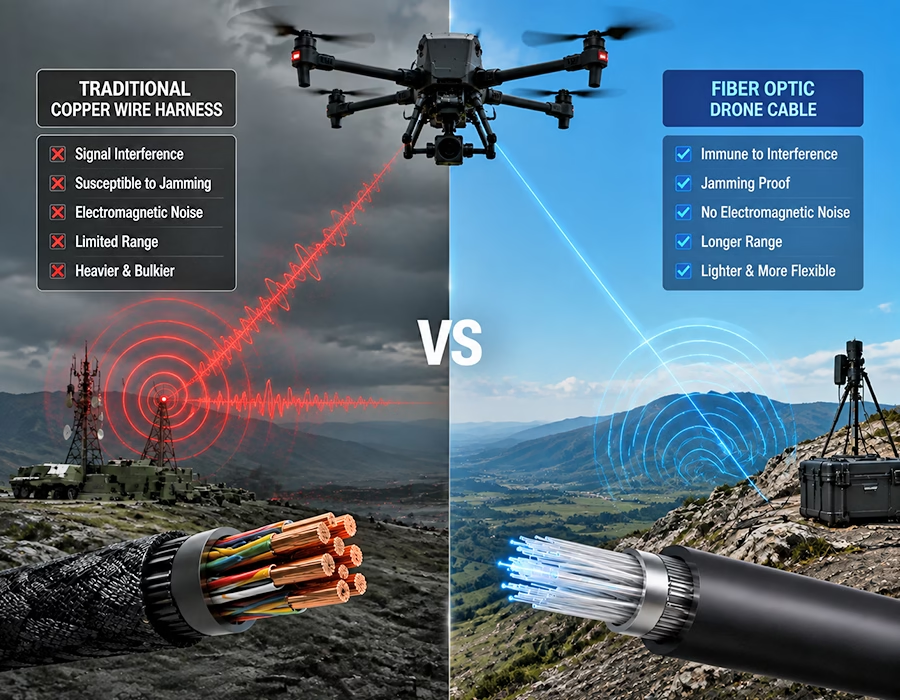
Fiber optic drone cable solves that problem at the root. It swaps the radio link for a physical strand of fiber. The fiber unspools between the drone and the operator as it flies. It carries light, not radio waves, so a jammer has nothing to detect or block.
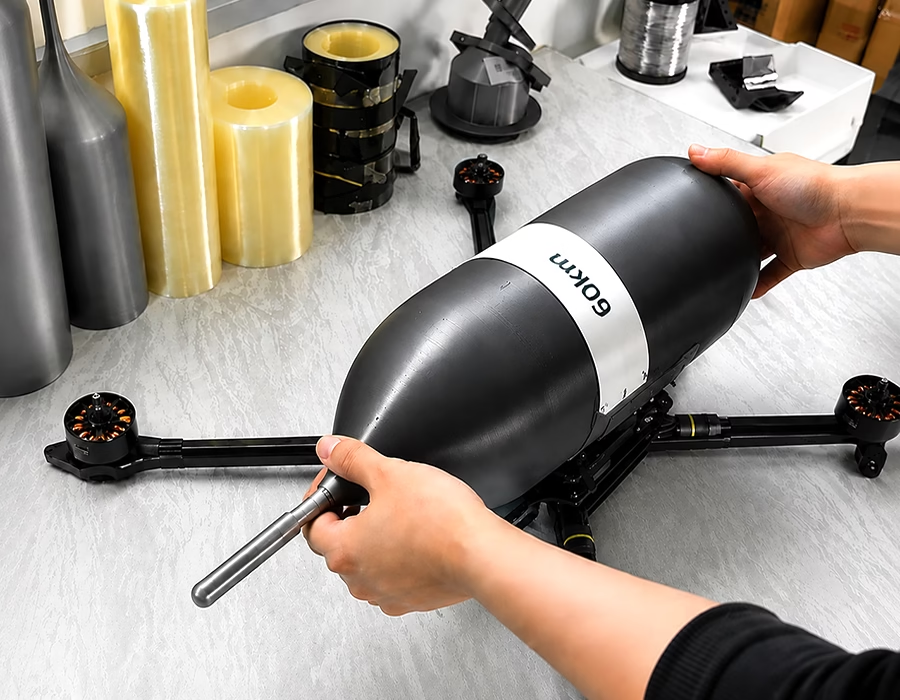
For engineers building or specifying these systems, the real challenge sits in the cable itself. A working spool has to survive an actual flight — kilometers of terrain, trees, and rough handling. It can’t snag, break, or add too much weight along the way. This guide covers why fiber-based control works, what the cable has to do mechanically, and how it pairs with the wire harness every drone still carries.
Why Radio Drones Get Jammed and Fiber Optic Drones Don’t
A standard FPV drone runs on a two-way radio link. Commands travel up; video comes down. Both move through open air as radio-frequency (RF) energy, so a jammer can detect, block, or spoof either one. Militaries have built entire electronic warfare programs around exploiting exactly that weakness.
Fiber optic drone cable removes the RF link. Video and control data travel as pulses of light through the fiber instead. The drone broadcasts nothing, so a jammer has nothing to lock onto — and radio-detection gear can’t spot it either.
Fiber wins on speed too. It typically delivers video with well under 20 milliseconds of latency, against 100+ milliseconds on a congested RF link. For a pilot flying through tight spaces or chasing a moving target, that gap matters as much as the jam-resistance.
What Fiber Optic Drone Cable Has to Survive
Attaching a spool of fiber to a flying object sounds simple. Getting it to survive one real flight is not. Four requirements drive the design.
Ultra-low weight
Every gram on the spool cuts into payload and flight time. The cable has to hit a tight weight budget per kilometer while still protecting the fiber core, so there’s no room for a heavy jacket or an oversized buffer layer. Our engineers apply the same weight discipline to custom drone wire harnesses, where every gram affects a system’s range of motion.
Tension-free payout
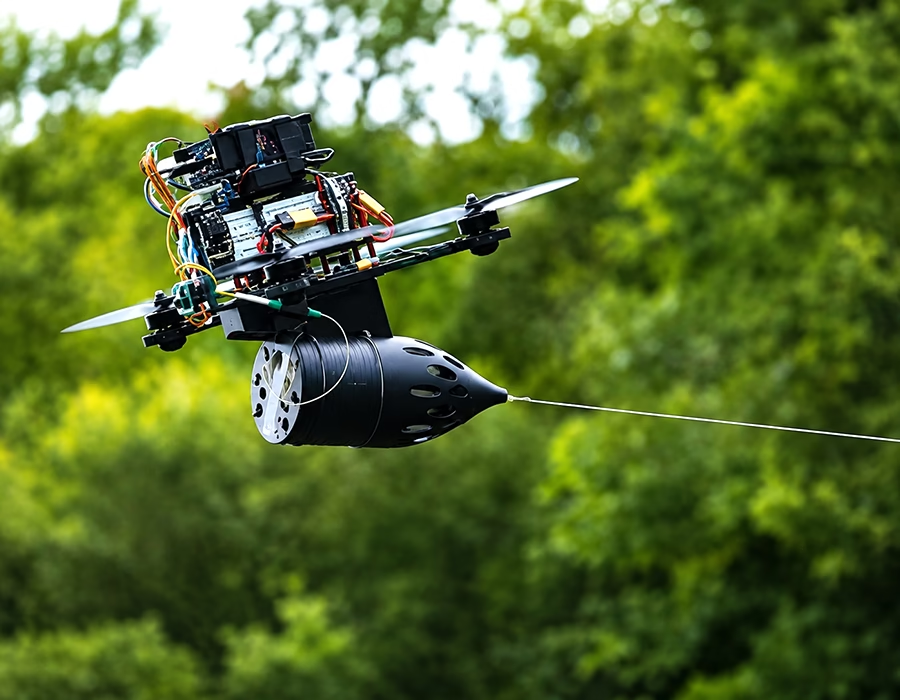
The cable can’t just be strong — it has to leave the spool clean, under zero tension. A snag or a kink changes the drone’s flight dynamics mid-mission and can snap the link outright. Spool geometry, winding pattern, and the coating’s friction all decide whether the payout runs smooth or catches.
Abrasion resistance
The cable drags across terrain, trees, and debris for kilometers once airborne. The outer coating needs enough abrasion resistance to survive that contact, and it has to hold up across the platform’s full temperature and moisture range.
Fiber count and connectors
Most systems run a single fiber core to save weight. Some multi-core designs trade weight for redundancy or bandwidth instead. On the connector side, standard cable assembly rules apply: fiber terminations need to mate reliably with the drone’s transceiver and the ground controller, using the same Hirose, Molex, and JST connector work we do on other harness projects.
Where fiber hands off to the wire harness
Fiber handles communication only. It doesn’t power the motors, run the flight controller, or feed the sensors. Every fiber optic drone still needs a conventional wire harness for battery power, motor drive lines, and sensor signals, built for high-vibration, weight-sensitive airframes like any other drone or robotics harness. The fiber link and the wire harness solve two separate problems using the same underlying discipline: lightweight, high-reliability cable assembly.
Fiber Optic Cable vs. Traditional Drone Wire Harness
| Fiber Optic Cable | Wire Harness | |
|---|---|---|
| Carries | Video, control commands | Battery power, motor drive, sensor signals |
| Main design driver | Jam-resistance, low weight, clean payout | Vibration resistance, current capacity, connector reliability |
| Typical length | 5–20+ km | Centimeters to a few meters |
| Failure mode to avoid | Snag, tangle, fiber break | Chafe, connector pull-out, intermittent contact |
Most commercial and industrial drones don’t need fiber at all. RF control costs less, weighs less, and works fine for inspection, mapping, or agriculture. Jamming isn’t a real threat in those environments. Fiber earns its weight and cost only where RF interference is active, or where the mission needs an undetectable link. Everywhere else, a well-built wire harness is still the right call.
Where Fiber Optic Drone Cable Falls Short
The trade-offs deserve a plain look, because they decide when this approach actually makes sense.
The spool caps how far the drone can go. Repeaters can extend an RF link, but fiber can’t. Range tops out at whatever fits on the reel, or however far the battery can haul it. Most systems carry 5–10 km of fiber; some extended-range builds reach roughly 20 km.
It adds weight and cost. Cable, spool, and optical transceiver together can add several ounces to a small airframe. Add in the incremental unit cost, and it’s a real hit to payload and endurance.
It’s also a single point of failure. A radio link degrades gradually as interference rises. A fiber link works, or it’s cut. Once the cable breaks, there’s no fallback.
These same trade-offs make the technology useful outside combat. Industrial inspection near heavy machinery, inside metal structures, or anywhere RF transmission is restricted is a natural civilian use case. Here, cable engineering — not tactics — decides whether it works.
FAQ
A: A fiber optic drone cable carries an optical link between the drone and the operator. It’s a payout cable built for extreme low weight, tension-free deployment, and abrasion resistance over kilometers. A wire harness is much shorter. It’s an internal cable assembly that distributes power and signal between the flight controller, motors, and sensors. Most fiber optic drones use both.
A: Connector interfaces and strain-relief points fail more than any other part of a wire harness. Vibration and repeated flex work a connector loose. They fatigue the wire right where it meets the connector body, not mid-run. Flex-rated conductors, sized-right strain relief, and vibration-resistant connectors at the design stage prevent most of this.
A: Yes, but it rarely makes sense. The weight, cost, and limited range only pay off when jamming or detection is a real risk. Most consumer and commercial drones never face that risk. For inspection, mapping, or delivery work, a well-designed wire harness with standard RF control is the more practical choice.
A: It depends on the harness and connector complexity. Most engineering teams can turn a wiring diagram into drawings and sample assemblies within days of design approval. That’s fast enough to iterate before full production starts.
Get a Custom Drone Cable Built Right
Whether you need a jam-resistant fiber link, a lightweight wire harness, or both, the engineering challenge stays the same. It comes down to extreme weight sensitivity, high reliability, and connectors built for real-world handling. Romtronic brings 29 years of custom wire harness and cable assembly experience to drone, robotics, and automation platforms, from design and rapid prototyping through ISO- and IATF-certified production. Contact our engineering team for a free technical consultation on your drone cable requirements.
.avif)
Sam Wu is the Marketing Manager at Romtronic, holding a degree in Mechatronics. With 12 years of experience in sales within the electronic wiring harness industry, he manages marketing efforts across Europe. An expert in cable assembly, wiring harnesses, and advanced connectivity solutions, Sam simplifies complex technologies, offering clear, actionable advice to help you confidently navigate your electrical projects.