Ideally, every custom wire harness project will begin with an optimal engineering documentation package. In this case, your procurement and production teams have delivered a perfect turnkey file to you. Normally, this package will contain 2D assembly drawings with clearly defined tolerances, a 3D STEP model to validate routing requirements, an itemized Bill of Materials listing all Manufacturer Part Numbers (MPNs), and accurate circuit netlists.
However, in reality, when a project involves short lead times, all too often reality does not follow suit. This is particularly prevalent in high-speed industries such as industrial automation, robotics, medical devices, and electric vehicle (EV) infrastructure.
Romtronic regularly works with OEMs and engineering teams who are facing the same challenge: they need a precision-engineered cable assembly or complex custom wire harness, but the documentation is not complete; they may only have a physical prototype sample from their R&D lab, a hand sketch or an incomplete preliminary list of what type of connections will be used.
Here is the bottom line: A completed blueprint is not required to initiate your project. You can partner with an experienced, high-mix, low-volume (HMLV) contract manufacturer with a well-documented engineering support infrastructure to transition from a conceptual prototype to an approved, fully manufactured product.
Why Many Wire Harness Projects Launch Without Full Documentation
It is not an engineering failure to launch into production with incomplete documentation; rather, it is commonplace in today’s fast-paced, next-generation hardware. The following circumstances typically apply during cost-critical cycles:
- Rapid rate of new product introduction (NPI) cycle: The electrical/mechanical enclosure architecture is still developing (in flux); however, due to supply chain lead times, all components must be ordered now.
- Reverse Engineering of Legacy Equipment – A critical piece of machinery needs to be replaced; however, the original drawings are unavailable, the supplier has gone out of business, or the original drawings have become obsolete.
- Supplier Transition Initiatives – You need to move your project away from an uncooperative or high-cost vendor; therefore, you must replicate an existing assembly that has been validated through prior field experience.
- Lean Process Automation Integration – Field engineers and system integrators who design custom control panels often lack sufficient internal CAD capacity to document every point-to-point connection.
You do not have to delay a product launch due to the complexity of documenting schematic designs; you can outsource that work to our Application Engineering team.
4 Practical Alternative Inputs to Jump-Start Your RFQ
Suppose you do not have a finished DWG, DXF, or PDF engineering drawing. An experienced manufacturer can accurately assess, price, and start your project with no problem. Specifically, we can use one or more of the following alternative input(s):
1. The Physical Sample Solution (The Gold Standard)
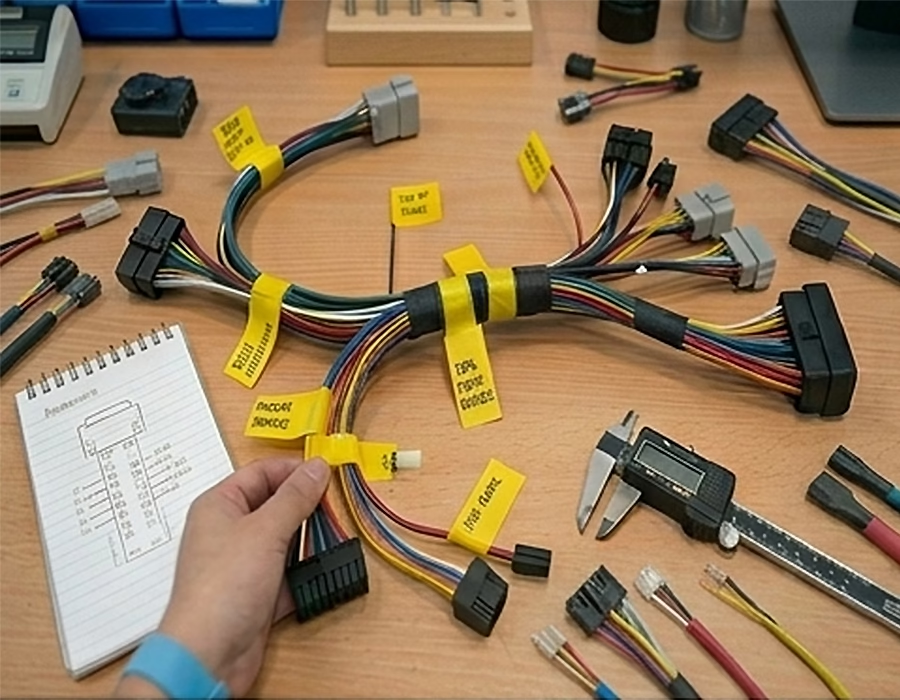
The most secure method for shipping legacy or handmade proof prototypes directly to our factory in China. Once we receive the sample, our Engineering Team will reverse-engineer the assembly. We will then physically disassemble it, measure the legs (lengths), wire gauges (AWG), verify the types of insulation used, and check the crimp profiles.
Pro-Tip: Make sure to use physical tags/tape flags on the proof prototype to indicate any changes you want to make (such as adding heat-shrink tubing to certain branches or upgrading your jacket temperature rating).
2. The Core Parameters Checklist
If there is no physical sample, you can still receive a quote by supplying a very simple spreadsheet. It must have the minimal amount of technical data required to create an accurate quote:
- The Component BOM: Please provide the Brand name and the MPN # for each connector housing, terminal, and wedge lock. Please include all major manufacturers’ connector housings, e.g., TE Connectivity, Molex, Amphenol, and JST.
- Wire Specifications: Please specify the required wire gauge (e.g., 18 AWG or 22 AWG), jacket material, and wire color code. Commonly used materials are PVC, high-flex silicone & Teflon.
- Dimensional Layout: Clearly state the physical length of each branch segment (Cut Length). In addition, define the exposure lengths for stripping and tinning.
- The Netlist (Pinout Table): Map out the point-to-point electrical continuity. Explicitly state which cavity on End A connects to which cavity on End B.
3. Enclosure Mechanical Fitment & Spatial Mapping
When using complex internal control box designs or automated machinery, you can send us the Spatial Boundaries defined by your enclosure or 3D preliminary files. By examining the relative positions of your PCB, Power Supply, and Rear Bulkheads, the engineering department can determine the best Route Path for your circuitry and Branch connections.
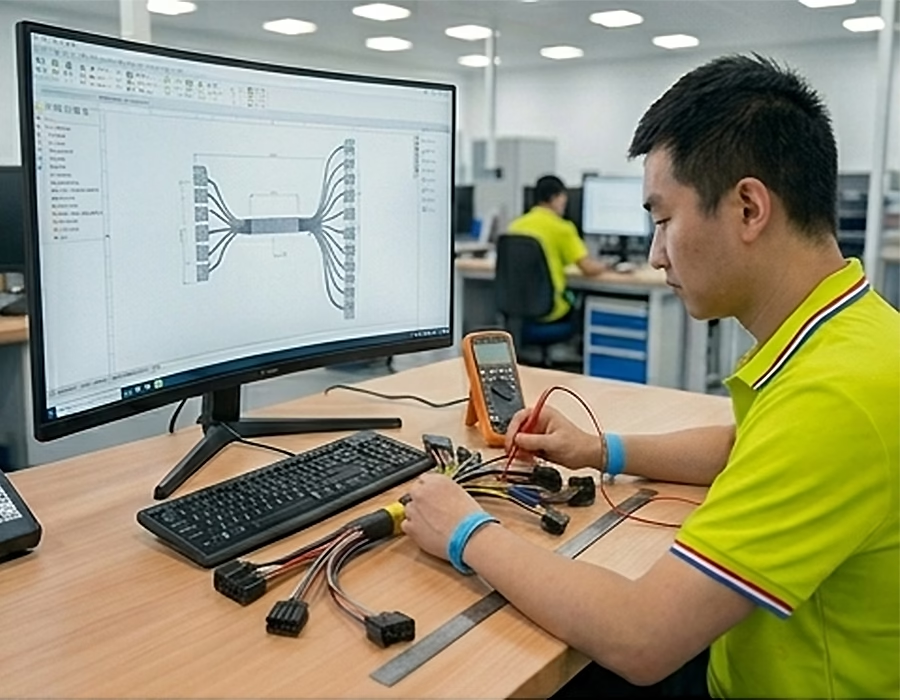
Next, we create a first-article prototype. Your team can install this sample directly onto your machine chassis to test-fit it. Consequently, this allows us to adjust physical tolerances before full production.
4. Explicit Operational and Environmental Requirements
To prevent premature field failures, communicate your exact environmental and operational baselines upfront:
- Electrical Characteristics: Specify whether your lines carry low-level electrical signals and whether they are subject to electromagnetic interference. If so, they will need special shielding and drain wires. If they carry high electrical current, they will need to have high-gauge wiring, too.
- Operating Environment: Indicate whether your assembly will be subject to significant flexing, vibration, thermal cycling, or exposure to moisture and industrial oils.
- Identification Systems: Have cable marked using custom inkjet, heat-shrink, or flag markers on each leg. This will help simplify the installation in your operation and make future troubleshooting easier and quicker.
Securing the Co-Development Process
When you place an order without a drawing, your contract manufacturer transitions into an active co-development partner. To eliminate manufacturing defects and ensure your design is optimized for scaled production, look for a partner that utilizes a structured development framework:
Initial Concept/Sample → DFM Review → 2D Production Drawing → Golden Sample Validation → HMLV Production
- Design for Manufacturability (DFM) Review: Engineers review your conceptual data to catch hidden technical risks. These include mismatched terminals and housing series, inadequate strain relief, or incorrect bend radii for high-flex robotic limbs.
- Engineering Drawing Creating: Before cutting a single wire, the factory creates formal 2D assembly drawings and a detailed BOM based on your inputs. This is done specifically for your official sign-off.
- The “Golden Sample” Process: We build a first-article prototype and ship it to your team for physical validation. This step ensures the assembly functions exactly as intended in your specific application environment before you commit capital to a production run.
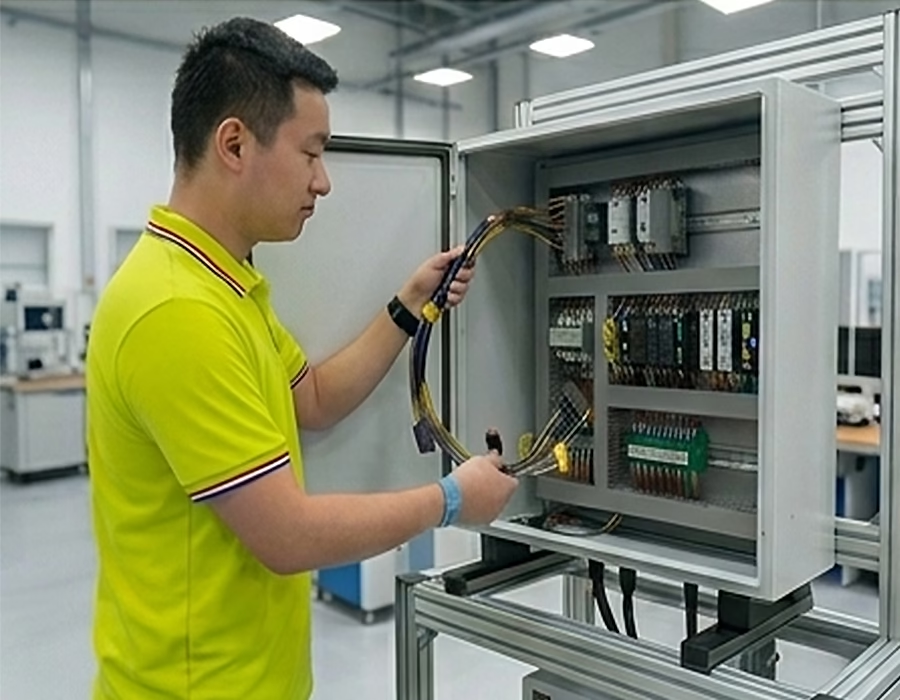
Mitigating Risk: The Quality Frameworks You Must Demand
Ordering custom electronics without finalized blueprints introduces the risk of miscommunication. To protect your brand reputation and ensure real-world reliability, verify that your manufacturing partner adheres to strict global quality management systems and industrial compliance standards:
| Quality Standard / Policy | Definition | Why It Matters for Incomplete Drawings |
| IPC/WHMA-A-620 Certification | Class 2 (Industrial) or Class 3 (Medical/High-Performance) | Guarantees that every wire crimp, solder joint, and insulation strip complies with rigorous, globally recognized visual and structural acceptance criteria. |
| Certified QMS Facility | ISO 9001, IATF 16949 (Automotive), and ISO 13485 (Medical) | Ensures lot traceability, rigorous risk-assessment protocols, and process consistency throughout the entire production cycle. |
| 300% Inspection Policy | Three-Stage Functional & Electrical Manufacturing Audit | Eliminates defect escapes by performing 100% electrical and visual checks at three distinct stages: post-solder/inner mold, post-outer overmold, and final FQC. |
Technical FAQ: Overcoming the Barriers of Drawingless Ordering
Q: Is it risky to order a custom wire harness without a drawing? Will a factory reject my order?
A: This depends on the factory you are working with. Most ultra-high volume automated factories will not accept orders unless they receive complete CAD files. These factories operate strictly under build-to-print policies and do not have an internal engineering department. They also fear that if they do not have complete information, such as missing netlists or poorly defined tolerances, they will face production issues.
Romtronic is an OEM/ODM/HMLV manufacturer. We do not turn away projects without complete documentation. We provide engineering support from our in-house engineering department to deliver production-ready documentation.
Q: How do you accurately test a wire harness without an original schematic?
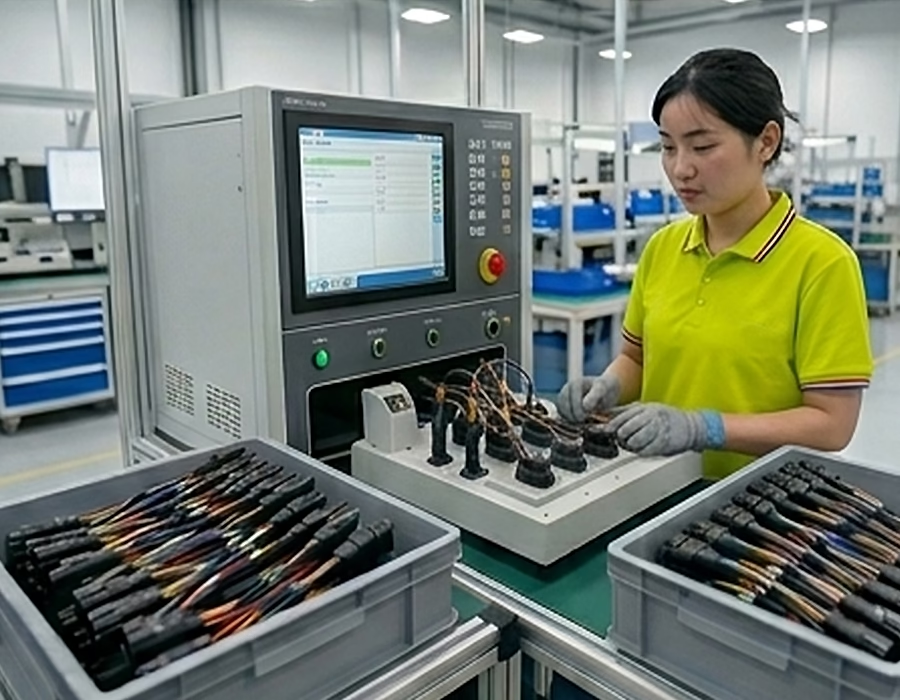
A: We have a very thorough 100% visual and electrical inspection process, and our QA builds custom mating test fixtures for wire harnesses based on the pinout mapping created during our joint engineering process. Each harness produced undergoes continuity and high-potential (Hi-Pot) testing to ensure the electrical configuration meets your needs. Each shipment of a harness includes a certified test report.
Q: I need a new wire harness for my classic car. Can I send a photo to get a quote?
A: We do not supply harnesses to individuals. Romtronic is a B2B company that works with OEMs and system integrators, as well as with industries; we do not manufacture one-off or aftermarket harnesses for personal vehicles, hobbyists, or DIY projects.
Conclusion: Partnering for Strategic Agility
The absence of a complete engineering package shouldn’t impede product development or prevent the timely deployment of major production lines. In high-mix, low-volume manufacturing operations, flexibility, agile engineering, and rigid quality controls are essentials.
The primary advantage of partnering with a premium wire harness assembly manufacturer is the ability to transform fragmented concepts into stable, on-time, certified manufacturing solutions. OEMs will eliminate time delays caused by prototyping delays, component mismatches, and field-service issues by prioritizing timely engineering collaboration, rather than just the lowest price per harness piece.
Ready to Launch Your Next Project?
If your technical drawings are incomplete, under revision, or non-existent, let our engineering team turn your sketches, photos, or physical samples into high-performance, fully certified assemblies through our structured design and validation workflows:
- Learn more about our core Custom Cable Assembly & Wire Harness Manufacturer capabilities. Our engineers translate your application descriptions into certified blueprints, optimizing the design through iterative consultations before delivering functional samples for fitment testing in real-world applications.
- Transform your initial operational concepts into reality with Romtronic’s end-to-end Custom Wire Harness & Solutions engineering support. We specialize in co-developing production-ready drawings tailored to your technical requirements, and in manufacturing-validated evaluation samples prior to scale production.
- Eliminate the roadblocks caused by incomplete documentation with our joint Cable Assembly Process. Our engineering team will map out the necessary 2D/3D technical drawings based on your environmental parameters, refine schematics through rigorous design reviews, and ship dedicated first-article samples for your physical verification.
- For deeper insights on technical component sourcing or standards compliance, feel free to read the authoritative IPC/WHMA-A-620 Standards Guide to see how industry-standard parameters protect your supply chain during reverse engineering.
.avif)
Sam Wu is the Marketing Manager at Romtronic, holding a degree in Mechatronics. With 12 years of experience in sales within the electronic wiring harness industry, he manages marketing efforts across Europe. An expert in cable assembly, wiring harnesses, and advanced connectivity solutions, Sam simplifies complex technologies, offering clear, actionable advice to help you confidently navigate your electrical projects.