The rules for mass-producing standardised parts are changing in today’s manufacturing environment; OEMs that manufacture for the medical, robotics, and electric-vehicle industries no longer purchase single-type cables in runs of 50k. OEMs now need 12 variations along with rapid engineering changes and prototype runs delivered within days.
As a result of these changes, the High Mix Low Volume (HMLV) cable assembly manufacturing model has become a key strategic resource for procurement professionals and design engineers. HMLV is more than just a manufacturing model; it is also a solution that offers lower risk, shorter development time, and improved flexibility and agility for both procurement professionals and design engineers.
1. Breaking the “Certification Paradox” in China
When sourcing specialised cables, OEMs often encounter the “Certification Paradox”:
- Tier-1 Giants: Hold IATF 16949 and ISO 13485 but refuse orders under 10,000 units.
- Small Workshops: Accept low MOQs but lack the quality systems for mission-critical projects.
Romtronic solves this dilemma by holding itself to the same stringent tier-one standards as larger companies and by enabling them to use modular tooling and digital workflows to reduce the cost of complexity associated with low-volume runs while continuing to provide OEMs with top-quality products.


2. The 2026 Quality Pillars: Critical Process Control
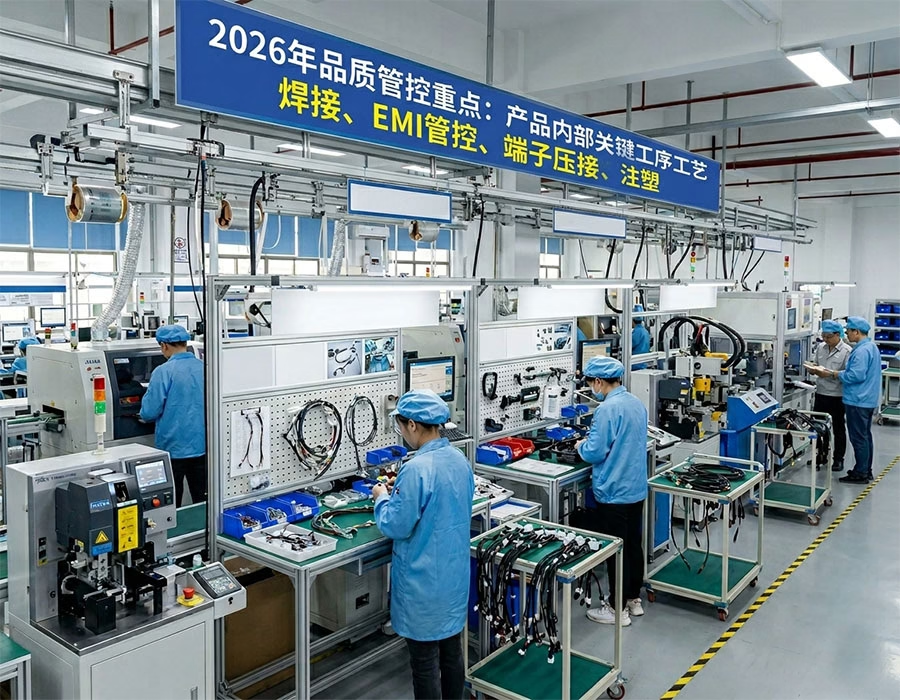
One way we keep the quality of hundreds of SKUs consistent is by mastering how to make those products (which is our obsession). We have (4) internal control pillars in our manufacturing facility that we use to produce products (shown in our 2026 Quality Control Roadmap):
I. Precision Soldering & EMI Management
In a high-mix production environment, the most likely point of failure for EMI shielding is at the solder connection. Our engineering team is responsible for ensuring that braided, foil, or spiral EMI shielding is terminated with 100% integrity to protect sensitive signals in medical imaging and robotic sensor assemblies.
II. Advanced Terminal Crimping
All crimping processes are qualified in strict accordance with testing requirements. We use semi-automated crimping machines with built-in cross-sectional analysis to ensure that all of our unique part numbers are mechanically/electrically reliable.
III. Specialised Overmolding (Low-Pressure Moulding)
We utilise Low-Pressure Moulding (LPM) and modular tooling to create long-lasting, IP-rated protection. This is the safest way for us to encase delicate printed circuit boards (PCBs) and sensors without the additional costs of traditional mass-produced (pre-manufactured) steel moulds.
IV. 100% Electrical Validation
In an HMLV production environment, sample testing does not provide enough assurance. Therefore, all Romtronic assemblies undergo 100% testing for continuity, insulation resistance, and Hi-Pot, guaranteeing zero-defect shipments.
3. How to Evaluate an HMLV Partner: The AECC Model
To ensure your supply chain remains resilient, evaluate your HMLV provider through the AECC Framework:
- Awareness: Does the partner identify “Silent Killers,” such as component obsolescence, during the design phase?
- Evaluate “on: Can the factory pivot? We focus on SMED (Single-Minute Exchange of Die) to ensure changeovers happen in minutes, keeping your project on schedule.
- Comparison: Look at the Total Cost of Ownership (TCO). Does the supplier offer DFM (Design for Manufacturability) support that reduces long-term rework?
- Commitment: The best partners feel like an extension of your own team, providing transparent communication from the prototype to the final pilot run.
4. 2026 Trends: Intelligence & Sustainability
As we move through 2026, two trends are dominating the HMLV space:
- Smart Overmolding: Integration of RFID tags into strain reliefs for real-time asset tracking.
- Sustainable Sourcing: Mandatory reporting on carbon footprints and the use of halogen-free, recyclable TPE jackets.
- Digital Twin Traceability: Assigning a digital serial number to every harness to track exact crimp force and operator data.
5. Engineering Resources & Consultation
As product lifecycles shrink, the question is no longer “Who is cheapest at scale?” but “Who can build the right cable, co”rectly, in the right quan”ity, “t the right time?”
Explore our engineering insights and connect with our team:
- HMLV Strategy Deep-Dive: https://www.romtronic.com/high-mix-low-volume-cable-assembly-explained/
- General Inquiries: https://www.romtronic.com/contact/
.avif)
Sam Wu is the Marketing Manager at Romtronic, holding a degree in Mechatronics. With 12 years of experience in sales within the electronic wiring harness industry, he manages marketing efforts across Europe. An expert in cable assembly, wiring harnesses, and advanced connectivity solutions, Sam simplifies complex technologies, offering clear, actionable advice to help you confidently navigate your electrical projects.