


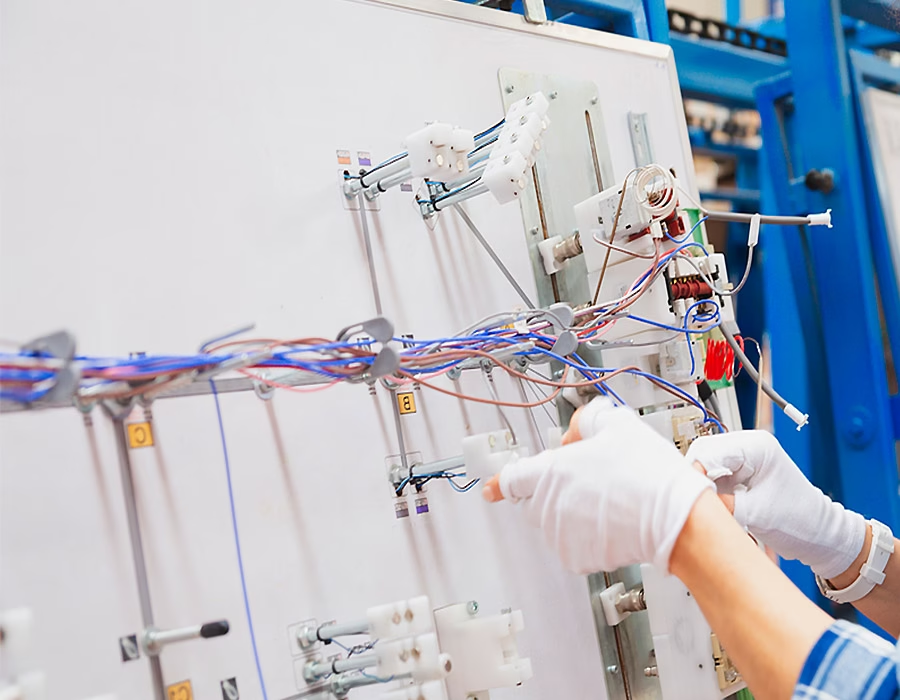
Robot wire harnesses bundle power, signal, and data cables into orderly looms that run through industrial arms and machines. Since robots commonly operate in high temperatures, dusty environments, and at rapid speeds, these harnesses must meet stringent safety and quality standards. A UL-listed wire harness, for example, has undergone strict fire, voltage, and load tests and is approved for use in accordance with the United States National Electrical Code. Similarly, a CE label on a machine (including internal wiring) indicates that it fulfills EU safety standards.
In practice, adhering to the proper standards (e.g., UL in North America, CE/RoHS in Europe) means your robot’s wiring is less likely to fail. Below, we break down the key standards – from UL and CSA to RoHS, IPC/WHMA-A-620, ISO 9001, and others – that help ensure wire harness compliance in robotic applications.
North American Standards: UL, CSA, NEC
In the United States, Underwriters Laboratories (UL) establishes the standard for electrical safety. A UL-listed cable or harness has “passed rigorous tests (fire, voltage, etc.) and is allowed for use in industrial equipment under the National Electrical Code (NEC)”. Many robotic control panels and devices are legally required to have UL-listed wiring. (There are also UL “Recognized” components – designated “UR” – that are utilized inside equipment, but a final harness must be UL-listed to carry the UL label.)
In Canada, the Canadian Standards Association (CSA) serves a similar purpose. Most industrial cables are certified by both UL and CSA. In reality, a lowercase “c” next to the UL logo shows it fulfills Canada’s C22.2 guideline. The CSA also conducts flame tests on wiring (FT1, FT4) to guarantee that the insulation does not catch fire in a panel. In short, look for UL and CSA logos on your wire harnesses, which indicate that the cables meet US/Canadian safety standards.
🔧 Need reliable robot wire harnesses that meet UL/CSA standards?
Romtronic designs and manufactures high-performance wire harnesses built to withstand extreme industrial environments while meeting global certifications.
📩 Contact us today for a free quote and sample →
EU & RoHS Compliance: CE Marking and Material Rules
In Europe, CE marking is the key to accessing the market. A CE sticker on the final machine (including wiring) indicates that it conforms with EU directives such as the Low Voltage and Machinery Directives. (Cables are typically not CE-marked, but they must be graded to meet those requirements.) RoHS compliance is just as critical in Europe. The RoHS Directive limits the use of hazardous compounds (such as lead, mercury, cadmium, and flame retardants) in electronics.
In fact, “all electrical cables sold in Europe must be compliant” with RoHS. Manufacturers verify their wires to RoHS specifications before shipment, and failing to comply with RoHS involves severe penalties. In practice, EU/EEA customers should seek CE-certified devices with RoHS-approved harnesses (lead-free, low-Pb).
Quality & Workmanship: IPC/WHMA-A-620 and ISO
Good wiring is not only safe, but also well-made. The IPC/WHMA-A-620 standard sets the global standard for wire harness assembly quality. It offers craftsmanship classes (ranging from Class 1, basic, to Class 3, demanding) and outlines the procedures for stripping, crimping, soldering, and inspecting cables. Many robotics OEMs train assemblers to meet the IPC-A-620 standard, ensuring that each harness achieves a consistent quality standard.
Most OEM contracts require harness suppliers to hold ISO 9001 certification (or industry-specific ISO/TS 16949 for the automotive industry, ISO 13485 for medical devices, etc.). An ISO 9001 quality management system assures that the manufacturer follows disciplined design, manufacturing, and testing procedures. In fact, “clients often need suppliers to have ISO certifications to assure product consistency and continual development.” In summary, UL/CSA/CE/RoHS cover safety and materials, whereas IPC-A-620 and ISO 9001 address assembly quality and production consistency.
Robot-Specific Durability Standards
Robotic wires withstand twisting, bending, and continual motion, necessitating particular durability tests. Germany’s TÜV 2 PfG 2577 (2016) standard includes mechanical durability testing (drag-chain flex, torsion, bending) for robot cables. UL’s RP-5770 (2018) recommends four mechanical performance tests for cables in repeated-flex applications, based on UL-758 standards. These specifications often demand millions of cycles (e.g., 5-20 million drag-chain bends and 1-10 million twists) with minor damage.
In practical terms, this entails using high-flex robot cable designs (typically orange or brightly colored) with finely stranded conductors. Many industrial robot harnesses use specific jackets (PUR, TPE) designed for continuous motion. They also provide IP/EMC classifications, such as IP67 connections for cables that run in a washdown cell. In short, even robot-specific safety standards are based on the same markings (UL/CE). Engineers generally select cable types that have already been tested to UL or German standards (rather than certifying a new cable from the start).
Key Standards at a Glance
The following table outlines the main certifications and standards for robot wire harnesses. Note the UL/CSA for North America, the CE/RoHS for Europe, and the global quality standards.
| Standard/Certification | Region/Scope | What it means |
|---|---|---|
| UL (e.g. UL 508A) | USA | US electrical safety standard for machinery wiring. Cables meet NEC requirements |
| CSA (C22.2) | Canada | Canadian wiring safety standard, harmonized with UL |
| CE Marking | EU/EEA | Mandatory EU mark for machines; indicates compliance with EU safety directives |
| RoHS Directive | EU (global impact) | Restricts hazardous substances (Pb, Hg, etc.) in cables |
| IPC/WHMA-A-620 | Global (industry) | Workmanship standard for cable/harness quality |
| ISO 9001 (QMS) | International | Quality management certification (ensures consistent processes) |
Table: Key robot wire harness standards and certifications.
FAQ: Quick Answers
A: Typically, the CE mark is applied to the machine or robot rather than the individual harness. However, each cable or connector used inside must conform to EU directives (such as Low Voltage and EMC) for the entire system to be approved. In brief, employ CE-rated components to ensure that the final assembly fulfills CE standards.
A: A UL-Listed product (such as a finished cable assembly) has been tested and is suitable for general usage. A UL-Recognized component (labeled “UR”) is only tested as part of a larger device and cannot function independently of it. For robot harnesses, the entire assembly should be UL-listed
A: There is no law requiring it, but IPC/WHMA-A-620 is the de facto industry standard for harness quality. Many OEMs and cable manufacturers train to A-620 standards to maintain consistency in workmanship. In fact, adhering to A-620 merely means that your assemblers and inspectors agree on what constitutes “good” for crimps, solder junctions, and strain relief.
A: While ISO 9001 is not an electrical safety standard, most clients anticipate it. An ISO 9001 (or IATF 16949, ISO 13485, etc.) certificate indicates that the organization has a strong quality management system. It means that each harness is manufactured using controlled techniques and tested for quality. In summary, ISO 9001 ensures that the manufacturer maintains strong manufacturing discipline.
Engineers and purchasers can confidently define robot cable assemblies once they understand and verify these requirements. Verify UL/CSA and CE/RoHS certifications for safety and material compliance, as well as IPC/WHMA-A-620-trained production facilities and ISO-registered facilities, to ensure consistent quality. Properly certified wire harnesses result in fewer surprises on the manufacturing floor and a longer service life for your automated systems.
🤖 Ready to upgrade your robotic systems with certified wiring solutions?
Our engineering team delivers fully customized harnesses that comply with UL, CE, and RoHS, ensuring durability and long-term performance for your automation projects.
📞 Get your free project consultation now →
.avif)
Sam Wu is the Marketing Manager at Romtronic, holding a degree in Mechatronics. With 12 years of experience in sales within the electronic wiring harness industry, he manages marketing efforts across Europe. An expert in cable assembly, wiring harnesses, and advanced connectivity solutions, Sam simplifies complex technologies, offering clear, actionable advice to help you confidently navigate your electrical projects.

