 Premier Manufacturer

The ¼-inch (6.35 mm) audio connector is a cornerstone of professional sound gear. It dates back to the late 1800s as a “phone plug”. Even today, electric guitars, keyboards, mixers, and amps commonly use ¼″ jacks for analog connections. This quarter-inch phone-style connector remains the industry standard for transmitting audio signals in music production and live sound.
Connector Types and Signal
A ¼-inch TS cable plug (tip-sleeve) has two contacts and an unbalanced mono signal. Guitars, basses, and other instruments typically use these TS (mono) cables to send a single-channel signal to an amp or mixer. (These are simple two-conductor cables. The tip carries the “hot” signal, and the sleeve is ground.) Unbalanced TS cables are more prone to noise over long distances, so runs are kept as short as practical.
TRS (Tip-Ring-Sleeve) connectors have three contacts, allowing stereo or balanced signals. Many headphones and console outputs use ¼″ TRS jacks for stereo audio. In professional setups, balanced ¼″ TRS lines link mixers, preamps, and amps to cancel noise (balanced wiring rejects interference over long cable runs). In short, TS = mono/unbalanced (standard for instruments), while TRS = stereo or balanced (common for headphone/studio connections).
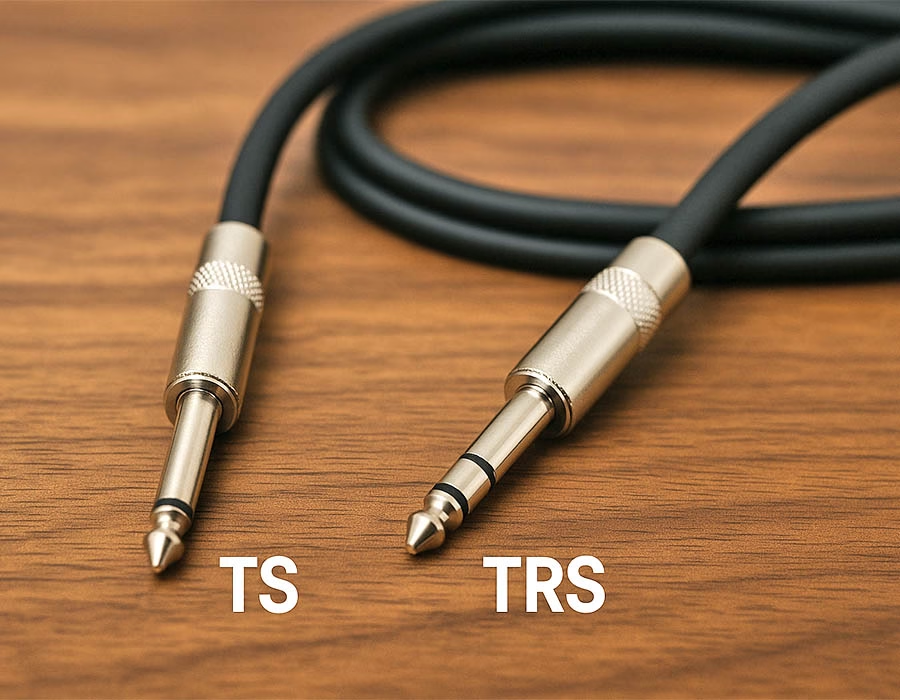
| Connector Type | Contacts | Signal | Typical Use |
|---|---|---|---|
| ¼″ TS (Mono) | 2 (Tip, Sleeve) | Unbalanced mono | Electric guitar, bass, keyboards (instrument cables) |
| ¼″ TRS (Stereo/Bal) | 3 (Tip, Ring, Sleeve) | Stereo or balanced | Headphones, studio monitors, balanced line interconnects |
Key Applications
Music & Recording
In music production, ¼″ cables are everywhere. Guitars and basses plug into amps or mixers with TS instrument cables. Depending on the device, keyboards, drum machines, and effects units may use TS or TRS outputs. Synthesizers and stereo keyboards often use ¼″ TRS cables for balanced or stereo line-level signals. Use well-shielded cables and keep runs short to preserve tone and minimize hum.
Broadcasting & Live Audio
Broadcast studios and live sound rigs rely on ¼″ connectors for patching and monitoring. Mixer and console patching often uses ¼″ cables. Balanced TRS cables carry line-level audio between equipment, helping to reject noise over long runs. Many studios and venues use ¼″ jacks for headphone outputs and monitor sends. Proper cable routing and grounding keep these multi-device signal paths clean.
Consumer Electronics
In home and consumer audio, ¼″ jacks appear on some receivers, studio monitors, and practice amps. Many audio interfaces and headphone amplifiers offer ¼″ outputs (often alongside 3.5 mm ports) for users seeking professional connectivity. Though most portable devices favor smaller 3.5 mm plugs or wireless, adapters are available. Serious users still prefer rugged 6.35 mm cables for studio-quality sound and durability.
Key Technical Factors
- Shielding: Use cables with braided or foil shields to block interference. (Instrument cables include shielding, while speaker cables use unshielded heavy conductors.)
- Gauge: Standard instrument cables use ~20–24 AWG conductors, while speaker cables use much thicker 12–16 AWG wire.
- Balanced vs Unbalanced: For long or noisy environments, choose ¼″ TRS (balanced) cables to reduce hum. TS (unbalanced) cables work for short instrument connections.
- Length: Keep cable runs as short and straightforward as possible. Longer cables or extra adapters increase the risk of hum and signal loss.
- Connectors: Choose quality plugs (gold or nickel plated) for corrosion resistance and a snug fit, ensuring a stable connection.
Quality and Reliability
High-quality cables start with reliable manufacturing. Romtronic International Co., Ltd. is a professional cable assembly manufacturer with 28+ years of OEM/ODM experience. Its factory is ISO 9001 and IATF 16949 certified, reflecting rigorous quality standards. Romtronic’s custom ¼″ audio cable assemblies serve clients worldwide, underscoring their commitment to durability and performance.
Choosing the right ¼-inch audio cable—with proper wiring, shielding, and connectors—ensures clear, noise-free signal transmission across music production, broadcasting, live sound, and consumer systems. Trusted manufacturers like Romtronic demonstrate how quality-driven design and craftsmanship keep professional audio connections reliable.
.avif)
Sam Wu is the Marketing Manager at Romtronic, holding a degree in Mechatronics. With 12 years of experience in sales within the electronic wiring harness industry, he manages marketing efforts across Europe. An expert in cable assembly, wiring harnesses, and advanced connectivity solutions, Sam simplifies complex technologies, offering clear, actionable advice to help you confidently navigate your electrical projects.

