Premier Manufacturer

In this article, we’ll discuss the three basic types of high-speed cables used in data centers, enterprise networks, and edge computing. These cable types (AOC – Active Optical Cable, DAC – Direct Attach Copper, Fiber Patch Cables) offer high bandwidth but differ significantly in cost, distance capability, power consumption, EMI performance, and flexibility.
We hope that by the end of this article, you’ll understand each cable type in simple, practical terms, so you can select the right one for your application without unnecessarily overspending on equipment or over-engineering your solution.
What Is an AOC (Active Optical Cable)?
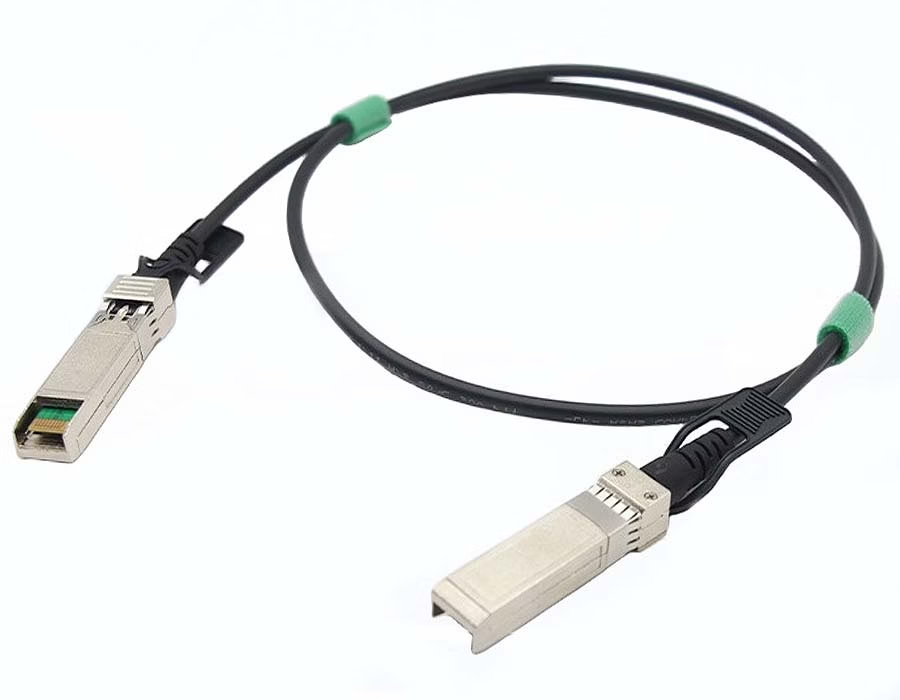
An AOC is a fully integrated optical cable with transceivers built into each end.
It converts electrical signals to light internally, making it:
- Lightweight and flexible
- Capable of long-distance runs (up to 100m)
- Immune to EMI
- Great for 10G/25G/40G/100G+ connections
Common use cases:
Rack-to-rack links, ToR–MoR connections, storage network uplinks.
Pros:
- Long reach
- High bandwidth
- Extremely EMI-resistant
- Plug-and-play (no separate transceivers)
Cons:
- Higher cost
- Consumes 1–2W per end
- Not field-repairable
What Is a DAC (Direct Attach Copper Cable)?

A DAC is a copper assembly designed for very short connections, usually inside a rack.
- Passive DAC: Zero power consumption
- Active DAC: Boosted signal for slightly longer distance (~10–15m)
Common use cases:
Server-to-switch, switch-to-switch inside the same rack.
Pros:
- Lowest cost
- Ultra-low latency
- No EMI-converting electronics
- Plug-and-play simplicity
Cons:
- Limited distance
- Copper is heavier and less flexible
- Not EMI-immune
What Is a Fiber Optic Patch Cable?
Fiber-optic patch cables are made of pure glass or plastic fiber with connectors such as SC, FC, LC, ST, or MPO.
Unlike AOCs, they require separate transceivers (SFP+, QSFP28, OSFP, etc.).

Common use cases:
- Telecom rooms
- Data center backbone
- ODF to switch connections
- Long-distance indoor/outdoor fiber runs
Pros:
- Most extended reach (meters to kilometers)
- Works with any compatible optical module
- High reliability and low loss
- Ideal for structured cabling
Cons:
- Requires choosing the right transceivers
- Installation can require fiber-handling experience
Comparison Table: AOC vs DAC vs Fiber Optic Patch Cable
| Feature | DAC Cable | AOC Cable | Fiber Optic Patch Cable |
|---|---|---|---|
| Cable Type | Copper | Fiber Optic | Fiber Optic |
| Max Distance | 1–15m | Up to 100m | Up to 40km+ |
| Cost | Lowest | Medium | Highest (depends on modules) |
| EMI Immunity | No | Yes | Yes |
| Power Consumption | Very Low | 1–2W | Varies by module |
| Flexibility | Low | High | High |
| Deployment | Plug-and-play | Plug-and-play | Requires transceivers |
| Best Use Case | Short-distance inside racks | Medium-distance high-bandwidth | Long-distance or structured cabling |
Which One Should You Choose?
✔ Choose DAC if:
- You need the cheapest solution
- The distance is under 5–10m
- You’re connecting servers to a ToR switch
✔ Choose AOC if:
- You need 10–100m
- You want flexibility and EMI immunity
- You don’t want to mix-and-match transceivers
✔ Choose Fiber Optic Patch Cables if:
- You want maximum distance
- You need to run a structured fiber
- You prefer customizing transceivers (10G–400G)
.avif)
Sam Wu is the Marketing Manager at Romtronic, holding a degree in Mechatronics. With 12 years of experience in sales within the electronic wiring harness industry, he manages marketing efforts across Europe. An expert in cable assembly, wiring harnesses, and advanced connectivity solutions, Sam simplifies complex technologies, offering clear, actionable advice to help you confidently navigate your electrical projects.