


Built for the Rugged Reality of Mobile Robots
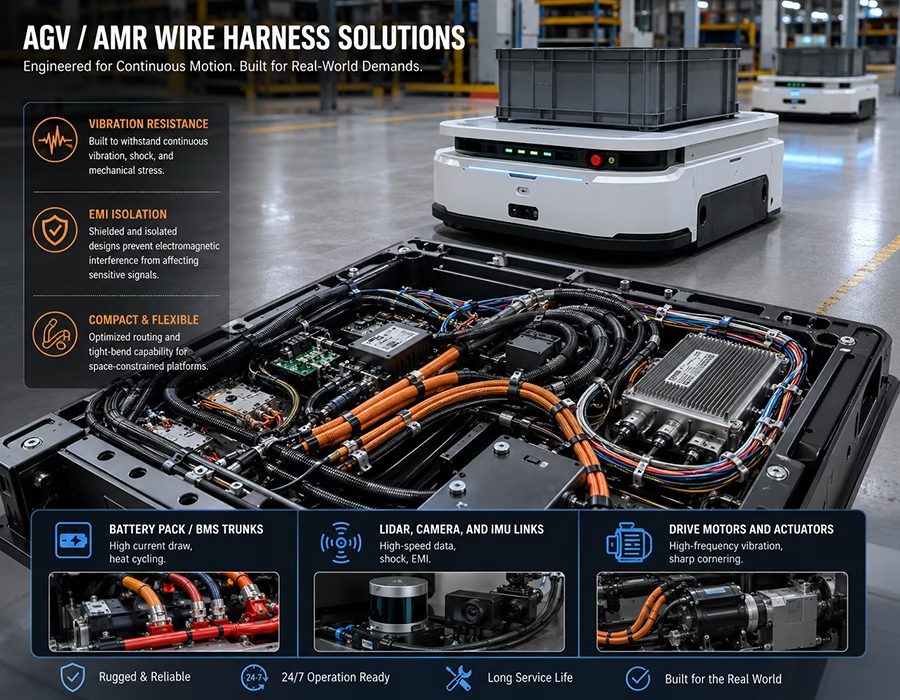
If you run a fleet of AGVs or AMRs, the wire harness is usually the last thing anyone thinks about — until it fails. A well-built AGV AMR wire harness has to survive conditions a fixed industrial cabinet never sees. These robots don’t sit still. They roll over expansion joints, dock plates, and cracked concrete for two or three shifts a day. Every one of those small bumps travels straight into the wiring.
That’s the real cause of most harness failures in the field: not one dramatic event, but thousands of small ones stacking up. Crimped terminals loosen. Solder joints fatigue. A connector seated fine on day one starts walking itself loose by month six. A second problem hides underneath, too. AGVs and AMRs pack high-current drive electronics right next to sensitive LIDAR and camera wiring in a tight chassis. Without proper isolation, electromagnetic noise from the drivetrain bleeds straight into the navigation system.
Here’s a quick breakdown of where things typically go wrong:
| System | What It’s Exposed To |
|---|---|
| Battery pack / BMS trunks | High current draw, heat cycling |
| LIDAR, camera, and IMU links | High-speed data, shock, EMI |
| Drive motors and actuators | High-frequency vibration, sharp cornering |
Romtronic engineers its AGV AMR wire harness builds specifically for this combination: vibration resistance, EMI isolation, and tight-footprint routing for platforms that run around the clock.
What Goes Into a Reliable AGV AMR Wire Harness
We design around three problems at once: getting power where it needs to go, keeping sensor data clean, and surviving years of vibration without babying the vehicle.
Power: High-Current Battery and BMS Wiring
Fast-charging lithium-ion packs throw off real heat, especially during opportunity charging between shifts. So we build these power trunks with high-temperature silicone or cross-linked polyethylene (XLPE) insulation. Both materials hold up under sustained heat without hardening or cracking, unlike standard PVC over time. We terminate these lines with heavy-duty, tin-plated copper lugs or locking blind-mate connectors, so vibration can’t work a connection loose into an arc fault.
Signal: Shielding That Survives the Drivetrain Next Door
Your navigation stack is only as good as the data feeding it. That’s why we build low-voltage signal lines with floating braided shields rated above 95% surface coverage. This keeps high-frequency motor noise from bleeding into LIDAR, camera, and IMU lines. It matters more than it sounds, too. From the safety controller’s point of view, a single corrupted sensor packet often looks identical to a real obstruction. That’s exactly how you end up with robots stopping in the middle of an aisle for no reason.
Mechanical: Terminations That Don’t Back Out on Their Own
Standard plastic latches loosen under sustained vibration — it’s just a matter of time. So we spec industrial, positive-locking connector systems instead: Molex, JST, or ruggedized circular series, depending on the application. These physically lock in place rather than friction-fit. We also wrap breakout points in woven split sleeving, so wires aren’t chafing against sharp metal chassis edges every time the vehicle turns.
AGV/AMR Harness Configuration Matrix
| Zone | Core Challenge | Our Engineering Fix |
|---|---|---|
| Main Battery & BMS Lines | Heavy current draw, temperature swings, thick wire routing | High-flex, large-gauge copper power lines in heat-resistant XLPE, terminated with gas-tight crimped lugs |
| LIDAR & Sensor Assemblies | Signal degradation, high data rates, EMI noise | Low-capacitance twisted-pair cable under a 360° braided shield with overmolded connectors |
| Drive Wheel Actuators | High-frequency vibration, mechanical shock, tight bend radii | IEC 60228 Class 6 extra-fine stranded copper in abrasion-resistant PUR jacketing |
| Safety Bumper & Flasher I/O | Dust, moisture, and impact exposure | IP67-rated overmolded sub-harnesses with elastomer seal backings |
Two Failure Modes We See Constantly
Loose crimps causing random power drops. A forklift or AMR rolls over the same expansion joint a thousand times a day. Marginal crimps develop micro-fretting at the contact surface under that kind of repeated stress. That wear raises resistance slowly. Eventually, you get heat buildup, voltage sag, or a battery controller shutting the vehicle down mid-route — usually at the worst possible time. So we catch this at the source: automated, real-time crimp-force monitoring checks every termination during assembly. Every connection ends up a true cold weld, not a friction fit that degrades over years of use. Our guide to common failure modes in cable assemblies goes deeper into how we catch these issues during design review.
Sensor “ghosting” that triggers false emergency stops. Route a CAN bus or Ethernet data line too close to a motor cable without real isolation, and EMI will eventually corrupt a packet. Here’s the problem: a corrupted LIDAR frame looks exactly like a real obstruction to the safety controller. So the robot slams on the brakes for nothing, right in the middle of an aisle. We fix this with dedicated internal spacing protocols and high-coverage tinned-copper shielding. We also decouple that shield from the outer jacket with a low-friction wrap film, so the whole bundle can flex through tight compartments without tearing. For more, see our post on cable assembly requirements for AGV and AMR robot manufacturers.
Manufacturing Standards and QC
Every harness we build goes through the same gate sequence before it ships:
Inbound Component Verification → Real-Time Crimp Monitoring → Three-Stage Testing → Zero-Defect Shipment
| Gate | Test | What It Confirms |
|---|---|---|
| 1 | Post-crimp optical inspection | Crimp geometry and contact placement |
| 2 | High-voltage dielectric test | Insulation integrity at rated voltage |
| 3 | Mechanical pull & continuity test | Termination strength and circuit continuity |
Terminal crimps, solder joints, and wire dressing all follow workmanship criteria under IPC/WHMA-A-620. That’s the standard most manufacturers reference for high-reliability cable and harness work. Our production lines also run High-Mix, Low-Volume (HMLV), so a niche AGV prototype or a small proprietary batch won’t get stuck behind a minimum-order-quantity wall. For broader context, industry coverage has increasingly tracked the demand for high-flex, purpose-built interconnects as mobile and autonomous platforms scale up.
FAQ
A: High-temperature silicone or cross-linked polyethylene (XLPE). Both resist hardening and cracking under the heat cycling of fast charging, unlike standard PVC.
A: Floating braided shields rated above 95% surface coverage, isolating high-frequency motor noise from sensitive navigation data.
A: IPC/WHMA-A-620 Class 3 workmanship criteria. We verify it through a three-stage testing gate: post-crimp optical inspection, high-voltage dielectric testing, and mechanical pull/continuity testing.
A: Yes. Our lines are set up for High-Mix, Low-Volume (HMLV) production, so small or one-off builds aren’t held to standard minimum order quantities.
A: Submit your BOM, drawings, or 3D models. We return a DFM assessment and production quote within 24 hours, with initial engineering feedback within 12 hours.
Talk to Our Engineering Team
Cabling problems eating into your fleet’s uptime? Or maybe you’re finalizing a new AMR platform and want the wiring right the first time. Either way, send us your files. Upload your 2D wiring prints, 3D models, or BOM. We’ll run a full DFM review and send back a production quote within 24 hours.