


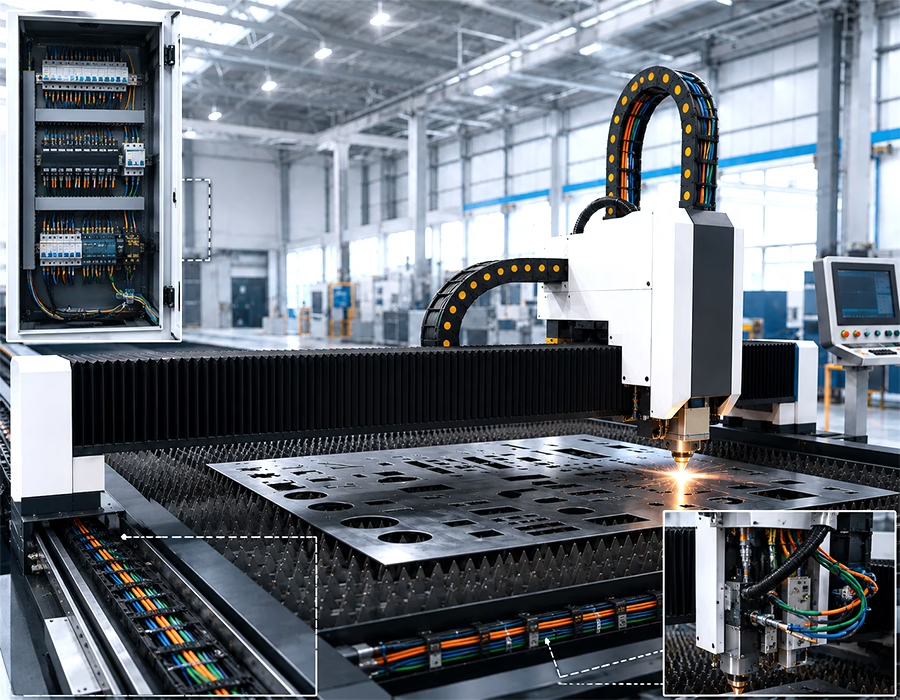
Kilowatt Fiber Resonators, Fast Gantry Moves, and Heavy EMI — All in One Machine
Wiring an industrial laser cutter is its own kind of engineering puzzle. You’ve got sensitive digital motion signals, real-time galvo control loops, and gas assist telemetry running right next to high-frequency RF power supplies. All of that sits next to high-voltage laser resonators and big servo drives, packed into the same footprint.
That’s a tough spot for a cable to survive in. Internal harnesses in these machines handle constant high-flex gantry acceleration inside drag chains. On top of that, they face nonstop exposure to abrasive metal dust and heavy high-frequency EMI.
Here’s the real-world consequence: one control cable wears through from flex fatigue, so your laser head loses positioning accuracy, or it just stops firing mid-cut. Either way, that’s scrapped sheet metal, a fried optical component, and a production line down while someone tracks the fault.
We build our wire harness assemblies specifically to avoid that outcome. That means high-performance internal harnesses, double-shielded sensor trunks, and high-flex gantry cable track assemblies. All of it is engineered to survive millions of flex cycles, while still keeping communication logic isolated from electrical noise.
We Take the Guesswork Out of Small-Batch Production for Industrial Laser Cutters
We’ve spent 29 years in OEM and ODM contract manufacturing for industrial CNC and laser machinery. If you run high-mix, low-volume (HMLV) laser automation builds, that’s exactly the kind of project we’re set up for. We take cable routing headaches off your plate.
Send us your mechanical layouts and schematics, and we’ll ship back pre-tested, fully verified drop-in harnesses ready for your assembly floor. You won’t need to manage internal wiring sub-processes on your end.
- ISO 9001 factory validation. Every laser cutter harness runs through our certified quality pipeline before it’s packed.
- IPC-A-620 Class 3 build standard. Every internal wiring branch, heavy-duty termination, and shield ground meets the highest workmanship standard used in high-reliability industrial electronics.
- Three-gate inspection. We check every assembly with an automated post-crimp optical sweep, a high-voltage insulation dielectric test, and a final mechanical pull test.
- Oil, dust, and flame-resistant jacketing. We use polyurethane (PUR) and fluoropolymer (PTFE/FEP) insulation built to shrug off cutting oils, metallic dust, and thermal strain without cracking. (Not sure which jacket material fits your machine best? Worth a quick read.)
What Actually Goes Wrong in Industrial Laser Cutter Wiring — And How We Design Around It
Sloppy point-to-point machine wiring is a slow-motion failure waiting to happen. Cables bind in drag chains, heat gets trapped inside drive cabinets, and field maintenance turns into a guessing game.
That’s why we pre-sort and pre-bundle our wire harness kits before they ever leave the factory. They drop straight into control enclosures, gantry tracks, and laser head modules without extra field labor:
- High-flex, continuous crimp metallurgy. Rapid gantry acceleration snaps standard copper strands right at the termination point. We monitor crimp force automatically on ultra-fine, high-strand-count conductors. It’s the same principle behind flex cabling engineered for millions of cycles on collaborative robot arms — repeated bending physics doesn’t care whether it’s a robot joint or a gantry axis.
- Low-capacitance, double-shielded data lines. To keep EtherCAT, CAN bus, or analog galvo control loops from dropping packets near the laser power source, we wrap data pairs in a high-coverage (95%+) tinned copper braid, backed by an aluminum foil layer.
- Laser-marked, pre-bundled branch layouts. Every conductor gets laser-marked with alphanumeric tags every 20mm. We pre-bind them so each one routes straight to the right servo drive or I/O module. No guesswork on the line.
Getting the bend radius right matters just as much as picking the right conductor. A cable that’s technically flex-rated will still fail early if you route it too tight through the drag chain.
Material and Compliance Reference for Industrial Laser Cutter Wiring
| Wiring Application | Material Spec | Why It Matters |
|---|---|---|
| Gantry motion & drag chain power | High-flex PUR jacket, ultra-fine copper stranding (Class 6) | Engineered for millions of continuous bending and torsional cycles without conductor breakage |
| Galvanometer & optical sensor feedback | Low-capacitance twisted-pair, FEP insulation, braided shield | Preserves sub-micron positioning feedback by isolating signals from nearby laser arcs |
| High-voltage laser source control | Silicone or PTFE insulation, rated 10kV+ | Delivers dielectric strength and thermal resistance right next to the resonator |
| Cabinet distribution & power supplies | UL 1015 / UL 1028 tinned copper, flame-retardant PVC | Rated 600V up to 105°C. Handles current surges from multi-axis servo acceleration |
For drag chain applications specifically, the jacket choice matters as much as the conductor. Our breakdown of PUR vs. TPE jackets for drag chain cable covers: which one actually lasts longer under continuous motion.
Two Failure Modes We Design Every Industrial Laser Cutter Harness Around
EMI Cross-Talk from High-Frequency Laser Resonators
When a fiber or CO2 laser source pulses, it throws off serious high-frequency EMI. Run your low-voltage sensor lines, safety interlocks, or limit switch feedback too close to those power feeds, and that noise causes real problems. You’ll see false emergency stops, ghost tracking errors, or erratic laser firing you can’t explain.
We design around this with custom-shielded branch harnesses. Sensitive communication lines sit inside a tinned copper braid Faraday cage (95%+ coverage) with dedicated drain wires. That setup grounds out the high-frequency noise and keeps your data streams clean through every cutting cycle. (We’ve also written about copper vs. aluminum foil shielding tradeoffs if you want the material science behind it.)
Conductor Fatigue in High-Acceleration Gantry Systems
Modern fiber laser cutters run linear motors or high-speed servo drives capable of over 2G of acceleration. Standard industrial wiring just doesn’t survive that kind of nonstop snapping motion. The copper strands work-harden and eventually break inside the jacket, leaving an intermittent open circuit that’s brutal to diagnose.
We build dynamic gantry harnesses to strict IPC-A-620 Class 3 standards to prevent this. That means high-flex, small-diameter conductors, paired with precision-molded strain reliefs and frictionless outer jackets. This combination kills the internal binding and tension points that cause conductor fatigue in the first place. The result: dynamic connections that stay reliable through millions of cycles.
Frequently Asked Questions
A: For the gantry and drag chain, you want a high-flex, PUR-jacketed cable with fine-strand copper conductors rated for continuous bending. For galvo and sensor feedback lines, low-capacitance shielded twisted pair with FEP insulation holds positioning accuracy better than standard hookup wire.
A: Industrial-grade drag chain cable typically handles several million bend cycles. The real number depends on bend radius, travel speed, and how tightly you route the cable. Under-speccing this is one of the most common causes of premature cable failure in gantry-driven machines.
A: This usually comes down to one of two things. Either EMI noise is bleeding into a sensor or communication line from the laser resonator or servo drives, or a conductor has fatigued and cracked from repeated flexing in the drag chain. Both have distinct fixes: shielding for the first, and a high-flex cable rated for the actual cycle count for the second.
A: Yes. Galvo control signals are low-voltage and precision-sensitive, which makes them vulnerable to EMI from nearby laser power supplies and servo drives. Shielded, low-capacitance twisted pair is the standard here, since even small noise pickup can throw off sub-micron positioning accuracy.
A: High-voltage laser source control lines commonly need ratings of 10kV or more, depending on the resonator type. Silicone or PTFE insulation is the usual choice here, since both hold up well against the heat and dielectric stress of running right next to the laser source.
A: Both handle continuous motion, but they trade off differently on abrasion resistance, oil resistance, and cost. PUR generally holds up better against oils and abrasive dust, making it the more common choice for laser-cutting environments.
Put Our Industrial Laser Cutter Interconnect Lab to Work
High-speed laser cutting leaves zero room for erratic signals, brittle insulation, or weak terminations. Maybe you’re chasing intermittent tracking drops. Maybe you’re re-engineering a CNC cabinet layout, or scaling up a new high-power fiber laser model. Either way, we can help you get ahead of it.
Want to see real-world teardown data from laser cutter harnesses we’ve built for other machinery brands? Just ask. Our engineering team is happy to share it.
Send your 2D wiring prints, cabinet schematics, or BOM to our Engineering Hub. Our team of 12 wiring engineers will run a full DFM audit and send you a clean production quote within 24 hours.
If your build also touches servo drives or PLC-based control cabinets, our pages on servo motor drive harnesses and PLC control cabinet wiring cover the adjacent engineering in more depth. And for the bigger-picture reliability case, our guide to extending cable assembly lifespan in harsh environments is a solid next read.