


Balancing Weight Limits with High-Signal Precision
Every commercial UAV program needs a UAV drone wire harness engineered for unforgiving aerodynamic and mechanical conditions. Unlike ground-based robotics, airborne systems are strictly bound by tight payload weight limits and compact enclosure dimensions — every unnecessary gram directly increases total flight time, reduces thermal efficiency, and limits equipment battery life.
- High-Voltage Propulsion Systems → Continuous EMI noise, thermal loading
- Thermal & Optical Gimbal Feeds → Continuous pan/tilt bending, micro-shielding demands
- LiDAR & Hyperspectral Payloads → Ultra-high-speed data lanes, strict SWaP limits
The core engineering challenge inside a drone fuselage is isolating low-voltage sensor data from the heavy electromagnetic interference (EMI) generated by high-voltage brushless motors and Electronic Speed Controllers (ESCs). Without proper shielding layouts and lightweight insulation, high-frequency motor noise can leak into sensitive LiDAR return lines, GPS receivers, and optical gimbal feeds — causing telemetry drift, corrupted sensor data, or signal packet drops that risk mid-air system failures.
Romtronic designs and builds custom, ultralight internal wire harnesses optimized for strict Size, Weight, and Power (SWaP) constraints, protecting critical airborne electronics without adding dead weight.
Technical Benchmarks: What Makes a Reliable UAV Drone Wire Harness
To ensure zero-dropout performance during long-range inspection or mapping flights, we configure our drone and payload wire assemblies across three key performance parameters.
1. Advanced Structural Weight Reduction
To minimize payload mass, we build signal lines using lightweight, high-performance insulating materials such as ETFE (Tefzel) or thin-walled FEP. These fluoropolymers offer high dielectric strength relative to their thickness, allowing thinner insulation walls at a given voltage rating than conventional PVC—reducing overall bundle weight without derating electrical performance. Where applicable, we also replace heavy copper braided shields with ultra-thin aluminum foil laminates or lightweight conductive textile matrices, further cutting bundle mass without compromising EMI performance.
2. High-Density Micro-Connectors
Standard industrial connectors are too heavy and bulky for tight drone bays. We specify micro-miniature, secure-locking connector families—including specialized Hirose, JST, and ruggedized Harwin Gecko/Datamate series—with pitch spacing down to 1.25 mm or smaller, while maintaining gas-tight connection integrity under high structural vibration.
3. Comprehensive Environmental Protection
Drone payloads routinely fly through high humidity, morning fog, coastal salt spray, and extreme temperature swings at altitude. We apply custom low-pressure overmolding and specialized elastomer potting to vulnerable wire breakout joints, sealing out moisture and airborne dust to maintain stable electrical isolation across the operating envelope — typically rated for continuous service from -65°C to 150°C, consistent with the MIL-W-22759/16 aviation wire specification that ETFE (Tefzel) hook-up wire is commonly built to.
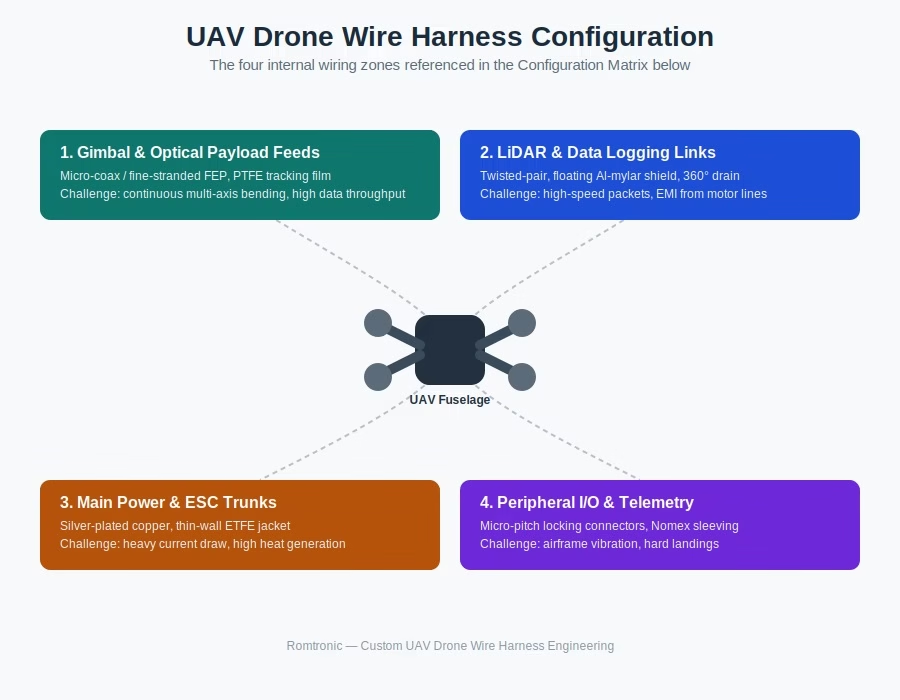
UAV Payload Harness Configuration Matrix
| Application Zone | Core System Challenge | Engineered Interconnect Solution |
|---|---|---|
| Gimbal & Optical Payload Feeds | Continuous multi-axis bending, strict weight limits, high data throughput | Micro-coaxial or ultra-fine stranded FEP wire bundles wrapped in low-friction PTFE tracking film for fluid joint rotation |
| LiDAR & Data Logging Links | High-speed packet delivery, EMI vulnerability from neighboring motor lines | Low-capacitance twisted-pair cable protected by a floating aluminum-mylar shield with 360° drain-wire termination |
| Main Power & ESC Trunks | Heavy continuous current draw, high heat generation, layout flexibility | High-strand, silver-plated copper conductors jacketed in heat-resistant, thin-wall ETFE insulation |
| Peripheral I/O & Telemetry Modules | Mechanical stress from airframe vibration and hard landings | High-density micro-pitch connector housings with positive-locking latches and abrasion-resistant Nomex sleeving |
Overcoming Critical Engineering Failures in Drone Electronics
Issue 1: Vibration-Induced Micro-Fretting and Intermittent Telemetry
Airborne systems face constant high-frequency vibration from multi-rotor propulsion lines. Substandard terminal crimps or non-locking friction-fit connectors experience micro-fretting inside the contact zone. Over repeated flight cycles, this wear degrades the electrical connection, causing intermittent telemetry drops or temporary sensor “ghosting” that can trigger automatic return-to-home protocols.
Our approach: Romtronic uses automated, real-time crimp-force monitoring across the production line to verify a consistent, cold-welded joint on every micro-termination. This produces a low-resistance contact path that remains mechanically secure under continuous flight vibration, rather than relying solely on post-production spot checks.
For a deeper look at identifying and isolating these hidden connection failures, see Common Failure Modes in Cable Assemblies & Wire Harnesses.
Issue 2: Shielding Breakdown and Sensor Packet Corruption
Standard heavy braided copper shields tend to crack when routed through compact, continuous-rotation camera gimbals. Once the shielding layer degrades, electromagnetic noise from nearby power lines can leak into the payload’s low-voltage data lines, causing video artifacting or corrupted telemetry packets.
Our approach: We deploy flexible, high-tensile copper-alloy micro-braids or ultra-thin conductive foil layers, separated from the outer jacket with specialized lubricating wraps. This lets the full bundle flex freely within tight gimbal cavities without tearing the shield or interrupting data coverage.
To learn more about tailoring wiring layouts to compact robotic mechanics, see Cable Assembly Requirements for AGV and AMR Robot Manufacturers.
Quality Standards & Verification Process
Every custom UAV drone wire harness passes through a structured production and testing sequence before shipment:
Inbound Component Validation → Real-Time Crimp Monitoring → Three-Stage Quality Testing Gate → Zero-Defect Shipment
| Gate | Test | Purpose |
|---|---|---|
| Gate 1 | Post-crimp optical inspection | Verifies crimp geometry and contact placement |
| Gate 2 | High-voltage dielectric test | Confirms insulation integrity under rated voltage |
| Gate 3 | Mechanical pull & continuity test | Validates termination strength and circuit continuity |
- Optimized for High-Mix, Low-Volume (HMLV) production: our manufacturing infrastructure efficiently handles custom, small-batch runs — so you can source premium, engineered harnesses for niche or proprietary drone builds without being forced into restrictive minimum order quantities.
Submit Your Design for Engineering Review
Don’t let cabling issues limit the flight time or compromise sensor reliability of your commercial UAV program. Whether you’re re-engineering a problematic wire layout on an active drone model or finalizing schematics for a prototype payload system, our engineering team can help optimize your layout.
Upload your 2D wiring prints, 3D mechanical models, or Bill of Materials (BOM) directly to our team. We’ll conduct a comprehensive Design for Manufacturability (DFM) assessment and return a detailed production quote within 24 hours, with full engineering feedback within 12 hours of submission.