


Deep water doesn’t forgive bad wiring. A subsea ROV or AUV working a few thousand meters down needs a subsea ROV wire harness that can take a beating no terrestrial machine ever sees, and it has to keep working the entire time. Pressure alone is the first problem: it climbs by roughly one atmosphere for every 10 meters of depth. Any microscopic air pocket trapped inside a standard harness will implode the moment it hits real depth.
Then there’s the seawater itself. It’s basically a conductive electrolyte, so the smallest breach in the outer jacket — a pinhole, a nick from handling — turns into galvanic corrosion almost immediately. That reaction eats through copper conductors fast, and a corroded conductor doesn’t fail gracefully; it just stops working, usually at the worst possible moment. On top of that, thruster vibration is constantly tugging at every termination, which is exactly the kind of repeated stress that pulls a standard crimp apart over time.
| System | What It’s Up Against |
|---|---|
| Thruster & propulsion power lines | High current draw, constant vibration, direct seawater exposure |
| HD cameras & sonar links | EMI from thrusters, pressure-induced signal distortion |
| Manipulator arm & hydraulic controls | Multi-axis bending, abrasive seabed debris, hydraulic fluid |
Romtronic builds pressure-tolerant, watertight harnesses for this environment, engineered to survive the chemistry and physics of the deep ocean.
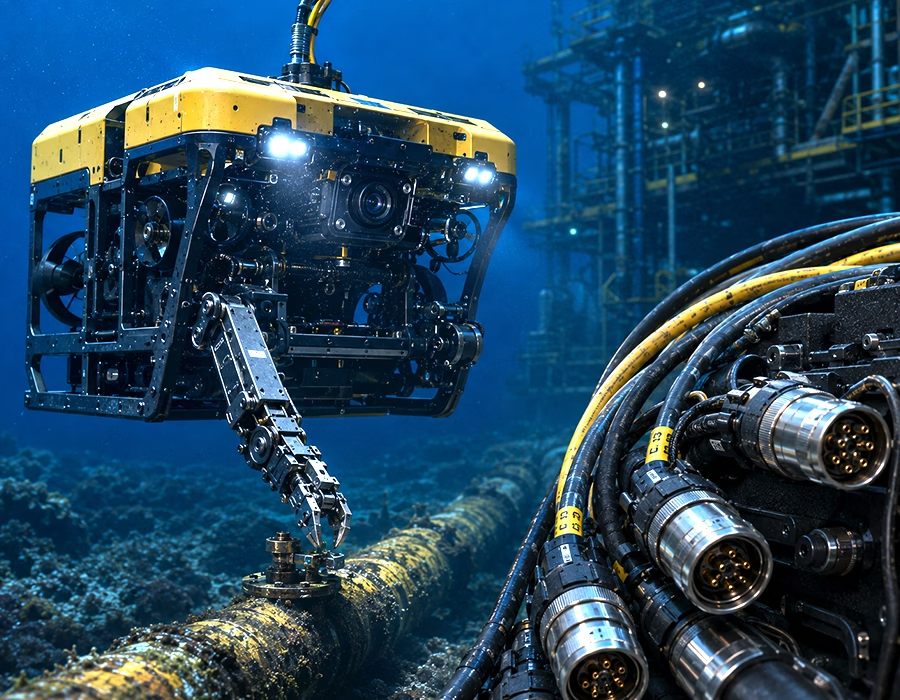
What a Subsea ROV Wire Harness Actually Needs to Survive Down There
We build around three specific failure points that terrestrial cable was never designed to handle.
1. Marine-Grade Tinned Copper Conductors
Bare copper corrodes fast once moisture gets anywhere near it, and in a submerged pod, moisture eventually gets everywhere. So we build every conductor from tinned copper instead. The tin coating resists oxidation and galvanic reaction far better than bare copper does, which matters most in the exact scenario you’re trying to avoid: a nick in the jacket that lets a little moisture wick along the wire core. Tinning slows that process down dramatically, buying real time before a minor breach turns into a real failure.
2. Void-Free Overmolding in Polyurethane
At depth, trapped air is a structural liability, not just an inconvenience. So we use high-density polyurethane (PUR) or specialized elastomeric jacketing, both of which shrug off oil, fuel, and saltwater exposure. We mold every joint with high-pressure liquid injection instead of standard casting, specifically to eliminate the internal air voids that would otherwise collapse under hydrostatic pressure.
3. Corrosion-Resistant, Wet-Mateable Connectors
A standard connector doesn’t last long under salt spray, let alone full submersion. That’s why we spec marine-grade connectors rated IP68 or wet-mateable for true subsea use — nickel-plated brass or stainless steel housings, double O-ring seals, and gold-plated pins, all working together to keep contact resistance low even after years underwater.
Subsea ROV & Marine Robotics Configuration Matrix
| Zone | Core Hazard | Engineering Fix |
|---|---|---|
| Thruster & Propulsion Power Lines | High current draw, dynamic motor vibration, constant seawater exposure | Extra-flexible, large-gauge tinned copper in oil- and UV-resistant PUR insulation with molded strain reliefs |
| HD Cameras & Sonar Signal Links | High-bandwidth data attenuation, thruster EMI, pressure-induced distortion | Fully shielded twisted-pair cable with 100% aluminum-mylar foil under a high-density tinned copper braid |
| Hydraulic Valve & Manipulator Arm Controls | Continuous multi-axis bending, abrasive seabed contact, hydraulic fluid exposure | High-flex, chemical-resistant bundles under abrasion-resistant woven sleeving |
| Battery Compartment & BMS Interconnects | Salt-mist corrosion, chemical outgassing, thermal buildup in sealed pods | Flame-retardant XLPE insulation with heavy-wall dual-wall heat-shrink terminations |
Two Failures We See Constantly in Marine Deployments
Capillary wicking after a jacket breach. Once a standard cable jacket is breached underwater, ambient pressure does the rest of the damage for you—it forces seawater straight into the bundle, and capillary action carries that moisture along the copper strands into the sealed electronics pod. From there, it’s just a matter of time before it corrodes a circuit board or takes out expensive navigation hardware. We catch this with meticulous, multi-point sealing checks at every termination, using the same marine-grade material approach behind our marine-grade cable assemblies for offshore wind farms.
Pin pitting from salt spray, even above the waterline. A vessel doesn’t have to be submerged to take damage—salt fog and sea spray attack exposed connector pins constantly, leading to pitting and intermittent data drops over time. We run our maritime connector designs through dedicated salt spray testing for marine cable assemblies to confirm they hold up mechanically and electrically over years of offshore service. For every high-vibration thruster connection, we also weigh ultrasonic welding against mechanical crimping to choose the method with the lowest resistance for that specific joint.
For broader compliance context, the National Marine Electronics Association (NMEA) and the IEC’s maritime electronics standards are the two reference bodies most manufacturers check against for marine and offshore electronics compliance.
Manufacturing Standards and QC
Every harness we build passes through the same validation sequence before it ships:
Inbound Component Verification → Real-Time Automated Crimp Checking → Three-Stage Quality Testing Gate → Zero-Defect Shipment
| Gate | Test | What It Confirms |
|---|---|---|
| 1 | Post-crimp optical inspection | Crimp geometry and contact placement |
| 2 | High-voltage dielectric test | Insulation integrity at rated voltage |
| 3 | Waterproof pressure-integrity test | Seal performance under simulated depth |
Terminal crimps, watertight overmolds, and shield terminations follow workmanship criteria under IPC/WHMA-A-620. Each build is also verified through our own independent in-house testing lab under ISO 9001-controlled processes. Our lines run High-Mix, Low-Volume (HMLV) production, so a specialized subsea or autonomous marine prototype doesn’t get stuck behind a standard minimum order quantity.
FAQ
A: Tinned copper. The tin coating resists oxidation and galvanic corrosion far better than bare copper, which matters most if the outer jacket is ever nicked or breached.
A: We mold every joint with high-pressure liquid injection rather than standard casting, specifically to eliminate internal air voids before the harness ever goes underwater.
A: IP68 or wet-mateable marine-grade connectors, with nickel-plated brass or stainless steel housings, double O-ring seals, and gold-plated pins.
A: Workmanship criteria aligned with IPC/WHMA-A-620, verified through a three-stage gate that includes a waterproof pressure-integrity test simulating actual depth conditions.
A: Yes. Our lines are set up for High-Mix, Low-Volume production, so a niche subsea or autonomous marine prototype isn’t held to a standard minimum order quantity.
Talk to Our Engineering Team
Don’t let a wiring shortcut cost you a depth rating or a mission. Whether you’re re-engineering a manipulator arm harness or finalizing the cabling for a new autonomous deep-sea platform, send us your files. Upload your 2D wiring layouts, 3D models, or BOM, and we’ll run a full DFM review and return a production quote within 24 hours.
Accepted formats: .jpg, .png, .xlsx, .pdf, .zip — max 10MB. Submissions are covered under our internal NDA policy.