In high-reliability wire harness manufacturing, selecting a joining method (crimping versus welding) is not only about choosing a method but also about selecting the long-term failure mode for your application.
To compare crimp and weld options, you can use a datasheet to evaluate the functionalities of each method. However, 10,000 thermal cycles later in an environment with lots of vibration, one method could be your hero, and the other method could result in the costliest recall of your vehicle (multi-million dollars). As a specialist in HMLV, I have seen many cases where marketing materials overpromise, and science prevails.
“With 29 years of OEM/ODM manufacturing expertise, Romtronic has mastered both ultrasonic welding and precision crimping to meet the rigorous demands of industrial and medical devices. In our independent laboratory, we perform destructive pull-force and cross-section tests to ensure that every custom termination—whether welded or crimped—exceeds industry reliability standards.”
1. The Engineering Reality: Fusion vs. Friction
To make an informed decision, we must look at the joint under a microscope.
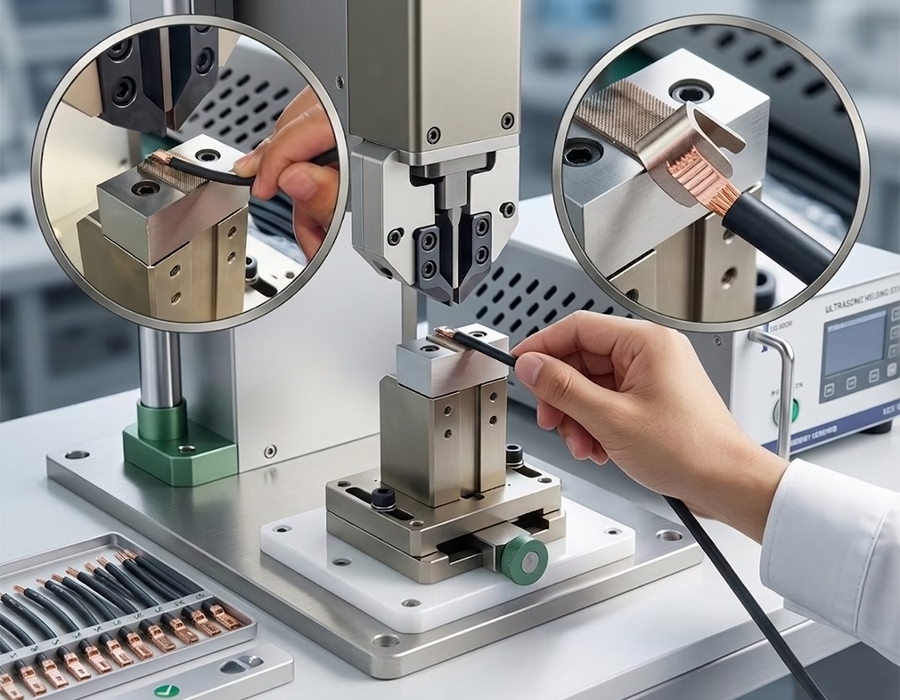
Ultrasonic Welding: The Molecular “Marriage”
This isn’t just “vibration.” It’s solid-state diffusion. By scrubbing away surface oxides at 20 kHz+, we fuse metal strands into a single solid-state mass.
- The “Invisible” Benefit: Because there is no terminal interface, there is zero interfacial resistance. In 800V EV systems, this ensures your joint doesn’t turn into a “parasitic heater” under heavy load. Our expertise in custom cable assemblies ensures these molecular bonds meet the strictest aerospace standards.
Mechanical Crimping: The Controlled “Crush”
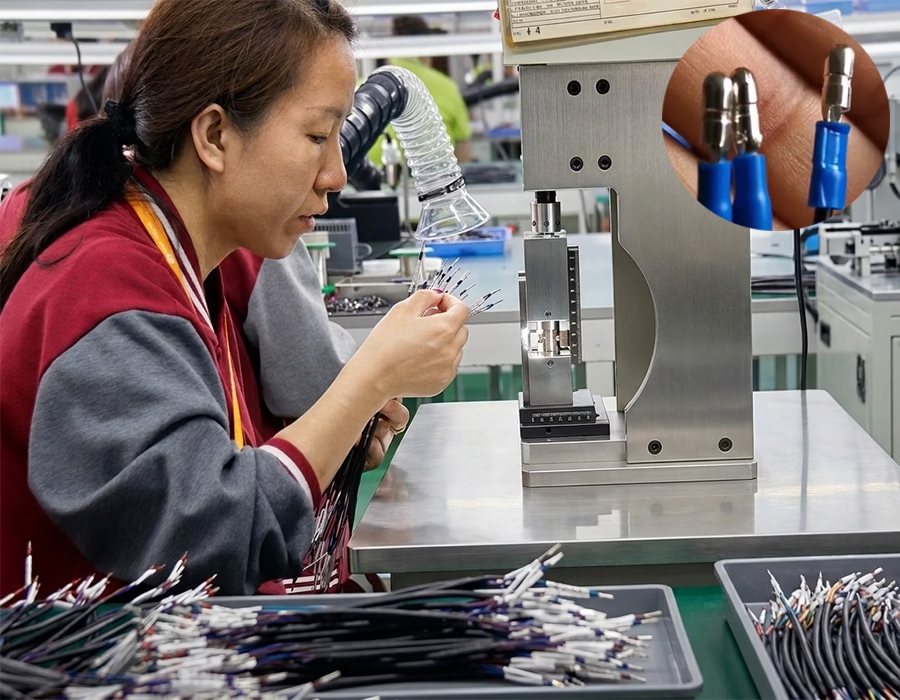
Crimping is a high-stakes game of ductility. You are forming a terminal to create a gas-tight seal.
- The “Hidden” Risk: A crimp is a living system. Over time, thermal expansion and contraction (Creep) can cause that “gas-tight” seal to breathe, leading to micro-corrosion and rising contact resistance.
2. Decision Matrix: A Direct Comparison
| Feature | Ultrasonic Welding | Mechanical Crimping |
| Electrical Stability | Superior. Resistance stays near zero for life. | Variable. Resistance creeps as the joint ages. |
| Material Synergy | The Al-Cu Savior. Fuses dissimilar metals easily. | Risk-Prone. Aluminum crimping often cracks. |
| Vibration Resistance | Brilliant. Molecular bonds don’t jiggle loose. | Vulnerable. Relies on terminal “spring-back.” |
| Maintenance Profile | High CapEx. Precision sonotrodes are costly. | High OpEx. Applicator dies wear out quickly. |
3. The “Shop Floor” Decision Framework
Choose Ultrasonic Welding If:
- You are Chasing “Zero-Heat” in High-Currents: For EV architectures or battery busbars, a crimp’s milliohm resistance is a liability. Welding is the only way to keep thermals under control.
- You are Transitioning to Aluminum: If you’re saving weight with Al-wiring, stop crimping. The oxide layer on aluminum is a stubborn insulator; only ultrasonic “scrubbing” guarantees a clean electrical path.
- Space is a Premium: Welding eliminates the bulk of the terminal. If you’re routing through a tight medical device, every millimeter counts. Our specialized medical wire harness solutions often utilize this space-saving tech.
Choose Mechanical Crimping If:
- Field Service is a Requirement: You can’t fly a 200kg ultrasonic welder to a customer site for a repair. A crimp tool fits in a technician’s backpack.
- You are in a Low-Power Signal Environment: For a standard 12V signal line with no vibration, don’t over-engineer. The ROI of a welder won’t make sense here.
- Industry-Standard Connectors: If your design dictates specific JST or Molex housings, the terminals are often engineered only for crimp applicators to ensure IP-rating compliance.
4. The Human Angle: Beyond the AI Hype
The real difference in modern manufacturing lies between Process Control and People Control.
- Crimping is only as good as the technician setting the crimp height and the quality of the terminal batch. It is a game of managing execution variability.
- Ultrasonic Welding is only as good as the initial validation. Once the energy, time, and pressure curves are locked in, the machine doesn’t get “tired.” It is a game of managing equipment precision.
At Romtronic, we don’t guess. We use our in-house lab to conduct cross-sectional analyses and pull-force testing for every new HMLV project. Whether it’s a 112Gbps high-speed link or a heavy-duty power harness, we let the Cpk (Process Capability Index) dictate the process.
Final Verdict
- Welding = High initial investment, but “sleep-at-night” reliability.
- Crimping = Low entry cost, but requires a vigilant quality team and strict tooling maintenance.
Need a Reliable Connection for Your Custom Project?
At Romtronic, we combine advanced ultrasonic welding technology with decades of wire harness production expertise. Whether you require high-conductivity welds for EV battery cables or high-speed crimping for medical sensors, our engineering team delivers precision results.
👉 Get a Custom Termination Quote in 24 Hours
.avif)
Sam Wu is the Marketing Manager at Romtronic, holding a degree in Mechatronics. With 12 years of experience in sales within the electronic wiring harness industry, he manages marketing efforts across Europe. An expert in cable assembly, wiring harnesses, and advanced connectivity solutions, Sam simplifies complex technologies, offering clear, actionable advice to help you confidently navigate your electrical projects.