Until recently, engineers paid little attention to wiring harnesses. It was sufficient for them to meet electrical specifications and pass durability tests.
Today, these assumptions no longer hold. When a certain electric vehicle platform project failed validation due to a wiring harness component, it was discovered that the issue stemmed from the component being inadvertently used as a signal entry point for electrical equipment.
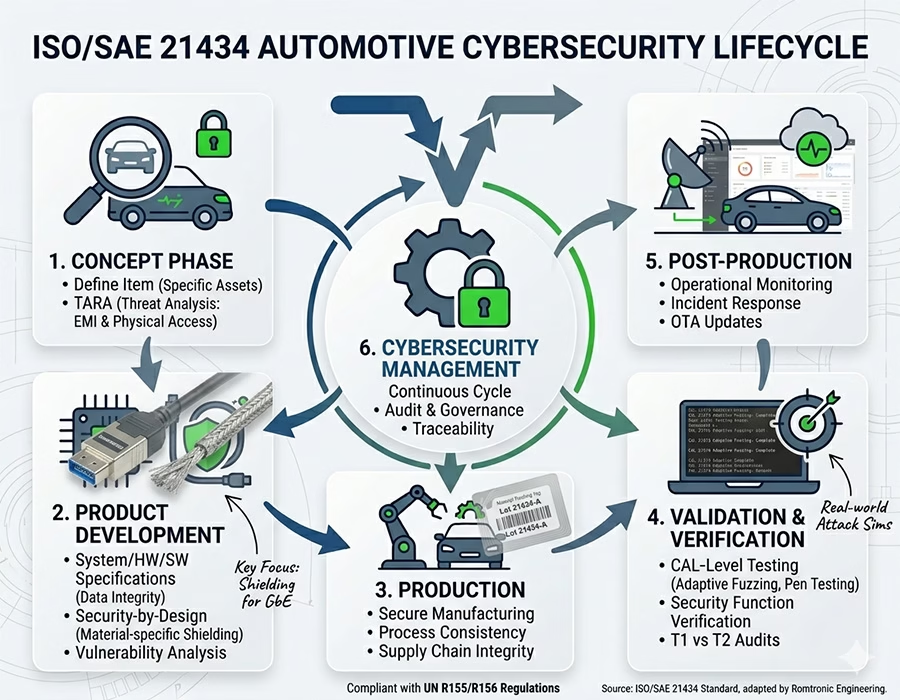
ISO 21434 will change perceptions of non-electromechanical (or “passive”) components in electrical systems, classifying them as cybersecurity-related items.
“As a specialized automotive wire harness manufacturer entering our 29th year of engineering excellence, Romtronic has seen this cybersecurity shift firsthand. We don’t just build cables; we manufacture ISO 21434-compliant interconnects in our independent laboratory. By adapting our HMLV (High-Mix Low-Volume) production, we ensure that these passive components meet the same rigorous security standards as the ECUs they connect to.”
1. Defining the “Smar” Cable” Att” ck Surface
In 2026, a “Smar Cable” is a functional node in the vehicle’s work. Whether it’s an automotive wire harness for ADAS sensors or a V2G charging link, these assemblies now include:
- Embedded ICs: For signal conditioning and authentication.
- High-Speed Protocols: Automotive Ethernet and USB4 handling sensitive data.
- Physical Gateways: Points where signal injection can bypass software firewalls.
The Reality: If a cable carries data, it carries risk. ISO 21434 requires these to be treated with the same rigor as an ECU.
2. CAL Levels: How Secure is “Secu” e”?
The Cybersecurity Assurance Levell (CAL) determines the intensity of testing required. Depending on the potential impact of a breach (Safety, Financial, or Privacy), your smart cables must meet specific validation tiers:
| CAL Level | Testing Rigor | Core Requirements |
| CAL 1 | Routine Verification | Known vulnerability scanning (CVE checks). |
| CAL 2 | Foundational | Fuzz Testing: Testing for buffer overflows & unexpected inputs. |
| CAL 3 | Advanced | Penetration Testing (T1): Simulating common attack vectors. |
| CAL 4 | Maximum Assurance | White-Box Adaptive Fuzzing: Advanced, self-learning attack simulations. |
At Romtronic, we align our in-house laboratory testing to support these specific CAL validation cycles, ensuring our custom cable assemblies aren’t the weakest link in your architecture.
3. The 4 Pillars of ISO 21434 Compliance
A. TARA (Threat Analysis & Risk Assessment)
At the cable level, TARA looks different. We evaluate:
- Signal Integrity: Can electromagnetic interference (EMI) be used to spoof sensor data?
- Tamper Resistance: Is the connector design resistant to physical probing?
B. Secure-by-Design Hardware
In this field, traditional electrical engineering and digital security converge. Shielding effectiveness (to prevent data leaks) and impedance control (to ensure the “purity” of encrypted communication signals) are our two primary focuses.
C. Validation & Sampling Requirements
Validation requires more than a simple test report. For ISO 21434 compliance, you must provide:
- 3 Sets of Samples (including units for destructive testing).
- Full Documentation: Software/Hardware Interface Manuals and Cybersecurity Plans (WP-06-01).
D. ASPICE Synergy
The ASPICE Cybersecurity Standard defines the software integration process, while ISO 21434 applies to the entire lifecycle. As experts in the HMLV field, we ensure that hardware meets the mechanical reliability requirements for wiring harnesses and provide process control for their embedded components.
4. Custom Harness Manufacturing: The Romtronic Cybersecurity
In theory, you can isolate every signal path. In reality, routing space is limited, and cost targets are aggressive.
The best teams aim for balanced risk reduction. Our approach as an HMLV (High-Mix Low-Volume) Specialist means:
- 300% Inspection: We verify that every shield and ground is perfectly seated to prevent “leak” signals.
- Rapid Prototyping: Delivering 5-15 day samples that are optimized for TARA requirements from day one.
5. Summary: The New Standard for Interconnects
In the past, wires and cables were typically concealed within walls. Still, today they have become a prominent presence at the intersection of three key issues: electrical performance, mechanical design, and cybersecurity risks.
When it comes to protecting modern software-defined vehicles (SDVs), the next critical step is selecting a suitable supplier that fully understands the differences between CAL Level 2 and CAL Level 4 certifications.
Are you navigating ISO 21434 requirements for your next project?
At Romtronic, we bridge the gap between complex cybersecurity standards and high-quality wire harness production. Whether you need a 24-hour quote or 5-15-day samples for high-density automotive applications, our engineering team is ready to assist.
👉 Contact Romtronic for a 24H Technical Quote
.avif)
Sam Wu is the Marketing Manager at Romtronic, holding a degree in Mechatronics. With 12 years of experience in sales within the electronic wiring harness industry, he manages marketing efforts across Europe. An expert in cable assembly, wiring harnesses, and advanced connectivity solutions, Sam simplifies complex technologies, offering clear, actionable advice to help you confidently navigate your electrical projects.