In the fields of avionics/electronics, engineering, and communications, reducing weight through high-density wiring systems without compromising signal quality is no easy feat!
Traditional electromagnetic interference (EMI) shielding methods in our industry typically rely on bulky cables to provide protection. Historically, the use of copper braided mesh has been the only way to guard against electromagnetic interference.
We all know that a shift toward “material optimisation” is essential when designing wiring harness assemblies. In the future, we must ensure that the wiring harness accounts for no more than 30% of the total weight; therefore, reducing its weight is the first step toward improving system efficiency. For more information on extending cable lifespan under harsh conditions, please refer to our guide: “How to Improve Cable Assembly Lifespan in Harsh Environments.”
“At Romtronic, entering our 29th year of custom cable assembly manufacturing, we’ve seen the industry pivot toward extreme lightweighting. While many suppliers are still stuck with heavy copper braiding, our independent laboratory has been optimizing graphene-shielded solutions to meet the strict EMI and weight requirements of modern aerospace and medical electronics.”
Why Metal Braiding is Hitting the Wall
Traditional shielding relies on raw mass to reflect or absorb interference, but it fails in three key areas:
- Mass Inefficiency: Copper’s density (8.96 g/cm³) adds a literal drag on fuel efficiency.
- Mechanical Fatigue: Metal foils work-harden. Every bend in a robotic arm or flight control surface creates micro-fractures that degrade Shielding Effectiveness (SE). Learn how to mitigate these mechanical stresses in our Vibration-Proof Cable Harnesses guide.
- The High-Frequency Gap: At multi-GHz and mmWave ranges, the “skin effect” makes thick metal shields redundant. At these frequencies, even microscopic gaps in a braid become critical leakage points.
The Graphene Advantage: Physics at the Bench
Graphene doesn’t just replace copper; it redefines the physics of shielding through its 2D lattice structure and extraordinary electron mobility.
1. Absorption-Dominant Shielding
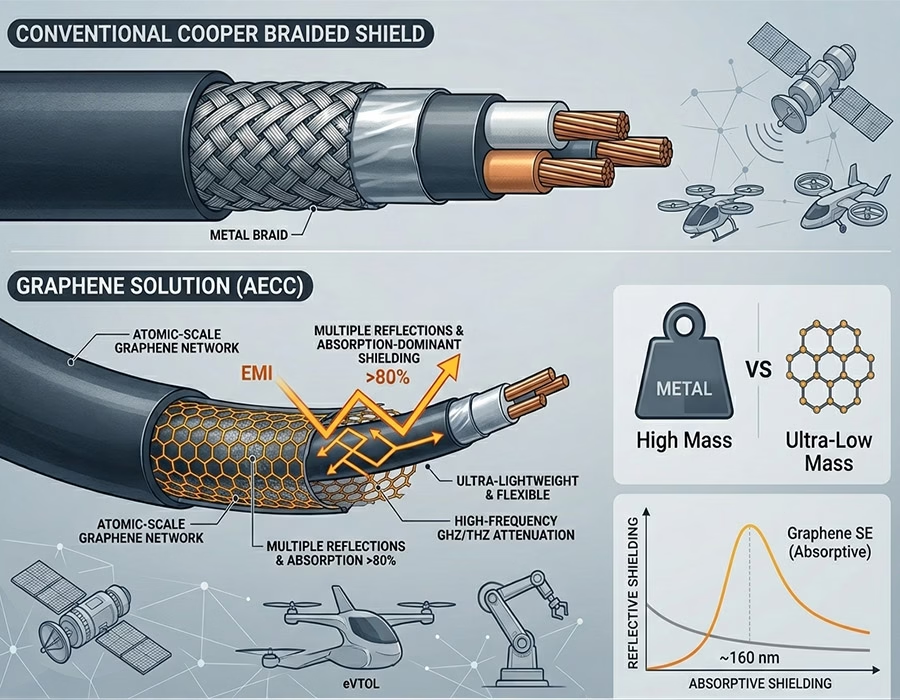
Unlike metals that primarily reflect waves, graphene-based composites excel in Absorption (AdB). Standard engineering benchmarks confirm that in 3D porous graphene structures, absorption accounts for over 80% of total SE, preventing secondary electromagnetic pollution inside device housings.
2. Radical Weight Reduction (The 547 dB Factor)
Data from JMST and ACS Nano is staggering: we are seeing graphene aerogels with densities as low as 57 mg/cm³, delivering a specific shielding efficiency (SE/rho) of up to 547 dB·cm³/g. This allows for a 60%-85% mass reduction compared to traditional shielding.
3. World-Class SE at Nano-Scale
The data is solid: ultra-thin 160-nm copper/graphene nanofilms have demonstrated an average SE of 60.95 dB in the Terahertz range. This is world-class protection at a near-atomic scale—ideal for 6G and advanced radar applications.
Real-World Performance: Where Theory Meets the Bench
On paper, graphene looks like a miracle material. In practice, implementation is where the real engineering begins.
- The Grounding Crucial: We’ve seen prototypes where graphene underperformed simply because the grounding path wasn’t optimised. Material alone doesn’t guarantee performance; the connector-to-shield interface does. For critical applications, choosing the Right Connector for Your Custom Wiring Harness is the deciding factor.
- Flexibility Without Fatigue: Comparative tests show that graphene composite films maintain 98.87% of their SE even after 1,500 bending cycles, far exceeding the durability of traditional metal foil.
The Bottom Line
Given that weight and space constraints have become significant challenges and signal integrity is non-negotiable, graphene has evolved from a laboratory experiment into an indispensable resource. For the AECC industry, the question is not whether graphene will replace traditional shielding materials, but how quickly your supply chain can adapt to them.
Optimizing Your Next-Gen Design with Graphene?
Weight and EMI interference shouldn’t compromise your project’s success. At Romtronic, our 29 years of manufacturing expertise ensure your graphene-shielded cable assemblies are built to perfection.
🚀 Contact Our Engineers for a Graphene Solution Quote
Technical References:
- JMST (2020): Terahertz shielding performance of Cu/graphene nanolayered composites.
- ACS Applied Materials: Ultrathin graphene: electrical properties and highly efficient electromagnetic interference shielding.
- Carbon (2016): Flexible conductive graphene/polyurethane composite films for biomedical applications.
.avif)
Sam Wu is the Marketing Manager at Romtronic, holding a degree in Mechatronics. With 12 years of experience in sales within the electronic wiring harness industry, he manages marketing efforts across Europe. An expert in cable assembly, wiring harnesses, and advanced connectivity solutions, Sam simplifies complex technologies, offering clear, actionable advice to help you confidently navigate your electrical projects.