


When it comes to high-performance engineering jobs, the failure usually comes from damaged electrical contacts rather than dead components; and damaged contacts due to vibration has fast become a major issue in virtually every industry that has to use electrical power to perform tasks, such as EV drive trains, industrial robots, drones and construction equipment.
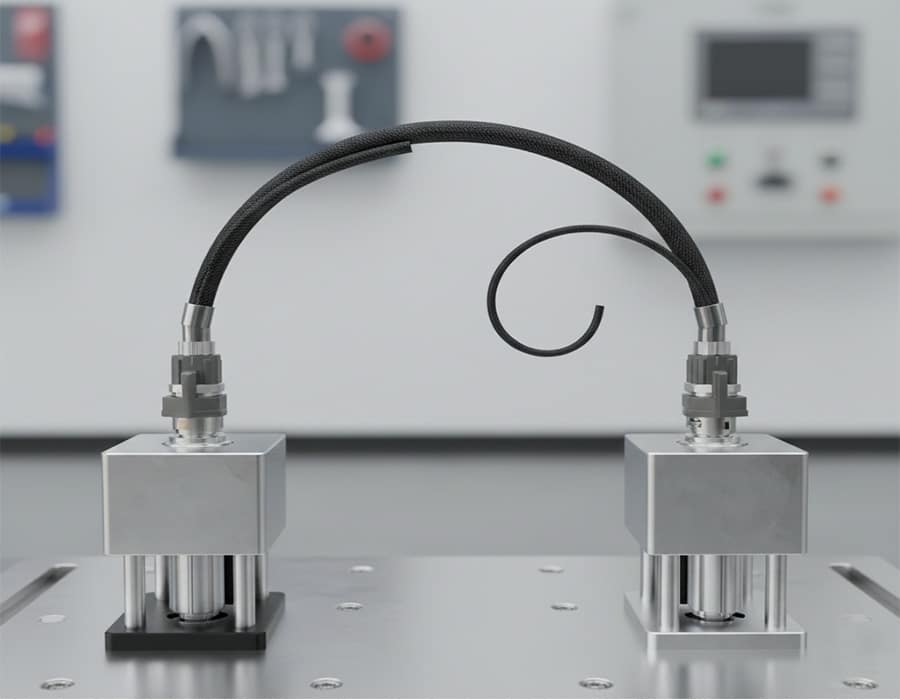
One of the more frightening truths for an engineer is that many failures in electrical systems begin as mechanical failures, i.e. a harness that works perfectly well when the assembly is being worked on may generate random false signals and/or lose power altogether when subjected to the harmonic stress found in day-to-day operations.
1. The Physics of Failure: How Vibration Destroys Cables
Vibration doesn’t cause instant damage; it’s more of a “slow poison” that wears down components over millions of tiny movements in several ways:
- Conductor Fatigue: When cables are repeatedly flexed, the copper strands within the cable “work harden” and eventually break. You may have a connection at rest, but as strands break, the resistance increases, and signal integrity degrades under load.
- Fretting Corrosion: Micro-oscillations at connector pins wear away the gold or tin plating, creating an oxidised, non-conductive debris layer; this causes intermittent signal flicker.
- Insulation Abrasion & Chafing: If a harness rubs against a metal frame or follows a sharp edge, it may erode the insulation, much like an eraser erodes paper; eventually, this will expose bare conductors and lead to short circuits.
- Resonant Whipping: If there is excessive slack in a harness between mounting points, it can reach its natural frequency, causing it to whip violently and pull wiring out of the crimp terminal.
2. Key Design Principles for Ruggedised Harnesses
Designing for vibration requires a shift from “static” thinking to Dynamic Mechanical Compliance.
High-Strand Count Conductors
For environments with constant movement, standard wire won’t suffice. Use high-strand-count copper. A greater number of smaller-gauge strands allows the cable to absorb mechanical energy and flex more easily without fracturing internally.
Proper Strain Relief & The 10x Rule
Strain relief prevents mechanical stress from reaching the delicate solder joints or crimp terminals.
- The 10x Rule: Maintain a minimum bend radius of at least 10 x the outer diameter (D) of the cable bundle. For mission-critical or high-flex paths, aim for 15×D.
- Service Loops: Always include a small U-shaped “slack” section before a connector. This acts as a mechanical shock absorber, preventing the chassis vibration from directly pulling on the pins.
Strategic Routing and Staggered Supports
How you secure the harness is as critical as the wire itself.
- By not fully tightening plastic cable ties, you create a “stress riser” in the insulation, so using cushioned P-Clamps to distribute pressure on the cable or Velcro straps instead eliminates this problem.
- Also, do not have clamps at the same distance apart from one another, as it will create harmonic resonance, which is when the cable reaches its maximum “whipping” effect due to the intervals being identical (e.g., 8″, 11″, 9″ between each clamp).
3. Material Selection: The Engineering “Armour.”
The right materials ensure the harness remains flexible and durable across its entire service life.
| Component | Vibration-Proof Choice | Why It Matters |
| Jacket Material | TPU or TPE | Exceptional abrasion resistance and flexibility across temperature extremes. |
| Connectors | Locking/Threaded | Prevents “walking” or decoupling. Use Bayonet or Triple-start threads. |
| Sleeving | Braided/Corrugated | Adds a sacrificial layer against friction and improves structural integrity. |
| Backshells | Strain Relief Boots | Ensures the transition from rigid connector to flexible cable is reinforced. |
4. Validation: Testing for the Real World
A high-reliability harness must be validated through the following rigorous testing methods:
- Random Vibration Testing (HALT/HASS): This test simulates 10 years of field use in a single weekend by sweeping across multiple frequency ranges.
- Flex Testing: This test evaluates the copper strand life expectancy by cycling the cable through its bend radius multiple times.
- Continuity Testing Under Load: This is the most accurate method for determining whether signals are still transmitted correctly while the harness is on the shaker table. Any intermittent failure will not be apparent when the shaker stops operating.
- Pull and Retention Testing: This test ensures that the terminals remain securely fastened to the connector housing even under excessive mechanical force.
Conclusion
In today’s engineering world, vibrations are present at all levels and can negatively affect your designs if you do not properly address them with the right materials and techniques. Early in the product design phase, consider incorporating some form of relief (e.g., high-strand conductors, strategic strain relief, or staggered mounting) to create a strong, durable product that withstands vibration.
When designing for systems that require a high level of reliability, typically seen in applications such as EV systems, aerospace, and robotics, the custom-engineered harness is not only a single component but also an insurance policy for the overall system’s reliability.
.avif)
Sam Wu is the Marketing Manager at Romtronic, holding a degree in Mechatronics. With 12 years of experience in sales within the electronic wiring harness industry, he manages marketing efforts across Europe. An expert in cable assembly, wiring harnesses, and advanced connectivity solutions, Sam simplifies complex technologies, offering clear, actionable advice to help you confidently navigate your electrical projects.

