1. The “Millikelvin” Paradox
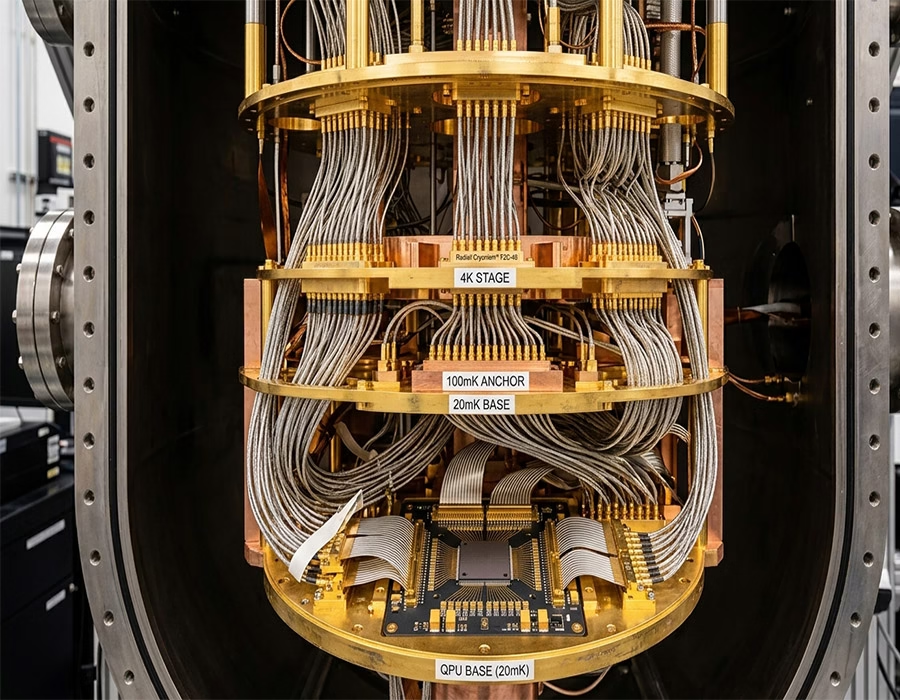
In the high-stakes race for “quantum supremacy,” the spotlight is usually on qubits. But ask any hardware engineer at IBM or Google, and they’ll tell you that the real nightmare lies not only in the processor itself, but also in the “spaghetti-like” tangle of circuits that keeps it running.
When operating temperatures drop to 10–20 millikelvins (colder than deep space), the laws of physics become exceptionally harsh. Connecting a room-temperature control rack to a sub-zero quantum processing unit (QPU) is nothing short of an ultimate balancing act. We call this the “wiring bottleneck.” How do you pump high-speed microwave signals into the “freezer” while ensuring not even a single microwatt of “warm” classical noise is introduced? A single mistake in material selection, or a connector that can’t withstand thermal contraction, is enough to cripple a multi-million-dollar quantum bit system.
“At Romtronic, entering our 29th year of engineering excellence, we understand that cryogenic cable design isn’t just about conduction—it’s about thermal isolation and signal integrity at near absolute zero. From our independent laboratory, we’ve supported advanced research by manufacturing custom cryogenic assemblies that balance the delicate trade-offs between superconductivity and thermal load for quantum OEMs.“
2. The Three Pillars of Cryo-Engineering
To build a functional quantum harness, we have to fight a three-front war: Heat, Noise, and Space.
A. The “Step-Down” Material Strategy
Because thermal and electrical conductivity usually go hand in hand (thanks to the Wiedemann-Franz Law), we can’t just use standard copper. We have to be strategic:
- The 300K to 4K Stretch: Here, it’s all about thermal isolation. We use Stainless Steel or Cupronickel (CuNi) coax to choke off the heat flow from the outside world.
- The 4K to 20mK Zone: This is where Niobium-Titanium (NbTi) superconductors take over. Below $9.2 \text{ K}$, NbTi loses its electrical resistance entirely. It carries signals with zero heat generation, and its thermal conductivity is far lower than pure copper.
- The “Non-Magnetic” Rule: Magnetism is a qubit killer. We strictly avoid nickel or steel in the “Cold Zone.” High-end connectors, such as Rosenberger WSMP® or Radiall Cryonium™, use Beryllium Copper or specialised phosphor-bronze to ensure zero magnetic interference.
B. Noise Suppression: Attenuators as “Thermal Firewalls”
Quantum signals are incredibly fragile. Beyond our signature 360° Shield Termination methods, we use:
- Thermal Anchoring: We install precision RF attenuators (10dB or 20dB) at different temperature stages. These aren’t just for signal levelling; they physically “dump” the thermal noise from the warmer stages into the fridge’s cooling system.
- Flexible Vibration Control: Rigid coax is a vibration highway. Technologies like Cri/oFlex® use ultra-thin ribbon cables to decouple the QPU from the fridge’s mechanical pulse. In high-density harness design, this is the difference between a stable gate and a decoherence disaster.
C. The Density Dilemma
Standard SMA connectors are too bulky for a 1000-qubit future. The industry is pivoting to Radiall F2C-40 or SMPM multichannel blocks that pack 40+ lines into a tiny footprint. This requires extreme precision in routing and strain relief.
3. Insights from the Trenches
At Romtronic’s independent laboratory, we’ve learned that the most common failures aren’t electrical—they’re mechanical.
Engineer’s Pro-Tip: “Metals shrink by about 1% when dropping from 300K to 20mK. If your harness doesn’t follow strictbend radius rulesor incorporate enough ‘slack,’ the cooling process will literally rip the connectors off the PCB.”
The heavy hitters, like IBM (System Two), are now moving away from “hand-built looms” and toward semiconductor-style Flexible Printed Circuits (FPC). This is the future of scalable cable design.
| The Challenge | The Pro Solution | Key Tech / Brands |
| Thermal Leakage | NbTi Superconducting Coax | Trexon / Quantum Microwave |
| Scaling Density | High-Density FPC Ribbons | Delft Circuits / IBM |
| Magnetic Noise | Non-Magnetic Plating (AuroDur®) | Rosenberger / Radiall |
| Cycling Failure | Solderless / Floating Mounts | Intelliconnect (Q-CON) |
4. Moving Beyond “Good Enough”
Cryogenic cabling isn’t an afterthought—it’s a core part of the quantum stack. If you’re planning your next dilution refrigerator project:
- Stop Guessing Below 4K: Always run electrical validation at cryogenic temps; room-temp data is just a rough estimate.
- Audit Your Materials: Ensure every component meets ISO & IATF standards and IPC/WHMA-A-620 quality benchmarks.
- Go Modular: Stop building “cable jungles” and start using high-density integrated blocks.
Need a Reliable Connection for Your Quantum Project?
Struggling with thermal loads or signal attenuation in your cryogenic design? At Romtronic, our 29 years of custom manufacturing help you bridge the millikelvin gap with precision-engineered interconnects.
🚀 Get a Custom Cryogenic Quote in 24 Hours
.avif)
Sam Wu is the Marketing Manager at Romtronic, holding a degree in Mechatronics. With 12 years of experience in sales within the electronic wiring harness industry, he manages marketing efforts across Europe. An expert in cable assembly, wiring harnesses, and advanced connectivity solutions, Sam simplifies complex technologies, offering clear, actionable advice to help you confidently navigate your electrical projects.