In 2026, the connector’s plastic component has moved past being just a basic housing; it’s now a functional dielectric component in the high-speed interconnect world. As we move toward 112 Gbps/224 Gbps PAM4 and initial 6G prototyping, the insulating material you choose will directly affect transmission-line physics.
Between Liquid Crystal Polymer (LCP) and Polyetheretherketone (PEEK), engineers are trading off signal transparency against structural integrity. This decision is as important as choosing connectors for high-speed cable assemblies during the original design phase.
“Entering our 29th year of specialized manufacturing, Romtronic has been at the forefront of high-speed material science. In our independent laboratory, we’ve benchmarked LCP and PEEK under extreme thermal and frequency loads to help our customers navigate the transition to Next-Gen AI data center architectures and 224Gbps link stability.“
Why Material Choice Matters Above 10 GHz
High-frequency signals aren’t just about “faster data”—they are sensitive to every picofarad of parasitic capacitance. At Romtronic, our design & DFM (design for manufacturability) process identifies three primary friction points in HF design:
- Insertion Loss Spikes: Often caused by a high Dissipation Factor (Df) in the GHz range.
- Impedance “Wandering”: Triggered by moisture-induced shifts in the Dielectric Constant (Dk).
- Post-Reflow Warpage: Resulting from mismatched thermal expansion during lead-free soldering.
The Dielectric Breakdown
| Critical Property | LCP (Liquid Crystal Polymer) | PEEK (Polyetheretherketone) |
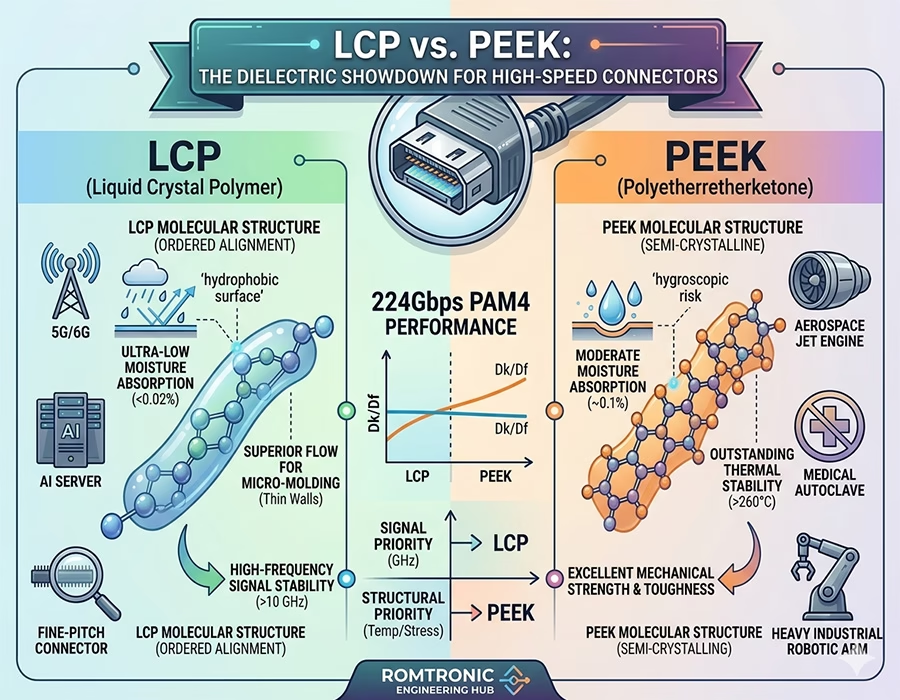
| Dielectric Constant (Dk) | 2.9 – 3.2 (Extremely Flat) | 3.2 – 3.6 (Frequency Dependent) |
| Loss Tangent (Df) | < 0.003 @ 10GHz | ~ 0.004 @ 10GHz |
| Moisture Absorption | < 0.02% (Hydrophobic) | ~ 0.1% (Hygroscopic Risk) |
| ~260 °C (Superior) | Down to 0.12mm | Typically > 0.25mm |
| Max Continuous Temp | ~240°C | ~260°C (Superior) |
Beyond the Datasheet
While a datasheet provides static numbers, our experience on the factory floor reveals the nuances that dictate long-term reliability:
1. The “Short Shot” Reality in Micro-Pitch Designs
PEEK is notoriously viscous, making it difficult to process in high-density 0.4mm pitch connectors. In contrast, LCP behaves like a “liquid crystal” during injection, flowing into micro-cavities with ease. In our laboratory, we’ve successfully achieved wall thicknesses of 0.12mm without flash, which is vital for customised M8, M12, M16 Cables where internal space is at a premium.
2. The Humidity Trap & Phase Stability
PEEK is the gold standard for medical wiring harnesses because it withstands autoclaving. However, for 224Gbps links, PEEK’s 0.1% moisture absorption is a hidden liability. Since water has a Dk of ~80, even trace humidity will shift the connector’s impedance. LCP is virtually hydrophobic, preventing “impedance drift” in high-humidity environments—a key requirement for high-speed transmission cables.
3. Dimensional Stability vs. Anisotropy
LCP is prone to warping due to its “wood-like” anisotropic shrinkage. At Romtronic, we compensate for this by optimising gate locations and mould-flow direction. Conversely, PEEK offers more isotropic (uniform) shrinkage, making it a “safer” pick for large-format [Industrial Machinery Wiring Harnesses] that prioritise structural ruggedness over extreme GHz performance.
Which One Wins?
Assertion: Your material choice should be dictated by the Signal Frequency first, and the Operating Environment second.
- Prioritise LCP when operating at>10 GHz (AI Servers, mmWave), where signal integrity and the performance of custom high-speed USB cables are non-negotiable. If your S-parameters are failing, LCP is your “rescue” material.
- Prioritise PEEK when: You face extreme temperatures (>250°C), constant mechanical vibration, or chemical exposure in [Aerospace] or [Marine Cable Assemblies].
How Romtronic Optimises Your Interconnects
We don’t just “plug and play.” During our 29 years of manufacturing, we have perfected the art of material selection. Our independent laboratory routinely tests mating cycles and signal attenuation in both LCP- and PEEK-based assemblies to ensure compliance with IPC/WHMA-A-620 and IATF 16949 standards.
Designing a high-frequency system for AI or 6G? Don’t leave your dielectric backbone to chance.
🚀 Get a Technical Quote for High-Speed Assemblies
.avif)
Sam Wu is the Marketing Manager at Romtronic, holding a degree in Mechatronics. With 12 years of experience in sales within the electronic wiring harness industry, he manages marketing efforts across Europe. An expert in cable assembly, wiring harnesses, and advanced connectivity solutions, Sam simplifies complex technologies, offering clear, actionable advice to help you confidently navigate your electrical projects.