Ever gotten three quotes for what looks like the exact same cable, with prices 5x apart? You’re not imagining things. Custom cable assembly pricing looks like a black box from the outside. But once you know what’s actually driving it, the numbers stop feeling random.
We’ve been building these things in Dongguan for almost three decades. The question we get more than any other — more than lead time, more than MOQ — is some version of “why does this cost so much?” So let’s actually answer it.
(Quick note before we dive in: this article uses “cable assembly” loosely here, covering both cable assemblies and wire harnesses. Want the technical distinction? Here’s the difference between a cable assembly and a wire harness — a good rabbit hole to go down after this one.)
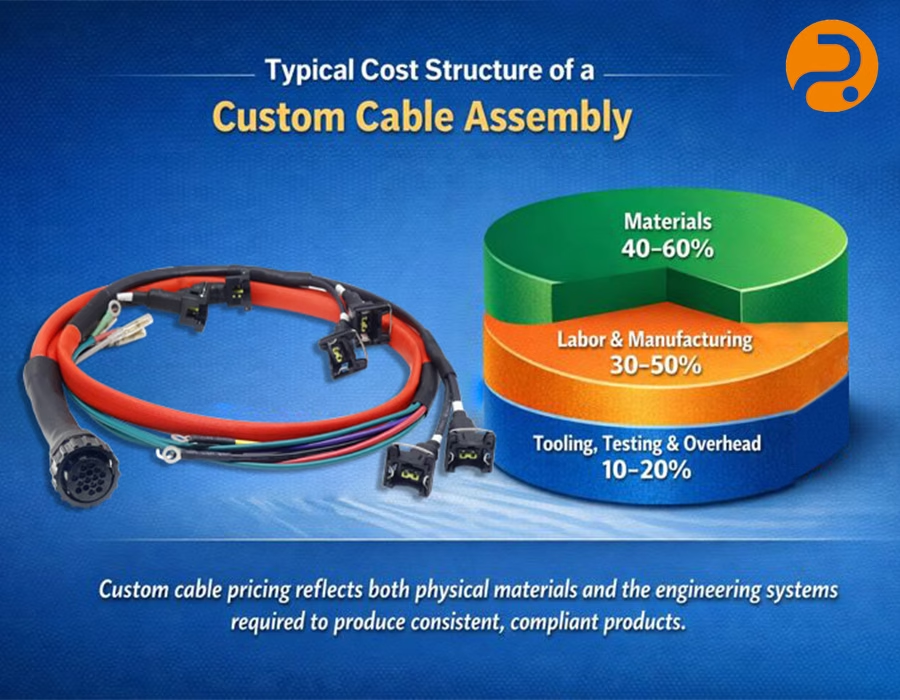
The Quick Version: Where Your Money Goes
Materials are usually the biggest line item, but here’s the thing nobody tells you upfront: labor and engineering time can flip that ratio fast if your design is complicated. A cable with 40 wires and three branch points can cost more in labor than in materials, even with cheap copper.
| Cost Category | % of Total Price | What’s In It |
|---|---|---|
| Materials | 40–60% | Wire, connectors, insulation, shielding |
| Labor & Manufacturing | 30–50% | Cutting, stripping, crimping, soldering, overmolding |
| Tooling, Testing & Overhead | 10–20% | NRE, fixtures, QC, compliance testing |
Materials are usually the biggest line item. But here’s the thing nobody tells you upfront: labor and engineering time can flip that ratio fast if your design is complicated. A cable with 40 wires and three branch points can cost more in labor than in materials, even with cheap copper.
Materials are where most of the cost conversation starts, and for good reason — they’re the most visible line item on a quote.
1. Materials: Still the Biggest Lever
Bare copper is your baseline. Tinned copper costs a bit more but resists corrosion better. Silver-plated conductors show up in high-frequency or extreme-temperature applications, and they’re noticeably pricier — you’re paying for both the plating process and the performance it buys you.Materials are where most of the cost conversation starts. They’re the most visible line item on any quote.
Conductors
Bare copper is your baseline. Tinned copper costs a bit more, but it resists corrosion better. Silver-plated conductors show up in high-frequency or extreme-temperature applications. They cost noticeably more too — you’re paying for both the plating process and the performance it buys you. (If you’re weighing copper against alternatives for a cost-sensitive project, copper-clad options are worth a look too.)
Insulation and Jacketing
PVC is the default for a reason: it’s cheap, and it works for most general-purpose applications. But the second you need real heat resistance, flexibility, or chemical resistance, you’re looking at PTFE, silicone, polyurethane, or TPE. Each step up the material chain adds cost. A silicone-jacketed cable can run 2-3x the price of an equivalent PVC one. (Here’s a deeper PVC vs. Teflon comparison if you’re trying to decide between the two.)
Shielding
Foil shielding is the budget option. Braided shielding costs more in both material and labor — you have to apply it, not just wrap it on — but it holds up better mechanically and gives you better EMI protection. Multi-layer shielding (foil plus braid) makes sense when signal integrity really can’t slip. Think servo motor cables or high-speed data lines running near noisy equipment.
Connectors
Here’s a fun exercise: take two cables that look identical from three feet away. One’s $3 a unit, the other’s $15. Nine times out of ten, the difference is complexity you can’t see from the outside.This one surprises people. A generic plastic connector might cost cents. A mil-spec or medical-grade connector with tight tolerances and specialized plating can cost dollars — sometimes more than the cable itself. If your BOM has a premium connector spec’d in, that’s often where a big chunk of your unit price is hiding. Take a high-current connector built for demanding power applications. It costs more for good reason — engineers design it for a job a generic part can’t safely do. If you’re not sure which connector family fits your application, our guide to choosing wiring harness components walks through the tradeoffs.
2. Design Complexity: The Cost Driver Nobody Budgets For
More conductors means more cut, strip, terminate, inspect, and test steps — and each one adds time. A single point-to-point cable with two ends is about as simple as it gets. Add branch points, splitters, or multiple legs, and now you’ve got a harness board layout, more routing decisions, and more places for something to go wrong during inspection.
Circuit Count and Branching
Tolerances matter more than people expect, too. Standard tolerance is fast and forgiving. Tight tolerance means precision fixtures, slower processing, and more rejects along the way — all of which show up in your unit price.Different terminal styles have different labor and tooling requirements, which is easy to overlook until it shows up on the quote.
Tolerances and Mixed-Signal Builds
And if you’re doing high-speed data, mixed signal and power in one cable, sealed environmental assemblies, or overmolded strain relief — all of that adds engineering time before a single unit ever gets built.
If you’re doing high-speed data, mixed signal and power in one cable, sealed environmental assemblies, or overmolded strain relief, that adds engineering time too. All of it happens before a single unit ever gets built.
3. Manufacturing Process and Labor
Every extra operation means more labor, more documentation, more traceability. And if your project needs custom fixtures or dedicated harness boards, that cost hits hardest at the start — before you’ve built a single production-run unit.crimping. But most custom cable work still leans heavily on skilled hands: soldering, ultrasonic welding, routing wire around obstacles, overmolding connectors. These aren’t steps you can just throw a machine at, especially at lower volumes where custom tooling doesn’t pencil out yet.
NRE stands for Non-Recurring Engineering, and it’s probably the single most misunderstood line item on a cable assembly quote.wire harness assembly process step by step.)
4. NRE: The One-Time Cost That Confuses Almost Everyone
NRE typically covers:
It’s a one-time hit, not a per-unit cost — but it can genuinely shock people on a first quote if they weren’t expecting it. Depending on complexity, NRE can range from a few hundred dollars for something simple to several thousand for a fully custom overmolded, multi-branch harness with dedicated test fixtures. The upside: once that’s paid, your per-unit price on reorders should drop noticeably, because you’re not paying to set up the process again.
- Custom molds for overmolding or sealed structures
- Dedicated crimp tooling or applicators
- Assembly fixtures and harness boards
- Test fixture development and programming
- Engineering drawings and controlled documentation
It’s a one-time hit, not a per-unit cost — but it can genuinely shock people on a first quote if they weren’t expecting it. NRE can range widely depending on complexity. A simple design might run a few hundred dollars, while a fully custom overmolded, multi-branch harness with dedicated test fixtures can run into several thousand. The upside: once you pay it, your per-unit price on reorders should drop noticeably, because you’re not paying to set up the process again.
5. Testing, QC, and Compliance
Basic continuity testing just confirms the connections are right. Beyond that, you’ve got hi-pot testing, impedance measurement, signal integrity checks, mechanical stress testing, and environmental aging tests — and which ones you need depends entirely on your application.
Basic continuity testing just confirms the connections are right. Beyond that, you’ve got hi-pot testing, impedance measurement, signal integrity checks, mechanical stress testing, and environmental aging tests. Which ones you need depends entirely on your application. Connectors specifically get their own battery of checks too — see our breakdown of connector test items and performance parameters if you want the specifics.
If you’re targeting IPC/WHMA-A-620, UL, ISO, or IATF compliance, you’re also paying for the infrastructure behind it. Think trained inspectors, documented processes, traceability systems, controlled production environments. It adds cost, no question. But it’s the kind of cost that keeps a $2 cable from causing a $20,000 field failure down the line.
6. Volume, Lead Time, and Logistics
This is the big one for anyone ordering prototypes or small batches: your per-unit price is going to be higher. That’s not the manufacturer padding margins — it’s just math. Engineering, setup, tooling, and testing all cost the same regardless of order size. You spread that fixed cost across however many units you order. Order 10, and each one absorbs a big chunk of it. Order 10,000, and it barely registers per unit.
Lead time plays into this too. Need it fast? Expedited production usually means overtime labor and bumping your job ahead of someone else’s in the queue. That shows up in price. Packaging, labeling, and shipping method are smaller factors, but they still add up on the final delivered cost.
7. The Hidden Costs Nobody Quotes You
Poor design work, sloppy crimping, undocumented last-minute changes, and skipped testing steps have a way of turning into production delays, warranty claims, and field failures — and those costs routinely dwarf whatever you saved on the original unit price.
Poor design work, sloppy crimping, undocumented last-minute changes, and skipped testing steps have a way of turning into production delays, warranty claims, and field failures. Those costs routinely dwarf whatever you saved on the original unit price.
The best cost savings happen at the design stage, not at the negotiating table.
8. How to Actually Bring the Cost Down
Bringing your manufacturer in early for DFM (Design for Manufacturability) review lets them flag complexity you can simplify before it’s locked into a drawing. Standardizing wire gauges and colors across your BOM, allowing acceptable substitute parts instead of locking in one exact connector, and planning realistic production volumes upfront — all of this adds up to real, lasting savings.
Bringing your manufacturer in early for DFM (Design for Manufacturability) review lets them flag complexity you can simplify before it’s locked into a drawing. Standardize wire gauges and colors across your BOM. Allow acceptable substitute parts instead of locking in one exact connector, and plan realistic production volumes upfront. All of this adds up to real, lasting savings.
We build cost control into the process before manufacturing even starts, not after.
9. How We Handle Cost Control at Romtronic
Our engineering team does early design review, manufacturability analysis, and material optimization on every project that comes through. We run a mix of automated processing and flexible semi-automatic/manual assembly, which lets us handle both high-mix low-volume programs and larger production runs without forcing every customer into the same box.
Our engineering team does early design review, manufacturability analysis, and material optimization on every project that comes through. We run a mix of automated processing and flexible semi-automatic/manual assembly. That combination lets us handle both high-mix low-volume programs and larger production runs, without forcing every customer into the same box.
In-house testing, documented QC systems, and structured process management cut down on rework and keep output consistent. That shows up as savings you can see on the quote — and savings you don’t see until you’re three years into production without a single field failure.
Bottom Line
Cable assembly cost comes down to design choices, manufacturing discipline, quality assurance, and how much risk you’re willing to carry downstream. Once you understand these levers, you can budget more accurately and stop comparing quotes on price alone. The cheapest number on paper isn’t always the cheapest cable over the life of the project.
It depends heavily on complexity, but simple point-to-point cables can run a few dollars per unit, while multi-branch harnesses with premium connectors and shielding can run into the tens of dollars per unit. Volume is the biggest swing factor — the same design at 10 units vs. 10,000 units can have a 3-5x difference in unit price.The best way to start any custom cable or wire harness project is a real technical conversation about your application before anyone starts throwing numbers around.
Usually it’s one of three things: a premium connector spec’d into the design, tighter tolerances than the application actually needs, or NRE costs that weren’t accounted for upfront. Ask your supplier for a line-item breakdown — a good one will give you one without hesitation.If you’re at the stage of comparing suppliers rather than just comparing quotes, our guide on how to qualify a cable assembly supplier is a good next read. And if you’re ready to request quotes, our cable RFQ checklist covers a few things this article didn’t get into.
Frequently Asked Questions
A: It depends heavily on complexity. Simple point-to-point cables can run a few dollars per unit. Multi-branch harnesses with premium connectors and shielding can run into the tens of dollars per unit. Volume is the biggest swing factor — the same design at 10 units vs. 10,000 units can carry a 3-5x difference in unit price.
A: Usually it’s one of three things: a premium connector spec’d into the design, tighter tolerances than the application actually needs, or NRE costs nobody flagged upfront. Ask your supplier for a line-item breakdown. A good one will give you one without hesitation.
A: Setup, tooling, engineering, and testing cost the same no matter the order size, and you spread that fixed cost across fewer units. Order 5,000 of the same cable later, and the per-unit price on those same fixed costs drops significantly.
A: NRE (Non-Recurring Engineering) covers one-time setup costs: molds, tooling, fixtures, test programming, documentation. Almost every fully custom project carries some NRE component, though the amount varies a lot based on complexity. Off-the-shelf or near-standard designs sometimes skip it entirely.
A: Bring drawings or schematics, cable length and tolerances, wire gauge, connector part numbers, electrical performance requirements, compliance standards you need to meet, target quantities, and your delivery timeline. The more of this you have upfront, the faster and more accurate the quote will be.
A: Get your manufacturer involved in DFM review early. Standardize components and wire gauges across your BOM, allow acceptable substitute parts where possible, and set realistic production volume forecasts. This beats trying to negotiate the price down after the design is already locked.
A: Generally yes, on labor and manufacturing cost specifically, though the gap has narrowed over the past few years. The bigger question isn’t just unit price — it’s total landed cost. Shipping, lead time, communication overhead, and quality consistency all factor in. A cheaper unit price with a bad quality track record isn’t actually cheaper.
A: HMLV production runs many different cable designs in smaller quantities, which leaves less room to spread tooling and setup costs across identical units. It typically costs more per unit than a single high-volume run of one design. But it’s often the right tradeoff for companies that need flexibility over raw unit economics.
A: Handing a supplier this information upfront gets you a faster, more accurate quote — and avoids surprise costs later.Yes, it adds cost. Trained inspectors, documented processes, and controlled environments aren’t free. But skipping certification to save money upfront is one of the most common ways buyers end up paying far more later in warranty claims and field failures.
A: Handing a supplier this information upfront gets you a faster, more accurate quote — and avoids surprise costs later.Look past the number. Ask about the supplier’s engineering support, process documentation, traceability, and quality systems. A low quote from a supplier with weak process controls often turns into a higher total cost. Factor in rework, delays, or failures down the line, and the math changes fast.
Custom Cable Assembly RFQ Checklist
Handing a supplier this information upfront gets you a faster, more accurate quote — and avoids surprise costs later.
Design Information
- Cable drawing or schematic
- Cable length and tolerances
- Circuit count and pinout
- Branching or harness layout
Electrical Requirements
- Voltage and current
- Signal type or data rate
- Shielding and EMI needs
- Impedance or loss targets
Mechanical & Environmental
- Operating temperature range
- Flexing or motion requirements
- Chemical or moisture exposure
- Sealing or strain-relief needs
Production Requirements
- Prototype and production quantities
- Target cost expectations
- Compliance standards (IPC, UL, ISO, IATF, medical, etc.)
- Packaging and labeling requirements
- Target delivery schedule
Ready to Get a Real Number Instead of a Guess?
We don’t do ballpark estimates. Send us your drawings and specs, and our engineering team will build a quote that’s actually tied to your application — plus flag any cost-saving opportunities before production ever starts, whether this is a new build or something you’re scaling up.
Get in touch and we’ll get you an engineering-backed quote fast.
.avif)
Sam Wu is the Marketing Manager at Romtronic, holding a degree in Mechatronics. With 12 years of experience in sales within the electronic wiring harness industry, he manages marketing efforts across Europe. An expert in cable assembly, wiring harnesses, and advanced connectivity solutions, Sam simplifies complex technologies, offering clear, actionable advice to help you confidently navigate your electrical projects.