


Wiring harnesses are more than just a bundle of wires; in high-risk environments like heavy industry, they serve as the nervous system of machinery. When designing for “heavy-duty” applications in 2026, you need to focus on resilience, precision, and predictive maintenance—not just on using thicker wires.
By striking the right balance between a harness’s environmental resilience and ease of manual maintenance, you’re not only creating high-quality components but also effectively reducing the risk of millions of dollars in losses due to equipment downtime.
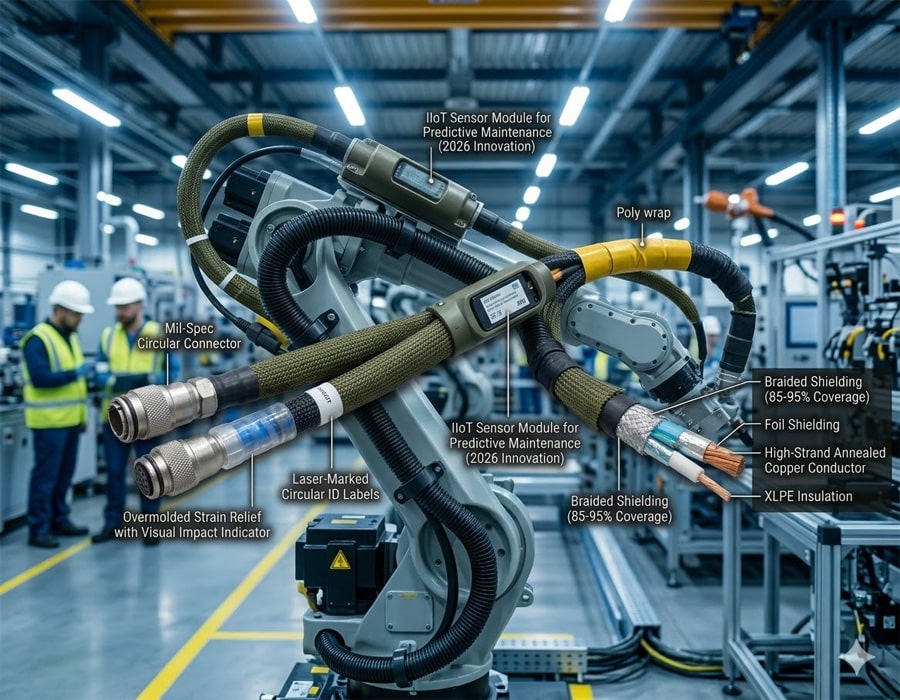
1. Mapping the “Industrial Habitat”
A design that looks perfect on a CAD screen may fail within weeks if real-world conditions are overlooked. Before selecting any connector, you must assess the “peak stress sources” in the specific application.
- Mechanical Fatigue: Constant high-G vibration and repetitive motion that lead to work-hardening.
- Thermal Extremes: Operating ranges from -50°C in arctic oil rigs to +150°C near industrial furnaces.
- Chemical Assault: Exposure to hydraulic fluids, corrosive degreasers, and UV radiation.
- Ingress Risks: High-pressure steam cleaning (IP69K) and abrasive particulate dust.
2. Material Science: The Foundation of Reliability
Drawing on the design principles of safety harnesses used at heights, the choice of materials is the first line of defence. Reliability is either rooted at the molecular level or contains hidden risks from the very beginning.
The Conductors & Insulation
- Tinned Copper: A must-have for high-humidity or “tropical” industrial zones to prevent the dreaded “black wire” oxidation.
- PTFE (Teflon) & Silicone: These provide “fire-resistant DNA.” Much like a welder’s Kevlar safety gear, these materials won’t melt or support combustion during intense heat cycles.
- XLPE (Cross-linked Polyethene): The gold standard for construction and mining equipment due to its superior abrasion and crush resistance.
Protective Jacketing
- PUR (Polyurethane): Just like specialised worker safety coatings, PUR jackets repel oil, water, and grime, preventing chemical degradation of the internal fibres.
- Forged Hardware: Use stainless steel or zinc-plated alloy connectors to withstand salt spray and long-term outdoor exposure.
3. Routing & Mechanical Armour: Defeating “Silent Killers”
Even the highest-quality materials can fail if they are not properly routed. Vibration is the number one enemy of industrial electronic equipment; it causes minute displacements that can lead to “phantom faults.”
- Stress Management: Use Overmolding at transition points. This transfers mechanical stress away from fragile solder joints and onto the rugged, moulded connector body.
- Smart Pathing: In a customized packaging machine, where cables move through cable carriers (drag chains) at high speeds, avoiding sharp edges and pinch points is mandatory. Maintain a safe “thermal buffer” from engines and exhaust systems. Respect the Minimum Bend Radius to prevent internal conductor fatigue.
- Mechanical Reinforcement: Integrate heavy-duty grommets and clamps to prevent the harness from “whipping” or snagging during high-vibration operation.
4. Signal Integrity: Protecting the “Brain” from the “Brawn”
In the era of Industry 4.0, wiring harnesses not only transmit high-voltage electricity but also carry sensitive data. This necessitates implementing layered defence measures to mitigate electromagnetic interference (EMI).
- Braided Shielding: Provides 85-95% coverage for superior structural strength and low-frequency protection.
- Foil Shielding: Lightweight and highly effective against high-frequency RFI (Radio Frequency Interference).
- System Grounding: A shield is only a “drain” if it has a low-impedance path to the chassis. Ensure continuity across all connection points to prevent sensor interference.
5. Human-Centric Design: DFM & Maintenance
True Design for Manufacturability (DFM) acknowledges that a human will eventually have to install and repair the system.
- Quick-Connect Systems: Borrowing from safety buckle designs, use keyed, Quick-Connect plugs to eliminate wiring errors and speed up field repairs during 12-hour shifts.
- Impact Indicators: An innovative safety carry-over—incorporate visual indicators at high-stress points that change appearance if the harness has been subjected to excessive pull-force or impact.
- Traceability: Use Laser-Marked wires or high-contrast heat-shrink labels. If a technician can’t identify a circuit in 30 seconds, the design is a liability.
- 2026 Innovation: Integrate RFID tags or smart sensors to track thermal cycles, alerting operators to perform predictive maintenance before a failure occurs.
6. Global Compliance: The Trust Factor
To compete in the 2026 global supply chain, your designs must be backed by rigorous validation:
- IPC/WHMA-A-620: The universal language of harness quality and artistry.
- UL/CSA & ANSI/ASSP: Crucial for North American safety and electrical compliance.
- Validation Testing: Your design isn’t proven until it survives Vibration Simulation, Thermal Shock, and IP-rated Ingress Testing.
Summary: Reliability is Designed, Not Added
Heavy-duty wiring harness design is a form of preventive engineering. By balancing durability (materials), flexibility (routing), and maintainability (ergonomics), you can create a system that continues to operate reliably even when other solutions fail.
Build for the environment. Design for the human. Engineer for the future.
.avif)
Sam Wu is the Marketing Manager at Romtronic, holding a degree in Mechatronics. With 12 years of experience in sales within the electronic wiring harness industry, he manages marketing efforts across Europe. An expert in cable assembly, wiring harnesses, and advanced connectivity solutions, Sam simplifies complex technologies, offering clear, actionable advice to help you confidently navigate your electrical projects.

