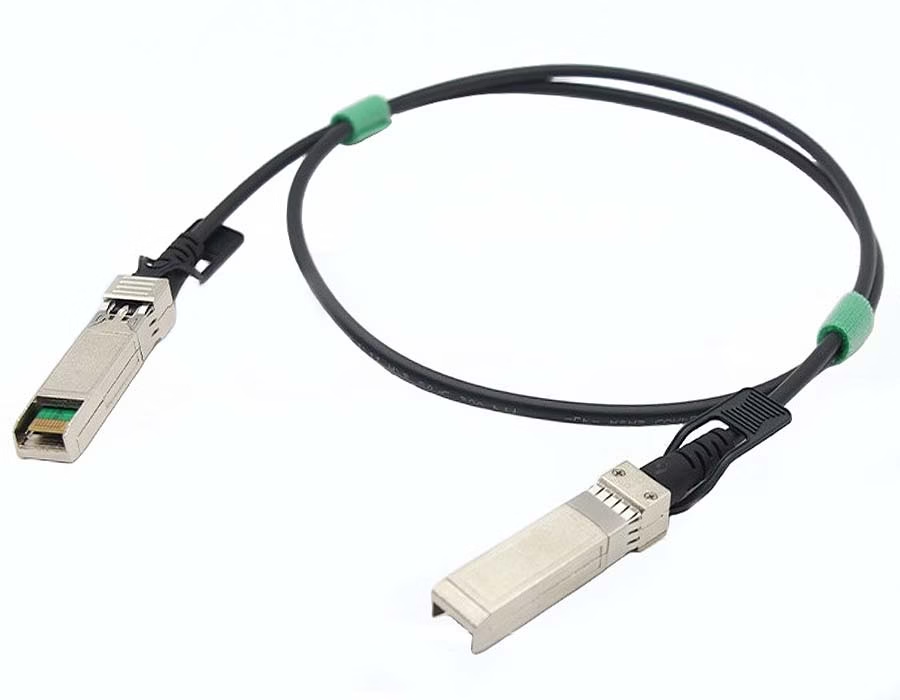
How fibre-optic connectors are terminated significantly impacts network performance. Insertion loss, return loss, mechanical strength, and long-term stability are all affected by how the fibre is joined, rather than by the connector or cable alone.

In practice, most fibre terminations are done using either fusion Splicing or mechanical Splicing. The basic difference between the two methods is simple: with fusion splicing, the fibres are melted and fused (welded) together, creating a permanent connection, whereas with mechanical Splicing, they are aligned and clamped together using an adhesive (not melted). There are advantages and disadvantages to both methods.
Fusion Splicing
How Fusion Splicing Works
Fusion Splicing is a method of connecting fibres by heating and melting the ends of the fibres with an Electric Arc. This allows both fibre ends to become soft enough to merge into a single fibre-optic path. After cooling, the Splice is reinforced with a heat-shrink sleeve to restore the fibre’s mechanical properties.
Typical Fusion Splicing Process
- Fiber preparation
The outer jacket, buffer tube, and coating are stripped to expose the bare glass fibre. The fibre is cleaned and precision-cleaved. - Core alignment
A fusion splicer automatically aligns the fibre cores using cameras and alignment algorithms. - Fusing
An electric arc melts the fibre ends, permanently welding them together. - Protection
A heat-shrink splice sleeve is applied to protect the joint from stress and environmental damage.
Advantages
- Very low insertion loss: typically 0.02–0.05 dB
- High return loss: usually ≥ 60 dB
- Excellent mechanical strength and long-term stability
- Permanent, highly reliable connection
Disadvantages
- High upfront cost: fusion splicers typically cost several thousand dollars
- Requires power and setup time: AC power or charged batteries are needed
- Not suitable for temporary connections: the Splice is permanent and not reusable
Best Applications
- Telecom backbone networks
- Data centers
- FTTH trunk lines
- Long-distance and high-bandwidth optical links
Fusion splicing is widely regarded as the industry-standard solution for high-performance and permanent fibre infrastructure.
Mechanical Splicing
How Mechanical Splicing Works
Mechanical Splicing does not involve heating the fibres together. The ends are aligned using an Alignment Tool (typically a V-Groove) and secured with a clamp or locking mechanism. An Index-Matching Gel may also be applied to fill gaps between fibre ends, minimising reflection and signal loss.
Typical Mechanical Splicing Process
- Fiber preparation
The fibre coating is stripped, cleaned, and cleaved, similar to fusion Splicing. - Alignment
The fibre ends are positioned inside the mechanical splice housing. - Locking
The fibres are mechanically fixed in place to maintain alignment.
Advantages
- Low equipment cost: no fusion splicer required
- Fast installation: typically 30–60 seconds per Splice
- No power needed: well-suited for field work
- Some designs are reusable
Disadvantages
- Higher insertion loss: typically 0.2–0.5 dB
- Lower return loss: around 30–40 dB
- Reduced long-term reliability: sensitive to vibration, contamination, and aging of the matching gel
- Best suited for controlled or low-risk environments
Best Applications
- FTTH indoor installations
- Temporary links
- Emergency or quick field repairs
- Low-count or lower-performance network segments
Mechanical Splicing is often referred to as “cold splicing”, as it relies entirely on physical alignment rather than thermal fusion.
Fusion Splicing vs Mechanical Splicing: Key Differences
| Feature | Fusion Splicing | Mechanical Splicing |
|---|---|---|
| Connection type | Permanent welded joint | Mechanical alignment and clamp |
| Typical insertion loss | 0.02–0.05 dB | 0.2–0.5 dB |
| Typical return loss | ≥ 60 dB | 30–40 dB |
| Equipment cost | High | Low |
| Installation speed | Slower | Very fast |
| Reusability | No | Sometimes |
| Long-term reliability | Excellent | Moderate |
Which Termination Method Should You Choose?
There is no universally “better” termination method—only the most appropriate one for the application.
- Fusion splicing is the preferred choice when optical performance, durability, and long-term reliability are critical.
- Mechanical Splicing is best suited for rapid deployment, temporary connections, and situations where speed and low upfront cost outweigh ultimate performance.
For large-scale or permanent deployments, fusion splicing typically offers a lower total cost of ownership over time, despite its higher initial investment.
Conclusion
The quality of a fibre-optic network is determined by the quality of its terminations, and fusion splicing offers the lowest loss and best stability, making it the preferred installation technique for both backbone and data centre applications. On the other hand, mechanical Splicing has its place as a viable and effective method for quickly installing fibre-optic cabling in the field or for making temporary connections.
Having a solid grasp of each termination method’s strengths and limitations enables engineers and installers to select the most appropriate process to ensure reliable, long-term network performance after installation.
.avif)
Sam Wu is the Marketing Manager at Romtronic, holding a degree in Mechatronics. With 12 years of experience in sales within the electronic wiring harness industry, he manages marketing efforts across Europe. An expert in cable assembly, wiring harnesses, and advanced connectivity solutions, Sam simplifies complex technologies, offering clear, actionable advice to help you confidently navigate your electrical projects.