


If you have ever attempted to manage ten or more wire harness variants simultaneously, you probably know how fast the complexity can spiral. Different connectors. Different wire gauges. Engineering changes occur continuously. All while trying to meet tight deadlines.
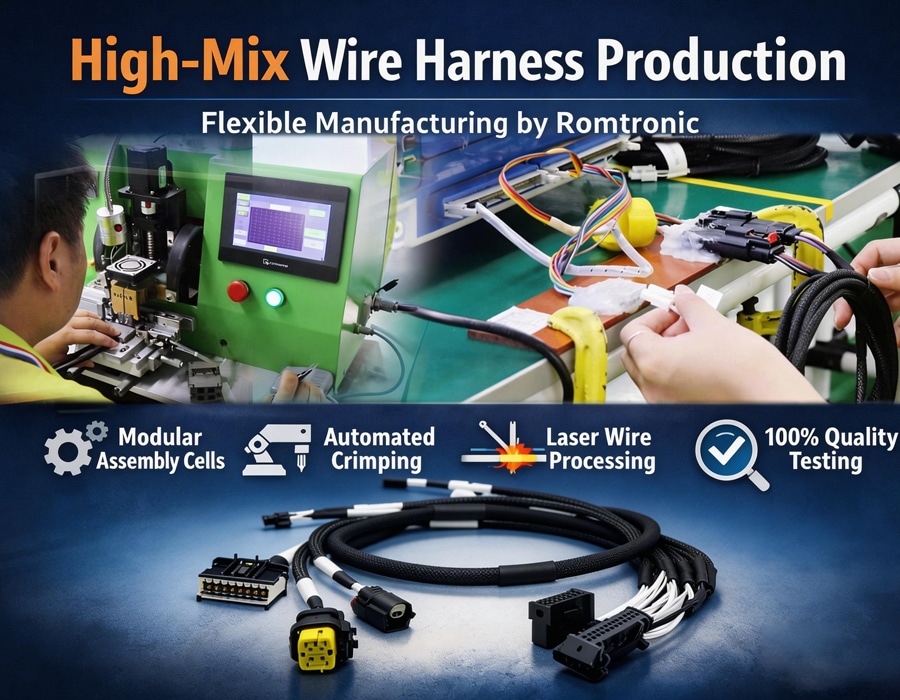
High-mix manufacturing of wire harnesses is not merely “more SKUs.” It is a totally new level of manufacturing discipline.
At Romtronic, we designed our systems around the needs of HMLV (High-Mix, Low-Mid Volume) manufacturing with an emphasis on stability, traceability and repeatable quality.
What Is High-Mix Wire Harness Production?
High-mix wire harness production refers to manufacturing multiple harness configurations in small- to medium-quantity runs, often with frequent design revisions and customised component selections.
Unlike high-volume production—where one design runs continuously—high-mix manufacturing requires:
- Rapid changeovers
- Strong documentation control
- Flexible production cells
- Cross-trained operators
- Coordinated supply chain planning
- Consistent quality across variants
Industries that commonly require flexible wire harness manufacturing include:
- Automotive electronics
- Medical devices
- Industrial automation systems
- Robotics platforms
- Smart equipment and IoT devices
In these sectors, customisation is standard—not optional.
Why Traditional Volume Factories Struggle With High-Mix Orders
Factories optimised for repetition often struggle to handle custom harness assembly programs with multiple variants.
Common issues include:
- Extended changeover times
- Higher rework rates
- Documentation confusion
- Scheduling bottlenecks
- Inconsistent testing execution
High-mix production requires modular systems, not rigid linear assembly lines.
Engineering First: DFM Before Production Begins
At Romtronic, efficiency starts in engineering—not on the shop floor.
Every project undergoes a structured Design for Manufacturability (DFM) review before entering production. This includes evaluation of:
- Bill of Materials consistency
- Connector lifecycle status
- Wire gauge optimisation
- Terminal compatibility
- Testing requirements
- Assembly feasibility
Where possible, components are standardised to reduce unnecessary variation while maintaining performance integrity.
Early engineering discipline minimises instability as multiple harness variants enter parallel production.
Modular Production Cells for Rapid Changeover Manufacturing
Instead of fixed assembly lines, Romtronic uses modular production cells designed for flexibility.
Each cell can be configured for specific harness variants and is supported by:
- Automated wire cutting and stripping
- Precision terminal crimping systems
- Laser foil and Mylar removal
- Pre-forming stations for routing consistency
- Controlled overmolding processes
Tooling is designed for quick switching, significantly reducing changeover time between low- to mid-volume production runs.
This modular approach allows multiple SKUs to flow through production without disrupting overall efficiency.
Digital Process Control & Traceability
In high-mix environments, traceability is critical.
Romtronic integrates structured process controls such as:
- Wire color sequence verification
- Barcode-based tracking systems
- Controlled engineering document management
- In-process inspection checkpoints
- Error-proofing (poka-yoke) mechanisms
Each harness follows a documented route. Even when fifteen variants are in production simultaneously, control remains disciplined and transparent.
Skilled Workforce + Standardised Execution
Automation supports consistency—but people ensure reliability.
Though automation ensures processes are stable and predictable, it is through human intervention and support that your company achieves true reliability in its operations.
Our operating staff is trained in multiple processes, enabling flexible employee assignment patterns to accommodate variations in production mix. With well-defined Standard Operating Procedures (SOPs) in place, there is less room for variation and reliance on informal knowledge transfer.
Additionally, quality inspections have been incorporated directly into the workflow to prevent the downstream transfer of defective products.
Successful high-mix production results when a managed system and skilled execution work together as one cohesive operation.
Supply Chain Strategy for Multi-Variant Stability
High-mix manufacturing increases component diversity. Without coordination, lead times become unstable.
Romtronic mitigates this risk through:
- Approved supplier networks
- Component lifecycle monitoring
- Forecast-based procurement planning
- Strategic buffer inventory for shared components
This approach supports rapid response to engineering changes without disrupting delivery schedules.
Testing & Validation in High-Mix Environments
Smaller batch sizes do not mean reduced standards.
Depending on program requirements, Romtronic performs:
- 100% continuity testing
- Hi-Pot insulation testing
- Crimp pull-force validation
- Functional verification
- Mechanical inspection
Testing is integrated into production cells rather than separated as a final-stage activity. This ensures consistent validation across all harness variants.
Traditional Volume Model vs. Structured High-Mix Manufacturing
| Traditional Volume Factory | Romtronic High-Mix System |
|---|---|
| Built for single design repetition | Built for multiple variants |
| Long changeover downtime | Modular quick-switch production cells |
| Reactive documentation management | Controlled engineering version control |
| Higher rework exposure | Embedded in-process inspection |
| Limited adaptability | Engineering-driven flexibility |
When High-Mix Manufacturing Is the Right Choice
High-mix production is typically the best fit when:
- Product designs evolve frequently
- Multiple harness variants share a common architecture
- Customisation is required per end application
- Annual volumes are moderate rather than mass scale
- Engineering collaboration is ongoing
In these scenarios, structured flexibility delivers better long-term stability than forcing volume-based production models.
Common Mistakes in High-Mix Wire Harness Production
Even experienced manufacturers can struggle if systems are not structured properly. Common mistakes include:
- Poor document revision control
- Inconsistent testing protocols across variants
- Insufficient operator cross-training
- Overcomplicated BOM structures
- Weak supplier coordination
High-mix environments amplify small process weaknesses. Discipline must be built into the system.
Frequently Asked Questions
What is high-mix wire harness manufacturing?
High-mix wire harness manufacturing refers to producing multiple harness designs in small or medium quantities, often involving customisation and ongoing engineering changes.
How do manufacturers reduce changeover time in HMLV production?
Changeover time is reduced through modular production cells, standardised tooling, pre-planned documentation control, and operator cross-training.
Can small-batch harnesses maintain the same quality as high-volume production?
Yes. With integrated testing, structured inspection checkpoints, and disciplined process control, small-batch harnesses can meet identical reliability standards.
Which industries rely most on flexible harness manufacturing?
Automotive electronics, medical equipment, robotics, industrial automation, and smart systems frequently require high-mix production due to design variation and customisation.
Conclusion: Flexibility Without Operational Chaos
High-complexity wire harness manufacturing doesn’t have to be characterised by variability or unexpected outcomes.
With engineering reviews, modular automation, qualified operators, structured documentation, and supply chain coordination combined, complexity can be managed.
At Romtronic, flexible wire harness manufacturing is an organised process rather than an unorganised process.
If a supplier is to be selected for a high-mix work program, early engineering collaboration can help mitigate future production risks.
.avif)
Sam Wu is the Marketing Manager at Romtronic, holding a degree in Mechatronics. With 12 years of experience in sales within the electronic wiring harness industry, he manages marketing efforts across Europe. An expert in cable assembly, wiring harnesses, and advanced connectivity solutions, Sam simplifies complex technologies, offering clear, actionable advice to help you confidently navigate your electrical projects.

