When evaluating custom cable assemblies or wire harnesses to purchase, many buyers focus solely on the price per unit. However, the unit price only tells part of the story regarding total costs. Total Cost of Ownership (TCO) determines the true cost by providing an overview of your cable program’s full lifecycle costs.
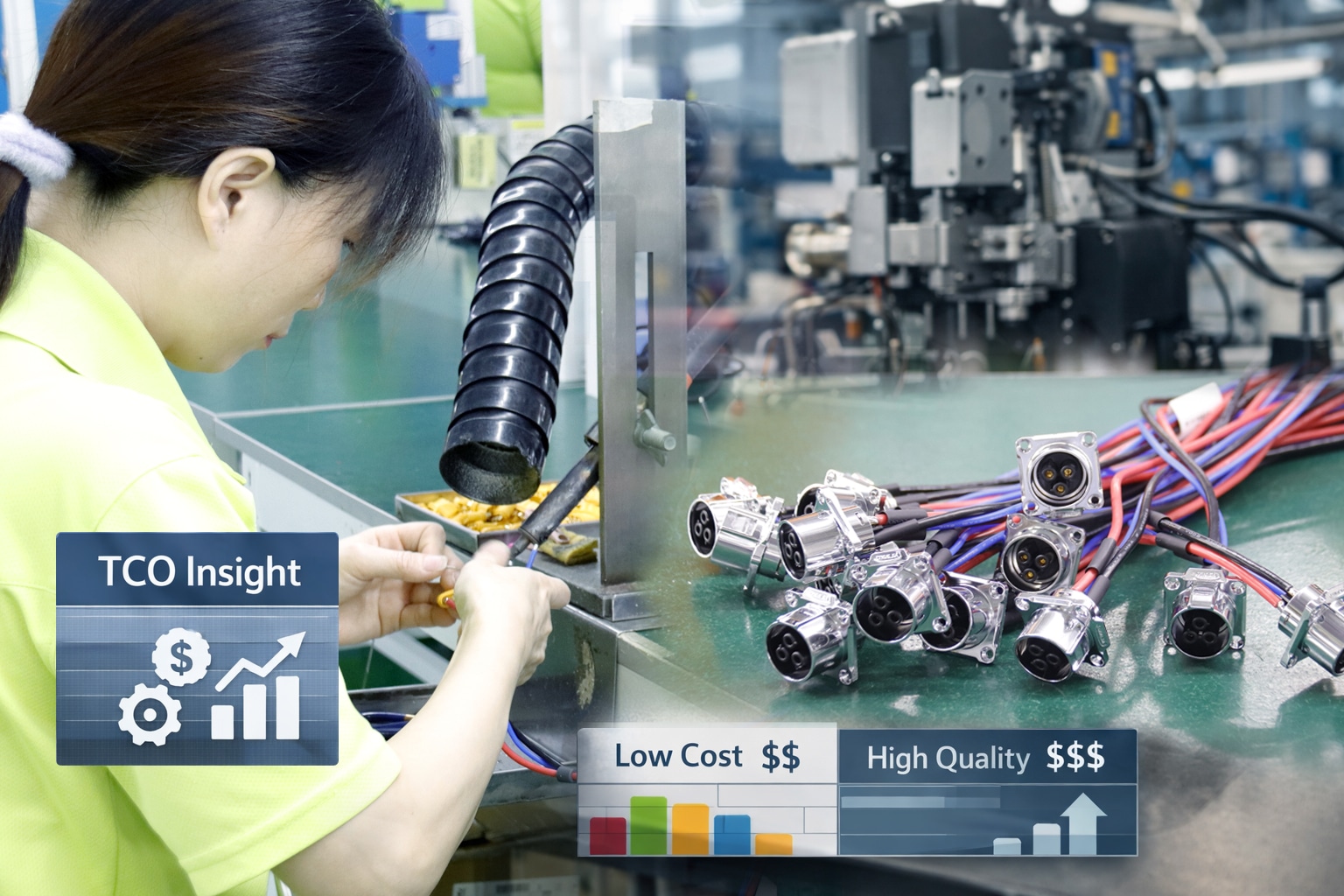
Calculating TCO is vital for procurement managers, engineers, and supply chain personnel to minimise hidden costs and downtime associated with supplier selection.
What is the Total Cost of Ownership (TCO) in Cable Programs?
Total Cost of Ownership (TCO) represents the overall expense of a cable program over its lifespan, not merely the unit cost at purchase.
It includes:
- Design & Development Costs – prototyping, tooling, design validation
- Material Costs – wire, connectors, shielding, insulation and compliance costs
- Manufacturing & Labour Costs – automation, production efficiency, and rework risks
- Quality and Testing Costs – continuity testing, hi-pot testing, environmental stresses, potential failures
- Logistics & Supply Chain Costs – inventories, lead times and risk management
- Operational and Downtime Costs – field failures, rework and warranty claims
TCO = All costs from design to end of life; not just the unit price.
This lifecycle viewpoint is crucial for high-performance applications in automotive, industrial, medical, and high-speed data systems.
Key Cost Drivers in Custom Cable Programs
| Cost Driver | What It Includes | Why It Matters |
|---|---|---|
| Engineering & NRE | Design, prototyping, tooling, DFM | Low upfront cost can lead to high rework later |
| Materials & Components | Connector grade, wire type, shielding, certification | Affects durability, compliance, and long-term reliability |
| Manufacturing & Automation | Manual vs automated production, process consistency | Higher automation = lower variability & fewer defects |
| Quality & Testing | Continuity, Hi-Pot, environmental tests | Reduces field failures, downtime, and warranty claims |
| Logistics & Supply Chain | Inventory, lead times, supply risk | Poor logistics = unexpected cost spikes |
Hidden Costs That Can Outweigh Unit Price
A supplier’s quotation may be low, but hidden fees can significantly raise your overall spending:
- Production downtime from defective cables
- Emergency shipments or requalification of suppliers
- Field service and warranty repairs
- Supplier switching or redesign costs
- Reputation damage and customer dissatisfaction
When you look at it this way, in an industrial environment, one hour of downtime may cost more than the savings from purchasing thousands of lower-priced units.
Practical TCO Calculation Framework
A practical approach to TCO estimation is as follows:
Total Cost of Ownership = Non-recurring Support and Engineering Costs + (Unit Cost x Volume) + Quality Failure Costs + Logistics Costs + Cost of Downtime / Failure – Cost Savings from Effective Product Lifecycle Management
Example Scenario:
- Supplier A: Lower unit price, mostly manual production, minimal testing
- Supplier B: Slightly higher unit price, automated production, full testing & validation
Over a 3-year lifecycle, Supplier B often costs less due to fewer failures, reduced downtime, and consistent delivery.
Design Optimisation Reduces Long-Term Cost
You can decrease TCO significantly by engaging in smart design engineering in the following ways:
- Standardisation of connectors and wires whenever possible.
- Using DFM principles to simplify the assembly process.
- Improving the quality of shielding, strain relief, and environmental protection.
- Validating designs as early as possible with automated testing.
- Using an automated process in production to achieve repeatable quality.
By doing these things, you will reduce rework and defects and achieve predictable costs throughout the product’s lifecycle.
Real-World Impact: When Cheaper Becomes Costly
Imagine an automotive production line:
- A low-cost wire harness fails quality tests once a week.
- Emergency replacements are shipped overnight.
- The assembly line stops for 2 hours.
The “cheap” option quickly becomes the most expensive once TCO is considered.
Conversely, a slightly higher upfront cost, backed by proven automation and testing, ensures uptime and avoids hidden financial risks.
Strategic Supplier Selection for Long-Term ROI
When evaluating suppliers, focus on:
- Engineering support and collaboration
- Automation capabilities and quality consistency
- Proven delivery reliability
- Lifecycle cost efficiency
Romtronic uses automated cable assembly lines and a high-mix product portfolio, along with stringent testing, to reduce the overall cost of ownership (TCO) for clients across the automotive, industrial, and medical sectors.
An ideal supplier isn’t just a source of cables; they help you maintain a consistent program cost for your business over the long term.
Conclusion: Think Beyond Unit Price
When in charge of custom cable program management, we ask more than “who has the cheapest price today” and move on to “who will give me my lowest total cost over the life of the cable”.
Understanding the total cost of ownership (TCO) enables us to make better supplier decisions, protect our uptime, identify hidden costs, and optimise both engineering results and financial success.
.avif)
Sam Wu is the Marketing Manager at Romtronic, holding a degree in Mechatronics. With 12 years of experience in sales within the electronic wiring harness industry, he manages marketing efforts across Europe. An expert in cable assembly, wiring harnesses, and advanced connectivity solutions, Sam simplifies complex technologies, offering clear, actionable advice to help you confidently navigate your electrical projects.