


Industrial machinery and automation rely on robust, error-free wire harnesses to safely transmit power and signals. In harsh factory environments (heat, vibration, moisture), even minor defects can cascade into failures. An industry study reveals that roughly 70% of harness failures originate from microscopic production flaws (e.g., poor crimps, insulation damage) that can grow exponentially if not detected early. Rigorous testing is thus essential – it detects mis-wiring, loose connectors, bad crimps, and other hidden defects before the harness is delivered. Testing is indeed crucial to ensure safety and reliability.
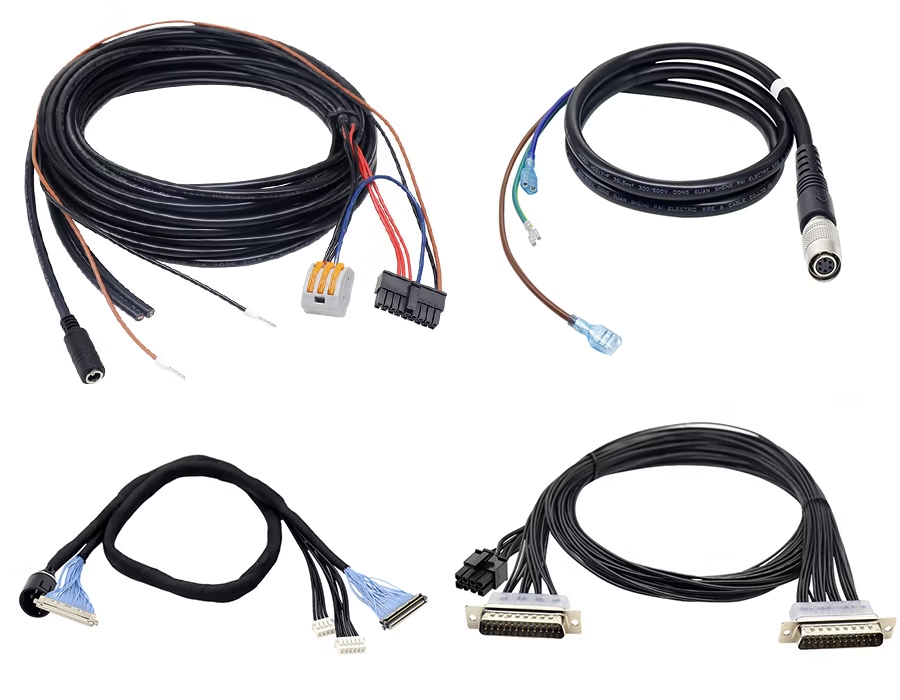
Why Testing Matters
Quality testing and reliability go hand-in-hand. When done right, they save millions by preventing recalls and warranty claims. Major recalls in the automotive and aerospace industries underscore the consequences of a harness failure in service, including safety risks and substantial liability costs. In contrast, validated designs and thorough testing yield durable assemblies with very low defect rates (often well under 1%). The bottom line: finding defects on the bench (where it’s cheap) avoids failures on the plant floor (where it’s costly).
Key Testing Methods
Industrial machinery harness manufacturers employ multiple testing methods at each production stage to ensure the reliability of their products. Early steps, such as visual inspections, can detect obvious issues (incorrect components, damaged insulation). After assembly, electrical testing verifies correctness: continuity testing ensures end-to-end connectivity of each conductor (no open circuits), while insulation/high-voltage testing applies high voltage between conductors to detect insulation breakdown. Contact resistance testing validates crimp terminal integrity by detecting poor connections.
- Visual inspection: Check wire routing, labels, and insulation for visible defects.
- Continuity test: Confirm each circuit is complete (no open circuits).
- Insulation/Hi-Pot: Apply high voltage between conductors to ensure insulation integrity (no breakdown).
- Pull/Crimp test: Measure the force required to pull terminals from crimped wires, ensuring crimps are secure.
- Functional test: Power the entire harness (or mate connectors) to simulate actual use, catching any wiring errors or shorts.
By layering these checks (electrical, mechanical, environmental, etc.), manufacturers catch nearly all issues before shipping.
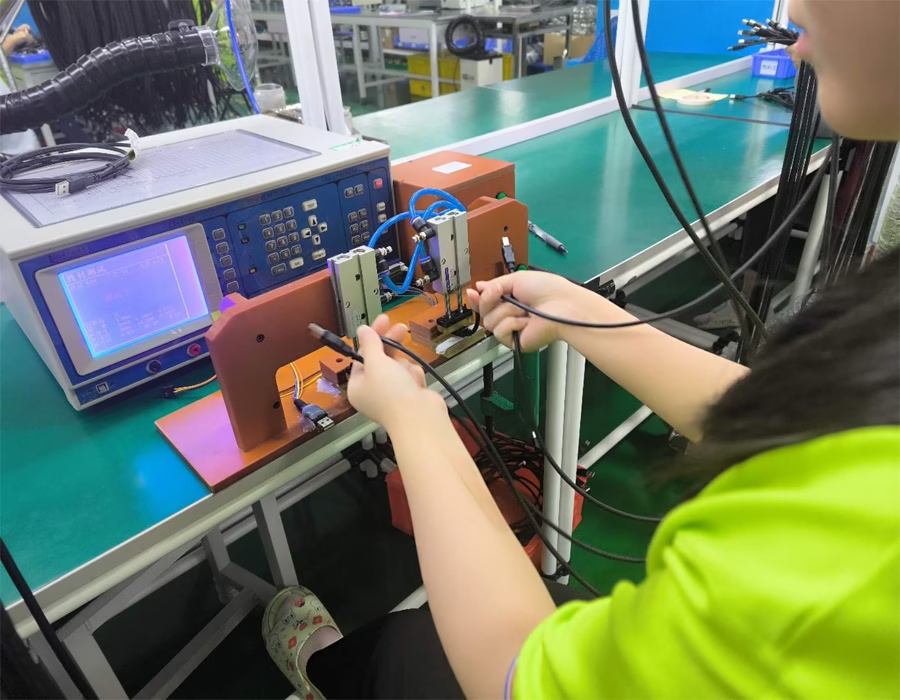
Above, an example of a cable assembly test bench: Technicians use specialized fixtures to check continuity and insulation on each assembled cable automatically. These test systems catch wiring or insulation faults early, ensuring reliability.
🔍 Want to ensure zero-defect wire harnesses for your industrial applications?
Romtronic combines visual, electrical, and environmental testing in every unit, delivering harnesses built to last under heat, vibration, and demanding duty cycles.
📩 Get in touch now for a QA-driven quote & sample plan →
Mechanical and Environmental Stress
Even after electrical checks, harnesses must survive harsh conditions. Mechanical stress tests simulate real-world forces (bending, twisting, vibration) to expose weak points. For example, a flex test repeatedly bends the assembly, verifying that wires and crimps don’t break under motion. Machines also perform vibration tests to ensure that connectors remain seated under continuous shaking.
Environmental tests expose harnesses to various conditions, including heat, cold, humidity, chemicals, and UV radiation. Commonly, harnesses undergo thermal cycling (e.g., –40 °C to +125 °C) and extended vibration to simulate years of use. Salt-spray and immersion tests (for corrosion and waterproofing/IP ratings) are also run. Passing these extremes confirms that the harness materials and assembly methods will withstand the field conditions.
Ensuring Reliability and Failure Rates
High-reliability industries aim for near-zero defect rates. In practice, failure rates are often very low. Automated assembly dramatically reduces defects: one analysis found that automated crimping produced only ~0.03–0.08% bad crimps, compared to ~0.5–1.2% with manual crimping. In regulated sectors (aerospace, defense), harnesses are built to the strictest standards – e.g., IPC-Class 3 with MIL-spec parts – to eliminate failures virtually.
In short, modern harness QC often achieves PPM-level performance. By catching almost all defects in-house, manufacturers dramatically improve uptime and product reliability.
Standards and Certifications
Meeting industry standards is critical to quality. The IPC/WHMA-A-620 standard is the global benchmark for cable and wire harness assembly. It defines how to crimp, solder, and inspect harnesses for different performance classes (from consumer to aerospace). Many factories certify to IPC-A-620 and train their staff accordingly to ensure uniform, high-quality.
Electrical safety certifications also apply. Wires and components used in industrial harnesses often carry UL/CSA approval (North America) or CE/VDE marks (Europe), indicating they passed flame, insulation, and voltage tests. For example, a harness built with UL-listed wires and UL-recognized connectors is assured to meet North American electrical codes. In global markets, industrial machinery utilizes CE marking based on IEC standards (such as IEC 60204-1) to certify electrical safety. Following these standards ensures that the harness is reliable and compliant with global legal requirements.
Cost vs. Quality: The ROI of Testing
Quality testing adds upfront cost, but it pays off in reliability and lower lifecycle expenses. Skipping tests might save cents today, but a single harness failure in the field can cost orders of magnitude more.
Investing in quality also avoids expensive recalls. Thorough harness validation (meeting standards like ISO 26262, AS50881, etc.) greatly outweighs any short-term savings from cutting corners. The long-term savings stem from avoided failures, including fewer warranty repairs, less downtime, and stronger customer trust. In regulated industries, the cost of non-compliance or a safety incident can easily dwarf the cost of good QC. In short, each dollar spent on testing yields much more in avoided failures and protection.
Common Wire Harness Tests
| Test Category | Purpose | Typical Checks |
|---|---|---|
| Electrical | Verify wiring and insulation integrity | Continuity tests and Hi-Pot (dielectric) tests |
| Mechanical | Ensure harness withstands stress | Flex/bend tests, tensile pull tests, and vibration testing |
| Environmental | Assess durability under harsh conditions | Temperature cycling, salt-spray, humidity, waterproof (IP) testing |
| Functional | Confirm overall operation | Connector mating, short-circuit checks, and end-to-end functional tests |
✅ Seeking wire harnesses you can trust under the most demanding conditions?
Romtronic’s manufacturing process includes visual, mechanical, environmental, and electrical testing to guarantee performance and compliance—protecting uptime and safety in your applications.
📞 Request your custom reliability report & quote now →
FAQs
A: Typically, every harness is checked for electrical continuity (no open circuits) and insulation integrity (using a Hi-Pot test). Technicians also perform mechanical stress tests (bending, tensile pull, vibration) to verify strength. Finally, a functional (end-to-end) test is run by powering the harness or mated connectors in a test fixture, validating its real-world performance. Many factories also include 100% pull/crimp testing and visual checks as in-line quality steps.
A: With modern QC, harness defect rates are often below 1%. Manual assembly might yield ~0.5–1.2% rejects, whereas automated processes typically achieve much lower (<<0.1%). High-end industries often target PPM-level defects thanks to stringent standards.
A: Key standards include IPC/WHMA-A-620 (assembly workmanship) and ISO 9001 (quality management). Component approvals, such as UL/CSA and CE/IEC, ensure that the wires and connectors meet the required electrical safety standards. Industry-specific certifications (e.g., IATF 16949 for the automotive industry, AS9100/Nadcap for the aerospace industry) are often needed by customers. Following these standards is the de facto way to guarantee quality, safety, and market acceptance.
A: Quality control does increase upfront cost (equipment, labor, training), but it drastically reduces long-term costs. Fixing a wiring defect after assembly can be 10–100× more expensive than catching it on the production line. Over time, lower scrap rates, fewer field repairs, and higher uptime more than justify the investment in testing.
A: Use best practices and technology: train assembly staff to IPC standards, use calibrated crimp/solder tools, and document every process step. Employ 100% testing fixtures and statistical process control. Automation (robotic crimping, vision inspection, automated testers) dramatically cuts human error. Finally, capture data on any failures and feed it back into design/production (a closed-loop “detect-analyze-fix” cycle) to continually raise quality and reliability.
.avif)
Sam Wu is the Marketing Manager at Romtronic, holding a degree in Mechatronics. With 12 years of experience in sales within the electronic wiring harness industry, he manages marketing efforts across Europe. An expert in cable assembly, wiring harnesses, and advanced connectivity solutions, Sam simplifies complex technologies, offering clear, actionable advice to help you confidently navigate your electrical projects.

