


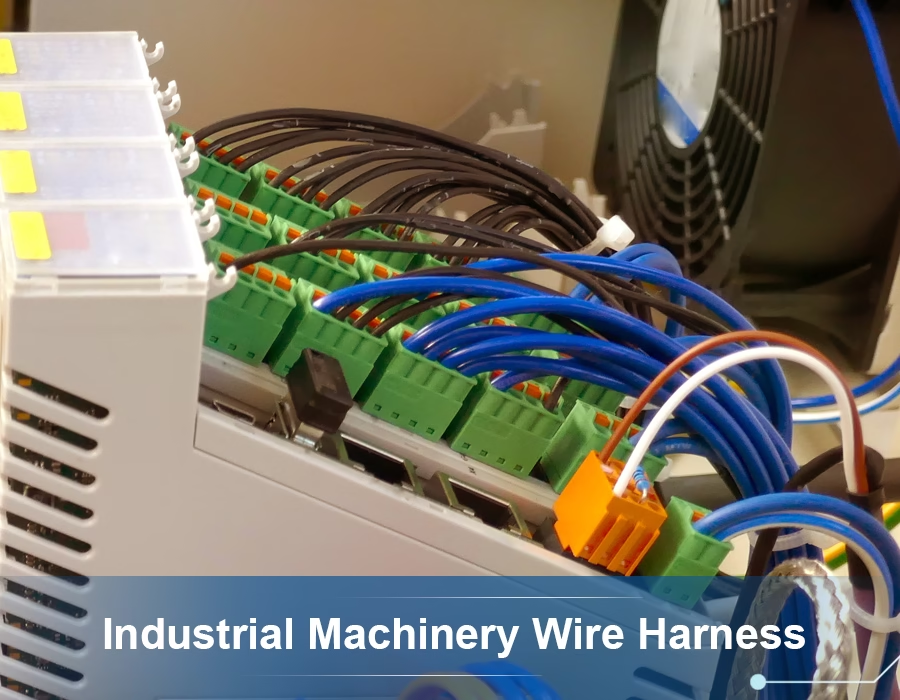
In modern factories and automated systems, reliable wire harnesses are the nervous system of heavy machinery. They operate in harsh environments, carrying power and data, so they must meet strict safety and quality standards worldwide.
In this guide, we’ll cover key wire harness standards and certifications – from international norms (ISO, IEC, IPC/WHMA) to regional approvals like UL (USA), CSA (Canada), CE (EU), and VDE (Germany). Along the way, we’ll keep it practical and relevant for automation, heavy equipment, and robotics applications.
When it comes to assembly quality, the IPC/WHMA-A-620 standard is the industry consensus for wire harness acceptance. This standard (updated to revision E in 2022) establishes requirements and tests for cable and harness assemblies, encompassing everything from wire stripping and solder/crimp integrity to connector criteria.
It even defines workmanship classes (Class 1–3) so manufacturers and inspectors agree on what’s acceptable (from consumer-grade to harsh-environment applications). In short, IPC/WHMA-A-620 ensures your harness meets globally recognized quality benchmarks.
✏️ Looking for industrial wire harnesses that meet global standards?
Romtronic delivers UL, CE, and IPC/WHMA-compliant harnesses designed for harsh industrial environments. From heavy machinery to robotics, our assemblies ensure reliability and compliance.
📩 Contact us today to discuss your project →
North America: UL, NEC, CSA, and More
In the U.S., Underwriters Laboratories (UL) sets standards for wire safety. UL‑Listed cables and harnesses have passed strict tests (fire, voltage, etc.) and are approved for use in industrial equipment under the National Electrical Code (NEC). (The NEC often requires UL-listed wiring in machines and control panels.)
UL also “Recognizes” parts (like wires or connectors) – a UL-Listed label is needed for final products, whereas UL-Recognized parts alone cannot get a UL label for building wiring.
In Canada, the CSA (Canadian Standards Association) provides similar rules. Many cables carry both UL and CSA marks – a lowercase “c” next to the UL symbol indicates that it meets the Canadian C22.2 code. CSA-approved AWM (Appliance Wiring Material) products undergo strict flame tests (FT1, FT4) to ensure the harness insulation is safe for industrial use.
If you see a cable marked with “UL” or “CSA”, you can be confident that it meets North American codes. For example, control panels in the U.S. often use UL 508A-rated components, and wires may be specified by UL styles (e.g., UL 1007, 1015) that have been tested in cable bundles and trays. These tests simulate real industrial conditions so that the harness won’t overheat or spark under load. Bottom line: UL/CSA certifications give you peace of mind that the wiring in your heavy equipment or robot meets U.S./Canada requirements.
Europe and Global Marks: CE, VDE, IEC
In Europe (and many other markets), CE marking is a key requirement. A CE label on a machine (including its wiring) indicates that the product complies with EU directives, such as the Low Voltage Directive and the Machinery Directive. In practice, CE tells you the electrical design (including harnesses) meets European safety standards.
The IEC (International Electrotechnical Commission) publishes global norms that underpin these rules. For example, IEC 60204‑1 covers electrical equipment on industrial machinery.
Many national bodies adopt IEC standards – Germany’s DIN/VDE is essentially IEC-aligned, and the VDE safety mark indicates testing by the German DKE/VDE agency.
In practical terms, ensure that your cables and connectors comply with EU/EN (or IEC) standards and have the appropriate IP ratings (e.g., IP67 for protection against dust and water). Many suppliers test to both UL and VDE in parallel, since that covers most global markets. In short, following CE/IEC standards (and national marks like VDE) ensures that your harnesses will comply with legal safety regulations in the EU and beyond.
In the world of automation and robotics, the same certifications apply. A robot’s harness still requires UL and CE compliance, as well as any necessary IP/EMC ratings. Organized, high-flex harnesses keep cables neat inside tight spaces (like a CNC control cabinet or an articulated arm). For example, many factory robots utilize specialized orange cables designed for continuous flex and high strand count. However, electrically, those cables are industrial wires that meet the certifications mentioned above. In practice, machine builders ensure robot harnesses use connectors and cable types that are already approved for the region.
🔧 Why choose Romtronic for certified wire harnesses?
With ISO 9001-certified manufacturing and strict IPC/WHMA-A-620 practices, we provide assemblies tested to UL, CSA, CE, and VDE requirements. Perfect for OEMs and system integrators who need safety and long-term performance.
📌 Explore our industrial cable solutions →
Key Standards at a Glance
| Standard/Certification | Region/Scope | Notes |
|---|---|---|
| UL (e.g. UL 508A) | USA | Underwriters Laboratories sets US wire safety rules; UL-Listed cables meet NEC requirements |
| CSA (e.g. C22.2) | Canada | Canadian Electrical Code standard; often harmonized with UL (look for a “cUL” mark) |
| CE Marking | EU/EEA | Required for EU; shows compliance with safety directives (LVD 2014/35/EU, Machinery 2006/42/EC) |
| DIN/VDE | Germany/EU | German electrotechnical standard (IEC-based); the VDE mark indicates testing by DKE/VDE |
| IEC 60204-1 | International | Safety standard for electrical equipment on machinery (wiring, interlocks, grounding). |
| IPC/WHMA-A-620 | Intl. (industry) | Industry consensus for cable/harness acceptance (includes workmanship classes). |
| ISO 9001 (QMS) | International | Quality management certification (ensures consistent manufacturing processes) |
Table: Key standards and certifications for industrial wire harnesses.
FAQs (Frequently Asked Questions)
A: Typically, the finished machine carries the CE mark, not individual harnesses. However, the wiring components in that machine must comply with CE-related directives (Low Voltage, EMC, etc.). In practice, use CE-rated cables, connectors, and enclosures so that the whole assembly can be CE-certified under EU law.
A: A UL-listed product (like a complete cable assembly) is tested and approved for general use (with a UL label). A UL Recognized component (with a “UR” mark) can be used as part of a larger device, but isn’t a final product on its own. In short, UL-Listed means “safe for installation,” whereas UL-Recognized means “approved as a part used inside equipment.”
A: It’s not legally required, but IPC/WHMA-A-620 is the de facto industry standard for harness quality. Many OEMs and cable makers train to A-620, and some even certify their assemblers. Following A-620 helps ensure everyone (both makers and users) has the same expectation of workmanship.
A: Yes. While ISO 9001 (or industry standards like IATF 16949 for the automotive sector) are not electrical standards, they demonstrate that industrial machinery wire harness manufacturers have established robust quality management systems. Customers typically require suppliers to hold ISO certifications to ensure product consistency and continuous improvement. These certifications effectively complement technical standards by validating good manufacturing practices.
By understanding these standards and marks, engineers and purchasers can select wire harnesses that ensure their industrial machinery remains safe, compliant, and reliable. Always verify that your cables, connectors, and assemblies are tested and certified for the markets and applications you need – it’s the best way to avoid headaches on the factory floor.
.avif)
Sam Wu is the Marketing Manager at Romtronic, holding a degree in Mechatronics. With 12 years of experience in sales within the electronic wiring harness industry, he manages marketing efforts across Europe. An expert in cable assembly, wiring harnesses, and advanced connectivity solutions, Sam simplifies complex technologies, offering clear, actionable advice to help you confidently navigate your electrical projects.

